
TL;DR
- Singles uses a two-number score; doubles uses three numbers (serving score – receiving score – server number)
- In singles, your score tells you which side to serve from: even score = right side, odd score = left side
- Doubles burns 350–450 calories/hour at competitive intensity; singles pushes 500–650 (FORWRD Health & Fitness Guide 2026, sourced from Zarei et al. 2025)
- Beginners should start with doubles — the partner reduces court coverage pressure while you learn positioning and the kitchen game
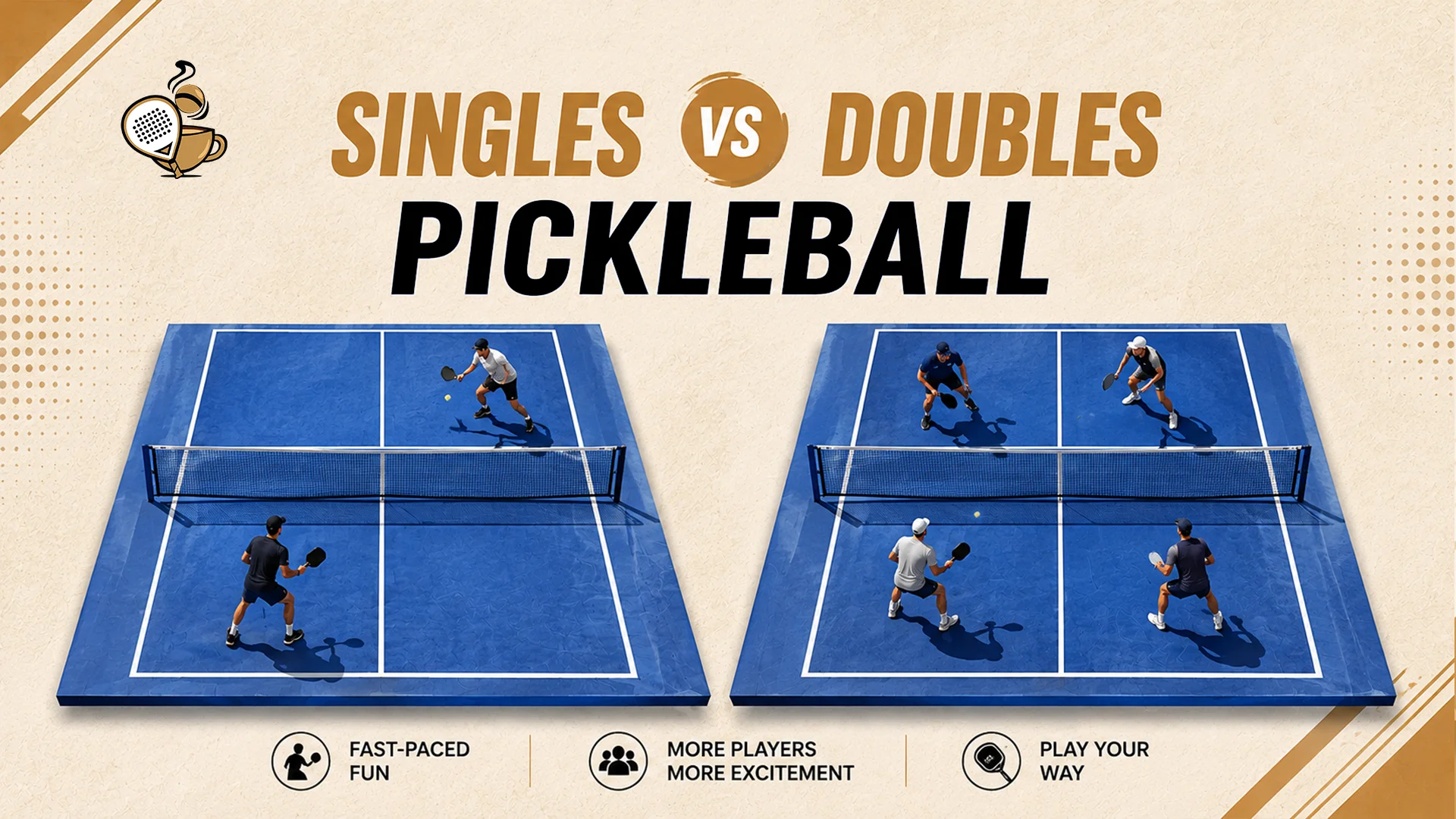
Same pickleball court. Same net. Same kitchen line. But once the point starts, singles and doubles pickleball feel like completely different sports.
The rules share a foundation — underhand serve, two-bounce rule, kitchen restrictions — but the serving sequence, scoring system, court coverage, and strategy split sharply the moment you go from two players to four. Players who learn one format and assume the other works the same way lose points they should not lose and make errors that should not happen.
This guide covers every meaningful difference: the rules, the scoring, the strategy, the physical demands, and the third format nobody talks about — skinny singles. Plus a clear answer to the question most guides avoid: which format should you actually start with?
The Core Differences at a Glance
| Feature | Singles | Doubles |
|---|---|---|
| Players | 1 per side (2 total) | 2 per side (4 total) |
| Score format | 2 numbers: server–receiver | 3 numbers: server–receiver–server number |
| Serving position | Right if score even, left if score odd | Right if serving team score even, left if odd |
| Serves per team per rally | 1 | 2 (first server, then second server) |
| Court size | Full court | Full court |
| Court coverage | Player covers full 20×44ft alone | Partners split coverage |
| Physical demand | High — continuous sprinting | Moderate — lateral shifts, less total ground |
| Calorie burn (competitive) | 500–650 cal/hr | 350–450 cal/hr |
| Strategy focus | Power, reach, stamina | Communication, soft game, kitchen dominance |
| Best for | Conditioning, individual skill development | Social play, beginners, longer sessions |
Serving Rules — Where Singles and Doubles Split
Serving is where most new players find the biggest gap between the two formats.
Serving in Singles
In singles, the serving player serves once per rally. Win the point — continue serving. Lose the point — the serve goes immediately to your opponent. No second server. No partner. Clean and direct.
Which side do you serve from? Your score tells you. Even score (0, 2, 4, 6…) — serve from the right side. Odd score (1, 3, 5, 7…) — serve from the left side. This positioning rule is not arbitrary: it means every time you score a point, you switch sides. It also means that if you can remember your score, you always know where to stand.
Serving in Doubles
Doubles introduces the first and second server system — the rule that confuses almost every new player.
When your team gains the serve, your first server serves until they lose a rally. Then the second server takes over. Only when the second server loses a rally does possession flip to the other team. Both players on a team serve before a side-out — except at the game’s opening, where the first team up serves only once before handing the serve across (the reason the first serve of the game is always called as 0-0-2, signalling that the serving team is already on their second server).
Which side do you serve from in doubles? The same rule applies — your team’s score determines the side. Even score: right side. Odd score: left side. But it is the serving team’s score that governs position, and each point won swaps which partner is in which court.
Scoring — the Clearest Rule Difference
Singles Scoring (2 numbers)
Call the score before every serve: your score first, then your opponent’s.
“5-3” — server has 5, receiver has 3. That is the complete score call in singles. No server number, because there is only one server per side.
Games are typically played to 11, win by 2. In tournament play, 15 or 21 is used for some divisions.
Doubles Scoring (3 Numbers)
Call the score before every serve: serving team’s score, receiving team’s score, server number.
“7-5-1” — serving team has 7, receiving team has 5, and it is the first server’s turn. “7-5-2” — serving team has 7, receiving team has 5, and it is the second server’s turn.
When the second server loses a rally, it is a side-out and the serve goes to the other team. Their first server calls the score with their team’s number first.
The 0-0-2 rule: The opening serve of every game is called as “0-0-2” — signalling that this team is already on their second server. This convention means that if the serving team loses that opening rally, the serve transfers immediately rather than the receiving team having to wait through two servers. It makes the opening exchange feel fair to both sides.
Expert Tip: In doubles, the server number is not tracking a specific player — it is tracking position in the serving order. The “second server” changes every time your team gets the serve back. Whoever is standing on the correct side based on your team’s score serves first (server 1). The other partner serves second (server 2).
Court Coverage — Where the Physical Difference is Felt
Both formats use a full-size court: 20 feet wide by 44 feet long, with the kitchen (non-volley zone) 7 feet from the net on each side.
In singles, one player covers all 880 square feet of their side alone. That means sprinting to wide balls, covering the entire baseline, and getting to the kitchen — all without a partner to share the work. Singles pickleball is a full-body conditioning activity. Heart rates in competitive singles consistently reach 145–165+ bpm, placing most players in vigorous-intensity cardio zones (FORWRD Health & Fitness Guide 2026, citing Zarei et al. 2025).
In doubles, two players divide the court. The dominant positioning in high-level doubles is both partners at the kitchen line — a compact, lateral-shift game where the ground you cover per rally is far shorter than singles. That shared coverage changes the sport’s physical character entirely. Doubles is slower in movement but faster in exchanges: less sprinting, more reflexes.
Strategy — Two Different Games
Singles Strategy
Singles rewards reach, power, and stamina. With no partner to rely on, the objective is consistently hitting the ball to spots that force your opponent to move — particularly wide balls and deep balls that drag them away from their preferred positions. The cross-court rally is central to singles because it gives you the most angle and keeps the ball away from the sidelines where errors happen.
Approaching the kitchen in singles is riskier than in doubles. If you come to net and your opponent passes you, there is nobody behind you. Singles players use the kitchen selectively — approaching when they have a ball they can put away, retreating when they have not set up the approach properly.
Doubles Strategy
Doubles is won at the kitchen line. The team that gets both players established at the non-volley zone first controls the point. The soft game — dinking, resetting, patient short exchanges — dominates at intermediate and advanced levels. Power matters less than placement and communication.
Communication is the skill doubles demands that singles never requires. Calling shots, deciding who covers the middle, signalling who takes a lob — all of this happens in real time, under pressure, with a partner whose instincts may differ from yours. Teams that communicate well look like they are reading each other’s minds. Teams that do not communicate misread each other constantly.
Physical Demands and Fitness — What the Data Says
For players choosing a format partly on fitness grounds, the difference is measurable.
Doubles (competitive): 350–450 calories per hour for a 150 lb player. Heart rate peaks around 112 bpm in competitive play — solid moderate-intensity cardiovascular exercise (Crenshaw Pickleball Club analysis, 2024; FORWRD, May 2026).
Singles (competitive): 500–650 calories per hour for the same player. Heart rate reaches 145–165+ bpm in competitive rallies — full vigorous-intensity cardio. MET value for competitive singles is approximately 7.8, compared to 4.1 for recreational doubles (Zarei et al. 2025; Smith et al. 2018 — cited in TrainCalc Pickleball Calorie Calculator).
Competitive doubles at 401 calories/hour sits on par with squash singles (402) and close to tennis doubles (405), based on measured activity data (Crenshaw Pickleball Club, July 2024).
The practical takeaway: If cardiovascular conditioning is your primary goal, singles is the stronger stimulus. If the goal is sustainable long-term play with lower joint stress and the ability to stay on court longer, doubles wins. Most serious players eventually do both — singles or skinny singles for conditioning, doubles for match play and social sessions.
Skinny Singles — The Third Format Nobody Talks About
Skinny singles is a practice format where two players play singles on half the court — either the two right-side boxes or the two left-side boxes — rather than the full 20-foot width.
It solves a specific problem: singles on a full court is genuinely exhausting, and the wide ball is a significant challenge for players still developing their footwork. Skinny singles keeps the intensity of single-player coverage but reduces the court width to make the drill sustainable and targeted.
How it works:
- Both players stay on the same half of the court for the entire game
- Standard serving, scoring, and kitchen rules apply
- The narrow format forces precise placement — wide misses are immediately out
- Crosscourt skinny singles and down-the-line skinny singles each target different shot patterns
Experienced doubles players use skinny singles to practice the shots they play most often at the kitchen line — the crosscourt dink, the down-the-line drive — without the physical toll of full-court singles. It is the most practical training format that most beginning players have never heard of.
Common Mistakes When Switching Formats
Players who learn doubles and try singles — or vice versa — make the same errors.
Doubles player switching to singles:
- Standing flat-footed at the kitchen during a singles match — there is no partner to cover the base, so aggressive kitchen play exposes the entire court behind you
- Forgetting the two-number score and calling three numbers out of habit
- Relying on the middle of the court as a safe position — in singles, the middle is where your opponent aims every passing shot
Singles player switching to doubles:
- Poaching — taking balls that belong to your partner — because solo coverage is what they are trained for
- Failing to communicate on split-court balls, especially the middle
- Neglecting the soft game — singles rewards power and reach, doubles punishes a player who tries to drive through every exchange
Which Format Should You Start With?
Here is the clear answer most guides avoid giving.
Start with doubles. For new players, doubles is the better entry point. Not for a vague ‘it’s more social’ reason. The specific mechanical reason is court coverage: covering 880 square feet alone while also learning the kitchen, the two-bounce rule, the scoring system, and the serving sequence is genuinely overwhelming. A doubles partner halves the court coverage challenge and gives you time to develop positioning instincts before the solo demands of singles.
Doubles also happens to be where most recreational pickleball happens. Open play sessions are almost universally doubles. Social events are doubles. Tournaments for recreational players are predominantly doubles divisions. If you learn doubles first, you can play immediately in any casual or competitive context.
When to add singles:
- Once your kitchen game is consistent and your positioning is automatic
- When you want a harder conditioning workout
- When you have access to a dedicated practice partner who wants to drill rather than just play
The honest case for singles first: If you come from a strong tennis or squash background, singles pickleball may feel more natural immediately — the one-on-one dynamic maps more directly to what you already know. In that case, starting with singles and adding doubles later works equally well.
| Player Profile | Recommended Format |
|---|---|
| Complete beginner | Doubles — lower physical demand, more available social play |
| Tennis / squash background | Either — singles maps to existing instincts |
| Fitness-focused player | Singles or skinny singles — higher calorie burn |
| Social / recreational player | Doubles — the dominant social format globally |
| Competitive / tournament-focused | Both — most tournaments have doubles and singles divisions |
| Player with limited court time | Skinny singles — maximum drilling value in minimum time |
Play More. Figure Out Which One You Love.
The honest answer to “which is better” is that most players end up playing both — and each teaches you something the other does not. Doubles develops your soft game, your communication, and your court awareness. Singles develops your footwork, your power, and your ability to construct a point alone.
Start with doubles. Add singles when your positioning is automatic. Throw in skinny singles when you want to drill without the full physical cost of a singles match.
If you want to get on court and try both formats, PadelCafe’s pickleball court is bookable in Lahore. Check our pickleball tournament guide to understand how both formats show up in competitive play, and book a session whenever you are ready.
Frequently Asked Questions
What is the main scoring difference between singles and doubles pickleball?
Singles pickleball uses a two-number score: server’s score first, then the receiver’s. Doubles uses a three-number score: serving team’s score, receiving team’s score, and the server number (1 or 2). The server number tracks whether the first or second server is serving — when the second server loses a rally, possession switches to the opposing team.
Is singles or doubles pickleball harder?
Singles is physically harder — one player covers the full 20-foot-wide court alone, heart rates reach vigorous-intensity zones (145–165+ bpm), and there is no partner to cover wide balls. Doubles is tactically harder at advanced levels — communication, positioning, and the soft kitchen game require skills that singles does not develop. Singles punishes poor fitness; doubles punishes poor communication.
Can you play pickleball singles on a doubles court?
Yes. The court dimensions are identical — 20 feet wide by 44 feet long, with the same kitchen zone and net height. Singles and doubles use the same full court. The only difference is that one player covers the entire court alone in singles. Skinny singles — a practice format using half the court width — is also played on the standard court — one half is designated as the playing area.
What is skinny singles in pickleball?
Skinny singles is a practice format where two players play singles on half the standard court — either the two right-side service boxes or the two left-side boxes. It reduces the physical demand of full-court singles while maintaining single-player coverage and forcing precise shot placement. It is widely used by intermediate and advanced players to drill specific shots — particularly the kitchen-line dink and the crosscourt exchange — without the fatigue of full singles.
Which format burns more calories — singles or doubles pickleball?
Singles burns significantly more. Competitive singles burns approximately 500–650 calories per hour for a 150 lb player, with a MET value of around 7.8 (Zarei et al. 2025). Competitive doubles burns 350–450 calories per hour, with a MET value of approximately 4.1 for recreational doubles (Smith et al. 2018). The calorie gap reflects the difference in court coverage — one player covering the full court versus two players sharing it.
Should a beginner start with singles or doubles pickleball?
Doubles. The practical reason is court coverage — covering the full court alone while simultaneously learning the kitchen rules, the two-bounce rule, scoring, and positioning is too much to manage simultaneously. Doubles halves the court coverage demand and gives beginners time to develop positioning instincts. Most recreational pickleball is also played in doubles format, so learning doubles first gives you immediate access to open play sessions and social games.


0 Comments