
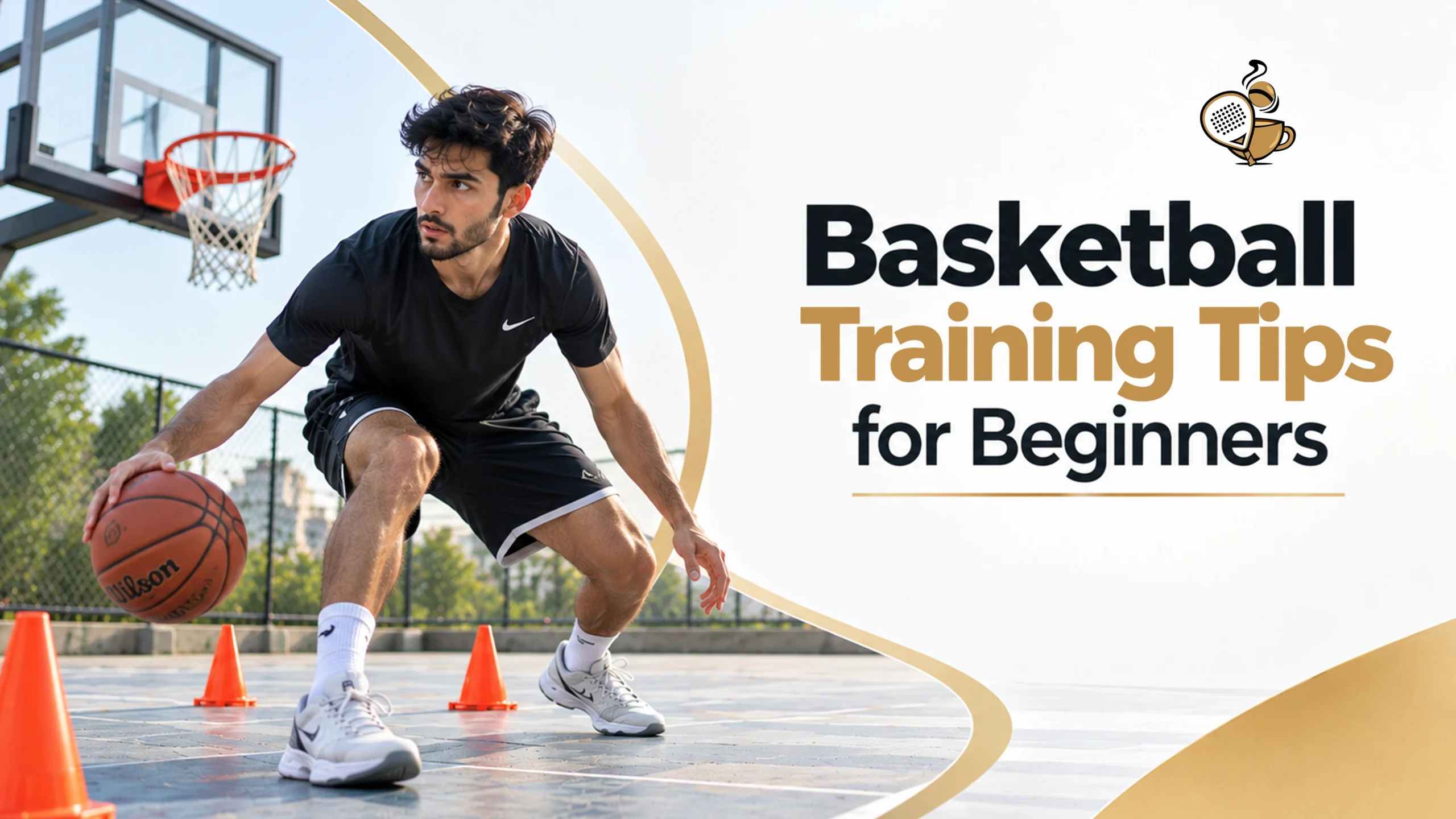
TL;DR
- Every player starts from zero. Fundamentals, stance, dribbling, passing, shooting, come before everything else.
- Dribbling with your fingertips, not your palm, is the single most common correction beginner players need.
- BEEF (Balance, Eyes, Elbow, Follow-through) is the shooting checklist that keeps your form consistent.
- Chest pass, bounce pass, and overhead pass are the three passes every beginner must master before game situations.
- Your defence stance (knees bent, hands up, weight on toes) is as important as any offensive skill.
- A structured weekly plan beats random practice every time. Same time, same drills, measurable improvement.
- Basketball fitness exercises (sprints, lateral slides, jump training) should run alongside your skill work, not separately.
- In Lahore, Padel Cafe (DHA Phase 6) has a dedicated basketball court available for individual and group training.
Nobody walks onto a basketball court and plays well. Not even close.
The players you watch on screen, the ones pulling off crossovers and hitting contested threes, spent years building one skill at a time. Before the flair came the fundamentals. Before the highlights came the repetition.
Basketball training for beginners is not complicated. But it does require a plan. Most new players spend court time shooting randomly, dribbling aimlessly, and then wondering why they are not improving.
This guide gives you the plan. Step-by-step. Drill by drill. Week by week.
Basketball Fundamentals for Beginners
There are four core skills in basketball. Every drill, every tactic, every game situation comes back to these four.
Shooting. You need to put the ball in the basket. Technique determines accuracy. Repetition builds consistency.
Dribbling. You need to move with the ball. Control and court awareness separate good dribblers from bad ones.
Passing. Basketball is a team sport. Passing is how the team moves. A player who cannot pass is a liability.
Defence. Points you prevent matter as much as points you score. Defence starts with your stance and your feet.
These four are your basketball fundamentals for beginners. Master them first. Everything else builds on top.
Step 1: Know the Rules Before You Train
You cannot train effectively in a sport you do not understand.
Basketball rules are specific. A few you need to know before touching the court:
| Rule | What It Means |
|---|---|
| Travelling | Moving without dribbling – illegal |
| Double dribble | Stopping your dribble and starting again – illegal |
| Out of bounds | Ball or player crosses the boundary lines – turnover |
| Foul | Illegal physical contact – free throws awarded |
| Shot clock | 24 seconds to attempt a shot (NBA); 30 seconds in FIBA |
| Scoring | Layup/inside shot = 2 pts, Beyond arc = 3 pts, Free throw = 1 pt |
Know these before your first drill session. Breaking a rule you did not know existed wastes training time and builds bad habits.
Step 2: Your Athletic Stance
Every skill starts with your stance. Get it wrong and nothing else works.
Stand with your feet shoulder-width apart. Bend your knees slightly. Keep your back straight. Put your weight on the balls of your feet, not your heels. Hands up and ready.
This is your default position. On offence. On defence. When you catch a pass. When you are about to shoot. Always return to this stance.
Beginners who skip this step look stiff and slow on the court. Players who master it move naturally and react faster.
Step 3: Dribbling: Build Your Foundation
Dribbling is not about bouncing the ball as hard as you can. It is about control.
Use your fingertips. Not your palm. The fingertips give you feel and direction. The palm gives you a flat, uncontrolled bounce.
Keep your eyes up. Looking down at the ball while dribbling is one of the most corrected habits in beginner coaching. When your head is down, you cannot see teammates, defenders, or the court.
Stay low. A low dribble is harder to steal. A high dribble is an invitation for the defence to take the ball.
Basketball Dribbling Drills
These are the drills that move the needle for beginners.
1. Stationary Crossover (3 levels)
Stand still. Dribble back and forth from hand to hand. Start below your knees (low). Move to knee level (middle). Then rise to waist level (high). Twenty seconds at each level.
This builds hand control, coordination, and the crossover instinct before you try it at speed.
2. Cone Dribbling (Zig-Zag)
Set five cones across the court. Dribble through them in a zig-zag pattern. Switch hands as you change direction. Push off your outside foot at each turn.
This drill teaches you to change direction while keeping the ball under control, exactly what a game demands.
3. Dribbling with Hand Signals
Line up on the baseline with a ball. Dribble forward while a coach or partner signals direction. Hand up = stop. Point forward = go. Point left or right = change direction.
This drill forces you to keep your head up. When your eyes are on the signal, your brain learns to stop watching the ball.
4. Figure 8 Dribble
Stand with feet shoulder-width apart. Dribble the ball in a figure-8 pattern around both legs. Alternate hands as the ball moves between them.
This improves hand-eye coordination and low-ball control simultaneously.
Step 4: Passing: Move the Ball Like a Team Player
Bad passers hurt their teams. Good passers make everyone around them better.
There are three passes every beginner must learn. Learn these three before worrying about anything fancier.
The Three Core Passes
Chest Pass. Hold the ball at chest height. Extend both arms and push the ball straight to your teammate’s chest. Step into the pass. Use your wrists to generate pace.
Aim for your teammate’s chest, not their feet. A bad target makes the catch harder.
Bounce Pass. Start the same way as a chest pass. Instead of passing directly, bounce the ball so it rises waist-high to your teammate. Aim two-thirds of the way between you and them.
Use this when a defender is in the passing lane. The bounce dips below their reach.
Overhead Pass. Hold the ball above your forehead. Extend your arms forward and release toward your target. Use this for longer distances or when you need to pass over a defender.
Basketball Passing Drills
It has two types:
Diamond Drill
Set four cones in a diamond shape. Place two or more players at the starting point. The first player dribbles to the centre cone, comes to a jump stop, pivots, and makes an overhead pass to the next line.
This drill builds two skills at once: the jump stop and the pass. Both are fundamental. Neither is optional.
Monkey in the Middle
Three players. One defender in the middle. Two offensive players either side. The offensive players try to complete passes while the defender attempts to intercept.
This drill teaches passing under pressure. It also teaches pass fakes. If the defender reads your pass, a quick fake can reset the situation.
Step 5: Shooting: Learn the BEEF Method
Scoring matters. But shooting before your form is right does more harm than good. You ingrain the wrong habits.
Start close to the basket. Not three-point line close. Step back from the net and practice from two to three feet out. Make a hundred shots from there before moving further back.
BEEF: The Shooting Checklist
Every beginner should memorise BEEF. It is a four-point checklist that runs through your head before and during every shot.
| Letter | What It Means | Why It Matters |
|---|---|---|
| B | Balance | Feet shoulder-width apart, slight stagger, weight balanced |
| E | Eyes | Focus on the back of the rim, not the ball in flight |
| E | Elbow | Dominant elbow stays tucked in under the ball |
| F | Follow-through | Hold your wrist in a “gooseneck” position until the ball hits the rim |
Run through BEEF every time you shoot. Every time. Not when you remember to.
Basketball Shooting Drills
Let’s discuss each drill in detail:
Form Shooting
Stand a few feet from the basket. Use your dominant hand only. Place the ball on your fingertips, elbow underneath. Extend your knees and arm together. Shoot and hold your follow-through until the ball hits the rim or drops through.
The purpose is not to score. The purpose is to embed the correct shooting motion. Do this twenty times before adding your guide hand.
Shoot and Follow
Three players, two balls, one basket. Player one shoots and immediately follows their shot for the rebound. Player two shoots as soon as player one releases. Player three waits for the pass from whoever gets the rebound.
This drill builds shot release speed, rebounding instinct, and the habit of following your shot, which most beginners do not do.
Ladder Shooting
Stand in front of the rim and take one step back. Shoot. On every make, take a small step back. On every miss, take a small step forward. Five makes back equals one ladder. Rotate to a new angle and start again.
This drill self-adjusts to your current ability. It also forces you to maintain form as you move further from the basket.
Step 6: Defence and Footwork
Offence gets the attention. Defence wins games.
Your defensive stance mirrors your offensive stance: knees bent, back straight, weight forward, hands up. The difference is your focus. You are tracking the ball and the player, not controlling either.
The Lateral Slide
This is the most important movement in defence. Do not cross your feet. Stay in your stance and push sideways, left, then right, then left again. One foot pushes, the other follows. Your weight stays balanced throughout.
Practice it without a ball first. When you can lateral slide smoothly for 30 seconds without crossing your feet, add an offensive player to track.
Defence Drills for Beginners
Here you go:
Defence, I Love It
Players spread on the court. Coach calls “Defence!” Players slap the floor, drop into defensive stance, and call out “I love it!” Coach points left or right, players slide. Coach fakes a shot, players hand up to contest.
This drill builds defensive reflexes. Slapping the floor snaps attention back to the task. The energy it demands is the energy defence actually requires.
Jump Stop Game
Players line up on the baseline. Coach raises one arm, players move forward. Coach drops their arm, players jump to a two-foot balanced stop. Any player out of balance or out of position takes three steps back. The player to cross the opposite baseline first wins.
Footwork and composure. Two things that determine whether you are good at defence or not.
Step 7: Basketball Fitness Exercises
Basketball demands more from your body than most beginners expect. Fast changes of direction. Explosive jumps. Long stretches of sustained running. If your body is not ready, your skills plateau.
Basketball fitness exercises do not require a gym. Many can be done before or after court time.
Cardio: Build Your Engine
Running is non-negotiable. Sprint the length of the court, jog back, sprint again. This mirrors the actual pace of a game more closely than steady-state jogging.
Aim for four to six sprint intervals per session when starting out. Build to ten over three to four weeks.
HIIT (High-Intensity Interval Training) is also highly effective. 20 seconds of effort, 10 seconds of rest, repeated eight times per exercise. Use squat jumps, high knees, and burpees.
Strength: Power Your Shots and Stops
You do not need heavy weights to build basketball-relevant strength. Bodyweight exercises are effective and low-risk for beginners.
| Exercise | Sets | Reps | Basketball Benefit |
|---|---|---|---|
| Squats | 3 | 15 | Leg drive for shots and jumps |
| Lunges | 3 | 10 each leg | Lower body stability and balance |
| Push-ups | 3 | 12-15 | Upper body strength for passing |
| Lateral bounds | 3 | 10 each side | Explosive sideways movement |
| Calf raises | 3 | 20 | Jump height and ankle stability |
Agility: Change Direction Without Losing Control
Set up two markers 10 metres apart. Sprint to the first. Lateral slide to the second. Back-pedal to the start. Repeat.
This replicates a full defensive possession: forward sprint, lateral movement, backward recovery.
Agility ladders are also excellent. Quick feet through the rungs train your fast-twitch muscle fibres to respond faster in game situations.
Your Basketball Training Plan: 5 Days a Week
A basketball practice routine for beginners that runs five days per week is manageable and builds results within four to six weeks.
| Day | Focus | Duration |
|---|---|---|
| Monday | Dribbling drills (stationary crossover, cone drill, hand signals) | 45-60 mins |
| Tuesday | Passing drills (diamond drill, monkey in the middle) + fitness | 45-60 mins |
| Wednesday | Shooting drills (form shooting, ladder shooting, shoot and follow) | 60 mins |
| Thursday | Defence (lateral slides, jump stop game, defensive stance) | 45 mins |
| Friday | Full-court scrimmage or game-situation play | 60 mins |
| Weekend | Rest or light stretching | Recovery |
This basketball training plan is structured around isolation before integration. You build dribbling, passing, and shooting separately, then combine them in Friday’s scrimmage.
How to Improve Basketball Skills: 7 Practical Tips
These are the seven practical tips to improve your basketball skills:
1. Dribble with your weaker hand every session.
It feels awkward. That is the point. Your dominant hand will always get better with use. Your weaker hand only improves if you force it.
2. Follow your own shots.
Most beginners watch the ball and wait. Follow every shot immediately. Offensive rebounds are easy baskets. The habit also keeps you in the play after a miss.
3. Watch professional players but watch the right things.
Do not watch for highlights. Watch defensive positioning. Watch how players create space. Watch what happens before the ball moves. The decision-making is what separates skill levels.
4. Set a number goal per session.
Not “I will practice shooting.” Instead: “I will make 50 shots from the elbow before I leave.” Specific targets keep your practice intentional.
5. Record your own sessions.
A 60-second video of your shooting form or dribbling tells you more than 10 minutes of self-reflection. Bad habits are visible from the outside. They are invisible from the inside.
6. Find a training partner at your level.
Not someone who beats you every time. Someone who challenges you without outclassing you. Competitive practice improves specific skills faster than solo drills.
7. Rest is part of the plan.
Rest days are not missed practice days. Muscles repair and rebuild during rest. A tired player practises bad habits under fatigue. One or two rest days per week protects the quality of the other five.
How to Improve: The Daily Basketball Workout Structure
A daily basketball workout for beginners does not need to be long. Forty-five focused minutes beats two hours of casual shooting every time.
Structure every session this way:
- 5 minutes: Dynamic warm-up (high knees, lateral shuffles, arm circles)
- 10 minutes: Ball handling and dribbling (two or three drills)
- 15 minutes: Core skill focus (whichever skill is scheduled for that day)
- 10 minutes: Shooting (always ends with game-situation shots)
- 5 minutes: Conditioning sprint (two to four court sprints)
- 5 minutes: Cool down and stretch
This structure keeps every session intentional. You warm up, train the skill, apply it, condition the body, and recover. No wasted time. No drifting into casual shooting for 45 minutes and calling it a session.
Becoming a Better Player: Basketball Lessons to Become a Pro
The gap between a recreational player and a serious one is not talent. It is structure and time.
Basketball lessons to become a pro are not about shortcuts. They are about organised input. A coach sees what you cannot see. They correct your footwork before it costs you in a game. They adjust your shooting mechanics before the bad habit cements itself.
Most players who plateau have been practising the same flawed movement for months, or years, without knowing it. A coach or structured programme identifies the flaw in session two.
Conclusion
Basketball improvement does not come from spending more time on the court. It comes from spending better time on the court.
Build your fundamentals one at a time. Dribble before you shoot. Shoot before you play full games. Condition your body alongside your skills. Keep a plan. Track your progress. Take rest seriously.
Every great player built their game this way. There is no other way.
Start with one drill. Then another. Then a full session. Then a week. Then a month.
The improvement will surprise you.
Basketball Access in Lahore
If you are in Lahore and looking for a basketball academy or a proper basketball court to begin structured training, Padel Cafe has a basketball court available for individual sessions, group training, and coached practice.
It is a practical starting point for beginners who want a structured environment, not just an open court where habits form unchecked.
Book your basketball session at Padel Cafe
Frequently Asked Questions
How should a beginner start basketball training?
Start with the basics: learn the rules, master your athletic stance, and work on dribbling and passing before shooting. Build one skill at a time. Follow a structured weekly plan rather than casual court time. A coach or academy in the first few sessions prevents bad habits from forming early.
What are the most important basketball skills for beginners?
The four core skills are shooting, dribbling, passing, and defence. Of these, dribbling is the first to master because it underpins almost every other action on the court. Beginners should also prioritise defensive stance early; most players neglect defence until they start losing games they should have won.
What are the best basketball drills for beginners?
The stationary crossover, cone dribbling, and hand-signal dribbling drill are the best starting points for ball handling. Form shooting and ladder shooting build shooting mechanics. The diamond drill covers both passing and footwork. The jump stop game builds defensive balance. Together, these six drills cover every fundamental a beginner needs.
Can beginners practice basketball at an academy?
Yes. In Lahore, Padel Cafe (DHA Phase 6) offers basketball court access and coaching for beginners. Structured academy sessions are more effective than solo practice because a coach corrects technique in real time. Beginners who train with guidance improve faster than those who practise independently for the same number of hours.
How can beginners improve basketball shooting?
Start with form shooting from three feet out. Use the BEEF checklist: Balance, Eyes, Elbow, Follow-through, on every shot. Never move further from the basket until your form holds consistently at the current distance. Practice 50 makes per session minimum. Follow every shot immediately instead of watching it travel.
How can I improve my basketball dribbling?
Use your fingertips, not your palm. Keep your eyes up. Stay low. Practice the stationary crossover at three heights; low, middle, and high to build hand control. Then progress to the cone drill and hand-signal drill. Work your weaker hand in every session. Ambidextrous dribbling takes time but is non-negotiable for real game play.
What equipment does a beginner basketball player need?
A standard size 7 basketball for adult men, size 6 for women and youth players aged 12-14. Court shoes with ankle support and a non-marking sole, not running shoes. A training shirt and shorts that allow full range of motion. A water bottle and a simple resistance band for warm-up and stretching.
How can beginners build stamina for basketball?
Basketball stamina comes from sport-specific conditioning. Court sprints, lateral slide intervals, and HIIT workouts build the right energy systems. Aim for four to six sprint repetitions per session, building to ten over a month. Add jump training for explosive recovery. Supplement with strength work targeting squats, lunges, and lateral bounds for court-specific power.


0 Comments