
TL;DR
- Most smashers get the best results between 24 and 26 lbs, not at the maximum.
- Higher tension improves control and feel, not raw power. Power comes from technique.
- Beginners should start low, around 18 to 22 lbs, for an easier, more forgiving smash.
- Strings lose 10 to 15 percent of their tension within the first month of play.
Most players chase a higher string tension for a bigger smash. That instinct is wrong. Cranking your strings to 30 lbs will not add power to your smash. It may even take power away.
Tension is one of the most misunderstood parts of badminton gear. Players hear that pros string tight, so they copy the number and wonder why their smash feels weaker. The truth is more useful, and it will help you hit harder.
This guide explains the best string tension for smashing at every level. You will learn what tension does to your smash and why higher is not always better. We also show how to find your own ideal setup, kept practical rather than technical.
What Is The Best Badminton String Tension For Smashing?
The best badminton string tension for smashing is 24 to 26 lbs for most players. This range balances power and control well. Beginners suit 18 to 22 lbs, while advanced players go higher, around 26 to 30 lbs.
Your ideal number depends on skill, not ambition. The right tension lets you hit a sharp, controlled smash without straining. Here is a quick guide by level.
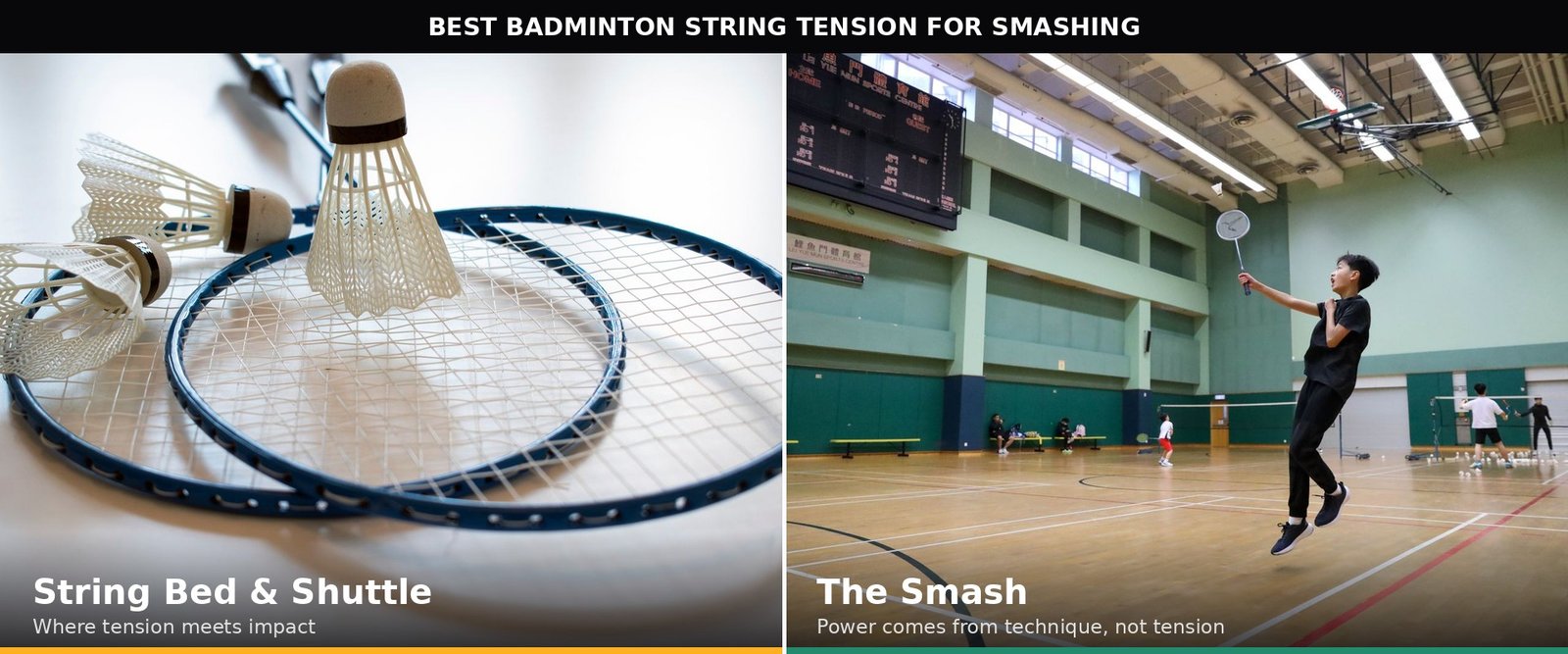
| Player Level | Smash Tension (lbs) | What You Get |
|---|---|---|
| Beginner | 18 to 22 | Easy power, big sweet spot |
| Intermediate | 22 to 26 | Balanced power and control |
| Advanced | 26 to 30 | Sharp, precise smashes |
| Professional | 30 and above | Maximum control, zero margin |
Expert tip: If you are unsure, start at 24 lbs. It is the safest sweet spot for a strong smash, and you can adjust up or down by 1 lb from there.
Does Higher Tension Mean A More Powerful Smash?
No, higher tension does not mean a more powerful smash. Higher tension improves control and feel, not raw power. The power in your smash comes from your technique, timing, and swing speed, not from tighter strings.
This surprises most players. The logic feels backwards, so let me break it down. It comes down to something called dwell time.
Dwell time is how long the shuttle stays on your strings during contact. Low tension strings stretch more on impact. They hold the shuttle a fraction longer, then snap back and add energy to the shot.
High tension strings act like a stiff plank. They barely stretch, so dwell time is short. The strings add no energy of their own, which means every bit of power must come from your swing.
So why do pros string tight? Control. Elite players already generate huge power through technique. They use high tension for a smaller, sharper response that places the shuttle exactly where they want.
How Does String Tension Affect Your Smash?
String tension affects your smash through two trade-offs: power versus control, and sweet spot size. Lower tension gives more natural power and forgiveness. Higher tension gives more control and precision but punishes any mistake.
Here is how each band feels on court.
Low Tension (18 To 22 lbs)
Low tension builds a trampoline effect into your string bed. The strings flex and spring back, adding power with less effort. Your smash feels easy and loud.
The sweet spot is large and forgiving too. Off-centre hits still carry decent power. The trade-off is control, since the shuttle can wobble slightly on contact.
Medium Tension (22 To 26 lbs)
Medium tension is the sweet spot for most smashers. You keep a good chunk of the trampoline power while gaining real control. The shuttle goes where you aim it.
This range suits club and intermediate players best. It forgives the odd mistimed hit without feeling mushy. For most people reading this, 24 to 26 lbs is the answer.
High Tension (26 To 30 lbs And Above)
High tension gives a crisp, precise response. The shuttle leaves the strings fast and exactly along your racket face. Advanced players love the control and feedback.
But the sweet spot shrinks sharply. Mishits lose power and sting your arm. High tension also sends more shock through the frame, which raises the risk of tennis elbow. A well-fitted badminton grip can help absorb some of that shock at the handle.
What String Tension Should You Use For Your Level?
Match your string tension to your skill level, not the pros. Beginners should use 18 to 22 lbs for easy power. Intermediate players suit 22 to 26 lbs. Advanced players can handle 26 to 30 lbs with good technique.
The reason is simple. Tension rewards players who already generate their own power cleanly. Jump ahead too soon and your smash gets weaker, not stronger.
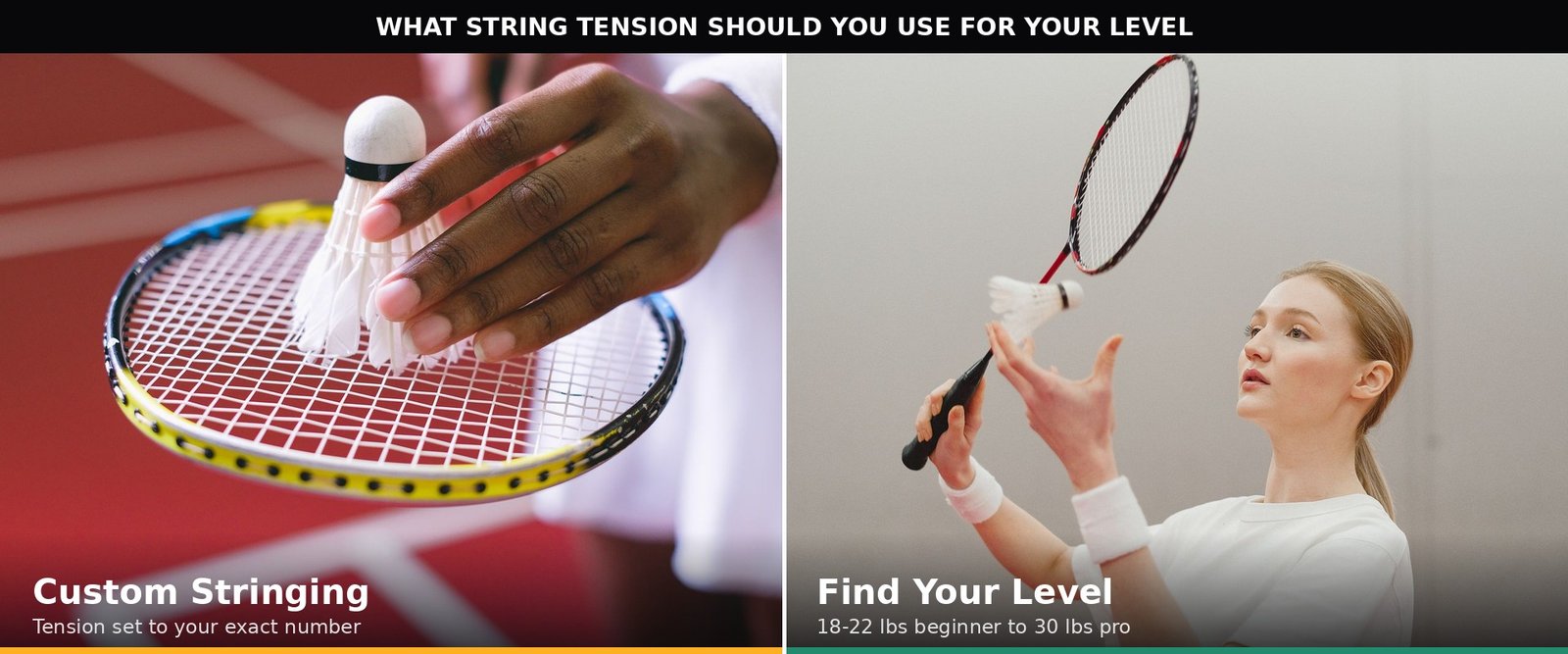
| Level | Tension (lbs) | Why It Fits |
|---|---|---|
| Beginner | 18 to 22 | Needs the trampoline for power |
| Intermediate | 22 to 26 | Building power, wants more control |
| Advanced | 26 to 30 | Generates own power, needs precision |
| Professional | 30 plus | Elite technique, maximum control |
Build up slowly as your technique matures. Add 1 lb at a time across restrings. Your arm and your timing will tell you when you are ready for more. If you are still working on fundamentals, a few sessions at badminton classes near you can help your technique catch up to your equipment.
Should Singles And Doubles Players Use Different Tension?
Yes, singles and doubles players often use slightly different tension. Singles players tend to use 24 to 27 lbs for steeper, more controlled smashes. Doubles players favour 22 to 25 lbs for faster, flatter exchanges at the net.
Doubles is a quicker, wrist-driven game. A slightly lower tension gives faster repulsion for rapid flat drives and defence. You react more than you wind up.
Singles rewards a heavier, placed smash from the back. A touch more tension sharpens that control over long rallies. The difference is small, so technique still matters most, whichever format the official badminton rules for your match call for.
What Else Changes Your Ideal Smash Tension?
Four things change your ideal tension beyond skill: shuttle type, weather, string choice, and your racket limit. Each one can shift your best number by a pound or two. Ignoring them can leave your smash feeling off.
Plastic or synthetic shuttles fly differently from feather ones. Drop your tension by 2 to 3 lbs if you play mostly with plastic shuttles. The extra give helps you get the shuttle moving.
Expert tip: Weather matters more than players think. In humid heat, add about 1 lb, since damp strings feel looser. In cold conditions, drop about 1 lb to protect the string bed.
Your racket also sets a hard limit. Every frame has a maximum recommended tension printed on it, so check your own badminton racket before restringing. Never string above that number, as it can crack the frame and voids most warranties.
How Do You Find Your Ideal Smash Tension?
Find your ideal smash tension by starting at 24 lbs and adjusting 1 lb at a time. If your smash lacks power, lower the tension slightly. If your smashes fly long and out, raise it gradually.
Keep a few simple rules in mind as you test.
First, change only 1 lb between restrings. A bigger jump makes it hard to feel what helped. Patience here pays off.
Second, listen to your arm. Any elbow or wrist pain means you should drop 1 to 2 lbs or switch to a softer string. No smash is worth an injury.
Third, restring on feel, not just on breakage. Strings lose 10 to 15 percent of their tension in the first month. A dull, dead string bed robs your smash long before the string snaps.
What Changed In 2025 And 2026 For String Setups?
Two shifts stand out. Data-driven stringing tools went mainstream, and hybrid string setups grew popular for smashers. Players now fine-tune tension with more precision than ever.
Online tension calculators and apps now suggest a starting number from your level and style. They remove much of the guesswork for newer players. The advice still needs a real test on court.
Hybrid stringing is the other trend. Players use a thinner string for the main strings and a tougher one for the crosses. The setup chases both power and durability in one frame.
Final Thoughts
The best smash tension is not the highest one. It is the one that matches your technique and lets you swing freely. For most players, that means 24 to 26 lbs, not a pro-level 30.
Chase power through timing and technique, then let tension fine-tune your control. Start at 24 lbs, adjust 1 lb at a time, and listen to your arm. Your ideal setup is a few restrings away.
Want to put your setup to the test? Read our guide to the best badminton rackets for smash to complete your kit. Then book a badminton court and feel your new tension in action.
Frequently Asked Questions
What tension do professional badminton players use for smashing?
Professional players usually string between 30 and 32 lbs or higher. This gives maximum control and a razor-sharp response. It only works because pros generate huge power through elite technique and timing.
Does higher string tension give a more powerful smash?
No, higher tension does not add power. It improves control and precision instead. Power comes from your swing speed and technique. Lower tension gives more free power through its trampoline effect.
What is the best tension for a beginner’s smash?
Beginners should string between 18 and 22 lbs. This range gives a large sweet spot and natural power with less effort. It forgives mistimed hits while you build proper smash technique over time.
How often should I restring my badminton racket?
Restring every two to three months, or when the strings feel dull. Strings lose 10 to 15 percent of tension in the first month alone. A dead string bed weakens your smash before it breaks.
Will high tension cause tennis elbow?
High tension can raise the risk. A stiff string bed sends more shock through the frame to your arm on mishits. If you feel elbow pain, drop your tension or switch to a softer string.
What tension is best for doubles smashing?
Doubles players suit 22 to 25 lbs. The slightly lower tension gives faster repulsion for quick flat drives and defence. It helps the wrist-driven, reactive style that fast doubles rallies demand.
Can I string higher than my racket allows?
No, never string above your racket’s printed maximum. Doing so can crack the frame and voids most warranties. Stay within the recommended range and adjust string gauge instead if you want more feel.


0 Comments