
Key Takeaways
- Advanced rackets demand technique. They reward clean hits with more power and precision. They punish mishits harder than beginner frames.
- Shape decides your game. Diamond frames give max power. Teardrop frames balance power and control. Round frames favor control.
- Carbon grade matters. 12K and 18K carbon faces feel firmer and return more energy than fiberglass.
- Weight is a trade-off. Heavier frames (365g+) add smash power but tire your arm. Choose a weight you can swing for a full match.
- Top picks for 2026 include the NOX AT10 Genius 18K, Adidas Metalbone 3.4, Babolat Technical Viper, and Wilson Bela Pro V3.
Walk onto any padel court and you will see the same mistake. A club player swings a racket built for beginners. It feels light. It feels forgiving. And it quietly holds their game back.
Advanced padel is a different sport. The ball comes faster. The rallies last longer. Your margins shrink. The racket you learned on is no longer the racket that will take you further.
At the advanced level, a racket is not just equipment. It is a decision-making tool. The wrong shape slows your attack. The wrong weight tires your arm in the third set. The wrong carbon grade turns clean hits into jarring vibrations.
This guide breaks down the best padel rackets for advanced players in 2026. We cover the four standout models and tell you which frame suits which style of play.
No hype. No marketing fluff. Just the specs that matter.
What Makes a Racket “Advanced”?
A beginner racket forgives. An advanced racket demands.
Advanced players want precision. They want power when they attack. They want a defined sweet spot, not a giant one that masks bad contact.
Here is what changes at this level:
- Firmer core. More energy return on fast swings.
- Higher carbon content. Stiffer face for control and durability.
- More demanding balance. Head-heavy frames reward good technique.
- Tighter sweet spot. Better placement, less forgiveness.
If your technique is solid, these rackets give more back. If it is not, they expose every flaw. Still finding your footing? Our guide to choosing the best padel rackets for beginners is the better starting point, and sharpening your game technique with our guide to improving your padel strategy will help you get more out of any frame.
Racket Shapes: Diamond, Teardrop, Round
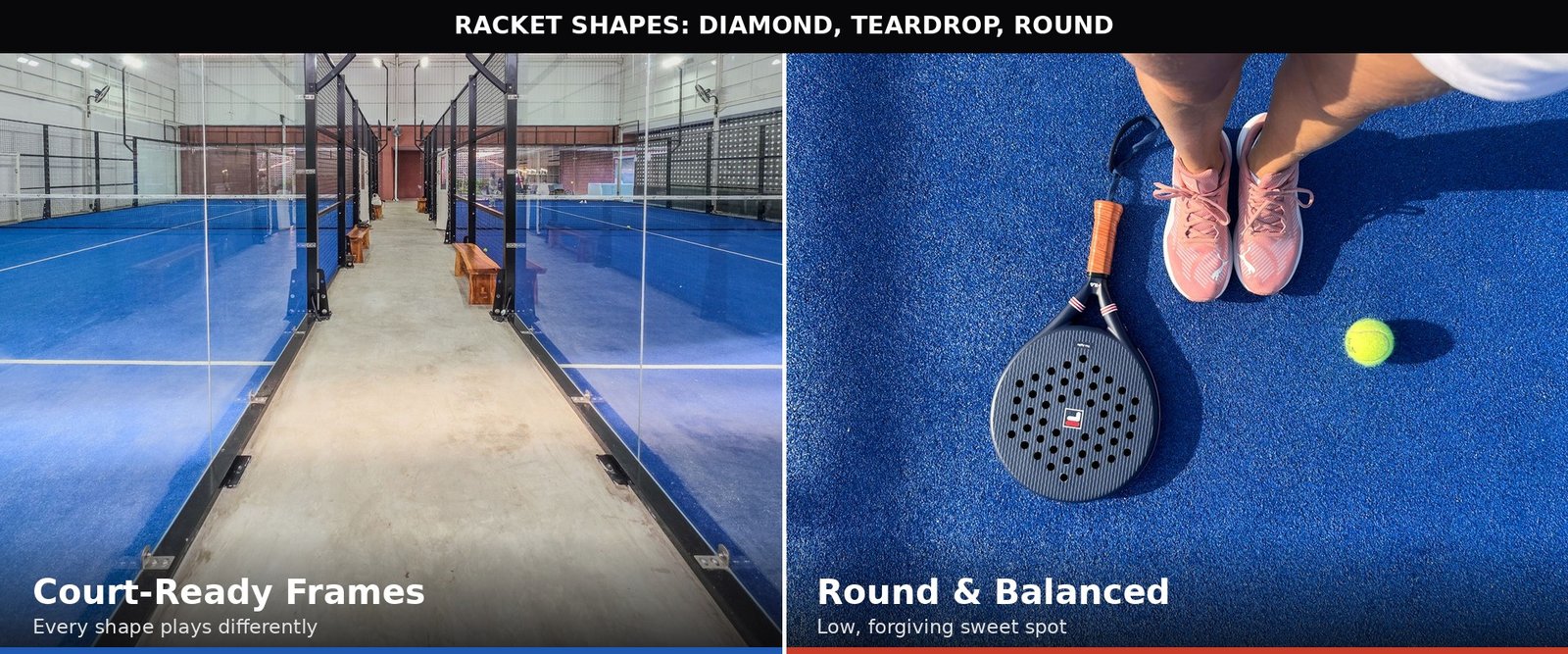
Shape decides where the sweet spot sits and how the racket feels.
| Shape | Balance | Sweet Spot | Best For |
|---|---|---|---|
| Diamond | Head-heavy | High, smaller | Aggressive attackers, smash-heavy players |
| Teardrop | Medium | Central, versatile | All-court players who mix attack and defense |
| Round | Head-light | Low, largest | Control specialists, defensive players |
Diamond frames put weight in the head. You get more momentum on overheads. But timing must be clean.
Teardrop frames sit in the middle. They suit players who transition between defense and attack.
Round frames are the most forgiving. Advanced players who win with placement still use them.
Weight, Balance, and Hardness
These three specs change how a racket feels more than any marketing label.
Weight
Most advanced frames sit between 365g and 375g. Heavier rackets add power. They also strain your arm over a long match.
Do not assume heavier is better. Choose a weight you can swing with good technique for three sets.
Balance
Balance is where the weight sits.
- Head-heavy: More power, slower handling.
- Medium: Balanced feel.
- Head-light: Faster reactions, less power.
Some advanced frames now offer customizable weight systems. The Adidas Metalbone lets you shift up to 11.2g between matches. The NOX AT10 has a Weight Balance system with interchangeable weights.
Hardness
Advanced rackets use firmer EVA cores. A hard core returns more energy. It also vibrates more. If you have elbow issues, look for vibration dampening tech like Babolat’s VIBRABSORB SYSTEM 2.
Top Padel Rackets for Advanced Players
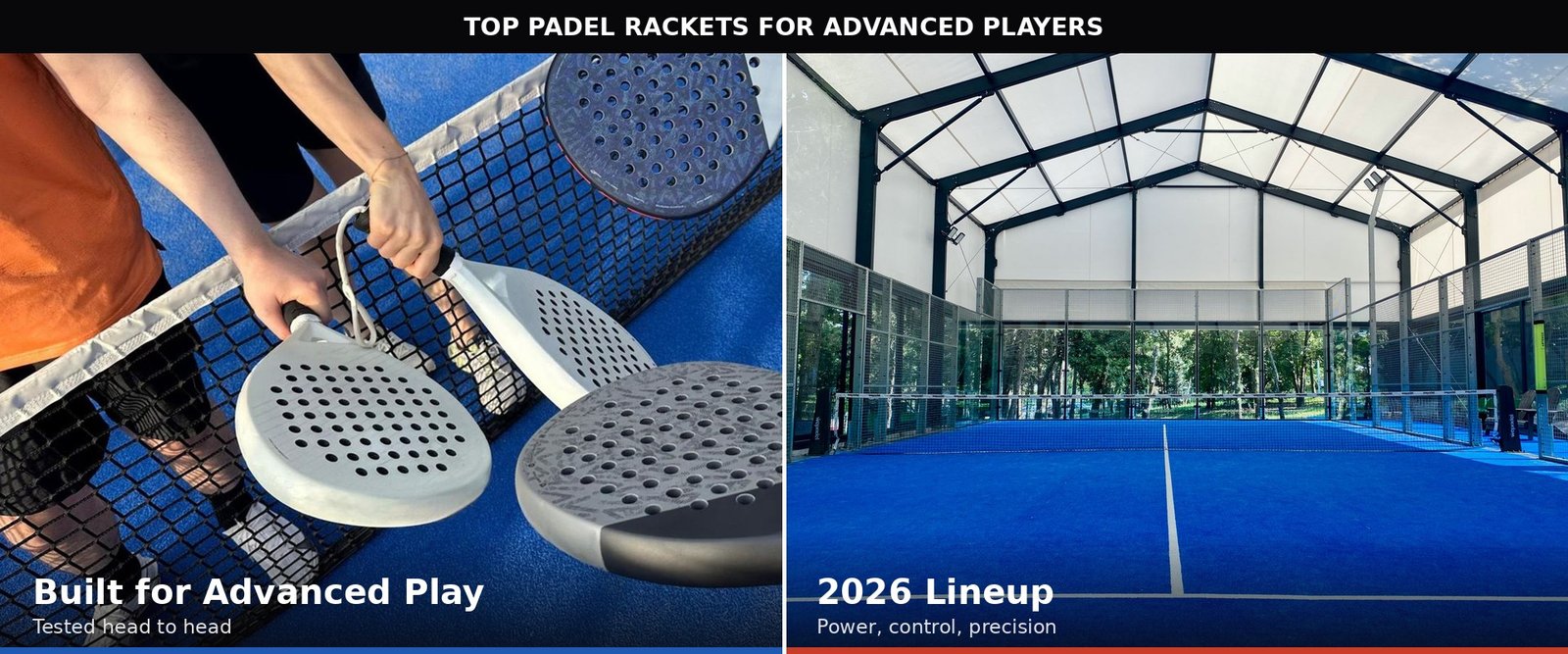
The 2026 lineup of advanced padel rackets is stronger than ever, with top brands pushing carbon technology, customizable weighting, and spin-enhancing textures to new limits. Racket design has moved fast since the early frames covered in our look at the evolution of padel rackets. Here are the four standout models that deliver on power, control, and precision at the highest level of play.
1. NOX AT10 Genius 18K
| Spec | Detail |
|---|---|
| Shape / Balance | Teardrop / Medium |
| Weight | 360-375g |
| Face | 18K Aluminized Carbon |
| Core | MLD Black EVA (multi-density) |
| Best For | All-court players who win with placement and control |
| Price | ~$259 |
The AT10 Genius is Agustin Tapia’s frame. It is built for versatility, not pure power. The 18K aluminized carbon gives a firmer, more consistent response across temperatures. The multi-density core is predictable on both defense and attack. The Weight Balance system lets you shift feel between matches without buying a new racket.
Verdict: The best all-round choice for advanced players who value control first.
2. Adidas Metalbone 3.4
| Spec | Detail |
|---|---|
| Shape / Balance | Diamond / Tunable high balance |
| Weight | 345-360g (base) |
| Face | Carbon Aluminized 16K |
| Core | EVA Soft Performance |
| Best For | Left-side attackers who want customizable power |
| Price | ~$263 |
The Metalbone is Ale Galan’s weapon. Its standout feature is the Weight and Balance System. You can add or remove weights to shift balance toward the head for smash power or toward the handle for net speed. The diamond shape and extended grip add leverage on overheads.
Verdict: The best choice for players who want to tune their racket to different opponents or court conditions.
3. Babolat Technical Viper
| Spec | Detail |
|---|---|
| Shape / Balance | Diamond / Head-heavy |
| Weight | 365g-370g |
| Face | 3K Carbon with Carbon Power Layer |
| Core | Hard EVA |
| Best For | Strong, well-conditioned power attackers |
| Price | ~$229 |
The Technical Viper is built for one thing: explosive power. The diamond shape and head-heavy balance put weight behind every smash. The 3D SPIN+ textured face grabs the ball for heavy spin on viboras and sliced volleys. Babolat’s VIBRABSORB SYSTEM 2 reduces arm shock without killing feel. At current padel racket pricing in Pakistan, it also sits at the more accessible end of this lineup.
Verdict: The purest power frame on this list. Choose it if your game is built around finishing points.
4. Wilson Bela Pro V3
| Spec | Detail |
|---|---|
| Shape / Balance | Teardrop / High |
| Weight | 360-375g |
| Face | 24K Carbon |
| Core | High-density Foam |
| Best For | Advanced attackers who want a stiff, pro-level feel |
| Price | ~$399 |
The Bela Pro V3 carries Fernando Belasteguin’s legacy. It uses 24K carbon on the faces, a step up from the 3K used in earlier versions. The feel is stiffer and drier. The rough surface combines 3D texture and sandy finish for durable spin. The teardrop shape and high balance make it versatile but aggressive.
Verdict: A premium frame for players who want a hard, precise feel and are willing to pay for it.
Quick Comparison
| Racket | Shape | Weight | Best For | Price |
|---|---|---|---|---|
| NOX AT10 Genius 18K | Teardrop | 360-375g | All-court control | ~$259 |
| Adidas Metalbone 3.4 | Diamond | 345-360g | Tunable power | ~$263 |
| Babolat Technical Viper | Diamond | 365-370g | Pure smash power | ~$229 |
| Wilson Bela Pro V3 | Teardrop | 360-375g | Stiff pro feel | ~$399 |
Materials: 12K vs 18K Carbon
The “K” number on a padel racket tells you how many carbon filaments are woven into each thread. 3K means 3,000 filaments. 12K means 12,000. 18K means 18,000. This number affects how the racket feels, how stiff it plays, and how much vibration reaches your arm.
Higher K-counts do not automatically mean “better.” They mean stiffer. And stiffness is a trade-off.
3K Carbon: The Standard Weave
3K carbon is the most common weave in mid-range and beginner frames. It has a coarser, more open structure. The feel is softer and more forgiving. It absorbs shock better than denser weaves. If you are still developing consistency, 3K gives you more margin for error.
12K Carbon: The All-Rounder’s Choice
12K carbon is the classic premium compromise. It offers a good balance between stiffness and feel. The response is firmer than 3K, but not punishing. It holds its playing character longer than fiberglass. Most advanced all-court players will find 12K meets their needs without excessive joint strain.
One independent test lab notes that the jump from 12K to 18K delivers roughly 6-10% more ball speed on smashes for advanced power hitters. That is a real gain, but a modest one.
18K Carbon: Maximum Stiffness, Maximum Demand
18K carbon sits at the premium end. The weave is denser, so the face is stiffer. Shots come off faster, especially on volleys and overheads. The feedback is sharp and precise.
But there is a cost. A stiffer face transmits more vibration to your elbow. Players with joint sensitivity should think carefully before choosing 18K. It rewards clean technique. It punishes mishits harder.
The NOX AT10 Genius 18K is the flagship example on this list. It uses aluminized 18K carbon to keep the feel consistent in both heat and cold.
24K Carbon: The Premium Outlier
24K carbon is less common. It uses 24,000 filaments per thread. The feel is very stiff and “dry.” It is used in Wilson’s Bela Pro V3, where the 24K face is paired with a high-density foam core to balance the stiffness with some comfort.
The Honest Caveat
The carbon weave is only one part of the puzzle. As one UK retailer puts it: “the difference between K counts is smaller than the difference between the underlying foam cores.” A soft-core 18K racket can feel friendlier than a hard-core 12K frame. Judge the whole racket, not just the number on the label.
Quick Reference: Carbon Weave Comparison
| Carbon Grade | Feel | Stiffness | Vibration | Best For |
|---|---|---|---|---|
| 3K | Soft, forgiving | Low | Low | Beginners, developing players |
| 12K | Balanced, firm | Medium | Medium | Advanced all-court players |
| 18K | Sharp, explosive | High | High | Power hitters without joint issues |
| 24K | Very stiff, dry | Very High | Very High | Elite players wanting maximum precision |
Is 18K better than 12K?
Not automatically. 18K is stiffer and more precise. But it demands cleaner technique. If your swing is not consistent, a 12K or 3K frame may be more forgiving.
The Bottom Line: Match the Racket to Your Game
Advanced padel rackets are not about buying the most expensive frame. They are about buying the right frame.
Here is what matters most:
- Shape first. Diamond for power. Teardrop for balance. Round for control.
- Weight second. Pick a weight you can swing for three full sets, not just one.
- Carbon third. 18K rewards clean technique. 12K forgives small errors. Neither is “better.”
- Test before you buy. Spec sheets tell you numbers. The court tells you the truth.
The four rackets in this guide, NOX AT10 Genius, Adidas Metalbone, Babolat Technical Viper, and Wilson Bela Pro V3, each serve a different style. None is universally best. The best one is the one that fits your swing, and it is worth pairing with the right footwear too; see our guide on how to choose padel shoes for the full picture.
Feel the Difference on Court
Visit Padel Cafe in DHA Phase 6, Lahore. Try different racket weights and shapes before you commit. Our team will help you find the frame that matches your game.
Location: Link Bedian Road, near PKLI Hospital, Phase VI, DHA, Lahore
Book your court now and bring your own racket, or test one of ours on site.
Frequently Asked Questions
What makes a padel racket suitable for advanced players?
Advanced rackets use firmer cores, higher carbon content, and more demanding balance points. They reward good technique with more power and precision but punish mishits harder than beginner frames.
Which padel racket is best for power and control?
The NOX AT10 Genius 18K offers the best balance of power and control. For pure power, the Babolat Technical Viper is the top choice. For tunable power, the Adidas Metalbone 3.4 lets you adjust balance between matches.
Are diamond-shaped padel rackets better for advanced players?
Diamond frames suit aggressive attackers who want maximum power. But not all advanced players need one. All-court players often prefer teardrop for versatility.
What is the difference between round, teardrop and diamond padel rackets?
Round frames have a low, central sweet spot for control. Teardrop frames balance power and control. Diamond frames put weight in the head for power but have a smaller sweet spot.
What weight should an advanced padel racket have?
Most advanced frames weigh 360–375g. Choose a weight you can swing for a full match without arm fatigue. Heavier is not always better.
Is 12K or 18K carbon better for a padel racket?
18K is stiffer and more precise. 12K is slightly more forgiving. Neither is “better”. It depends on your technique and preference.
Does racket balance affect power and manoeuvrability?
Yes. Head-heavy balance adds power but slows handling. Head-light balance improves manoeuvrability but reduces power.
How often should advanced players replace their padel rackets?
Advanced players who train 3–4 times per week should consider replacing their racket every 12–18 months. Signs of replacement: dead feel, cracked frame, worn face texture, or loss of power.
What is the difference between professional and advanced padel rackets?
Professional rackets are often custom-molded for sponsored players. Advanced rackets are retail versions with similar specs but standard construction. The performance gap is small for most players.
How do I choose a padel racket for competitive matches?
Match your shape to your style. Attackers: diamond. All-court: teardrop. Control: round. Test before buying. Weight and feel matter more than spec sheets.


0 Comments