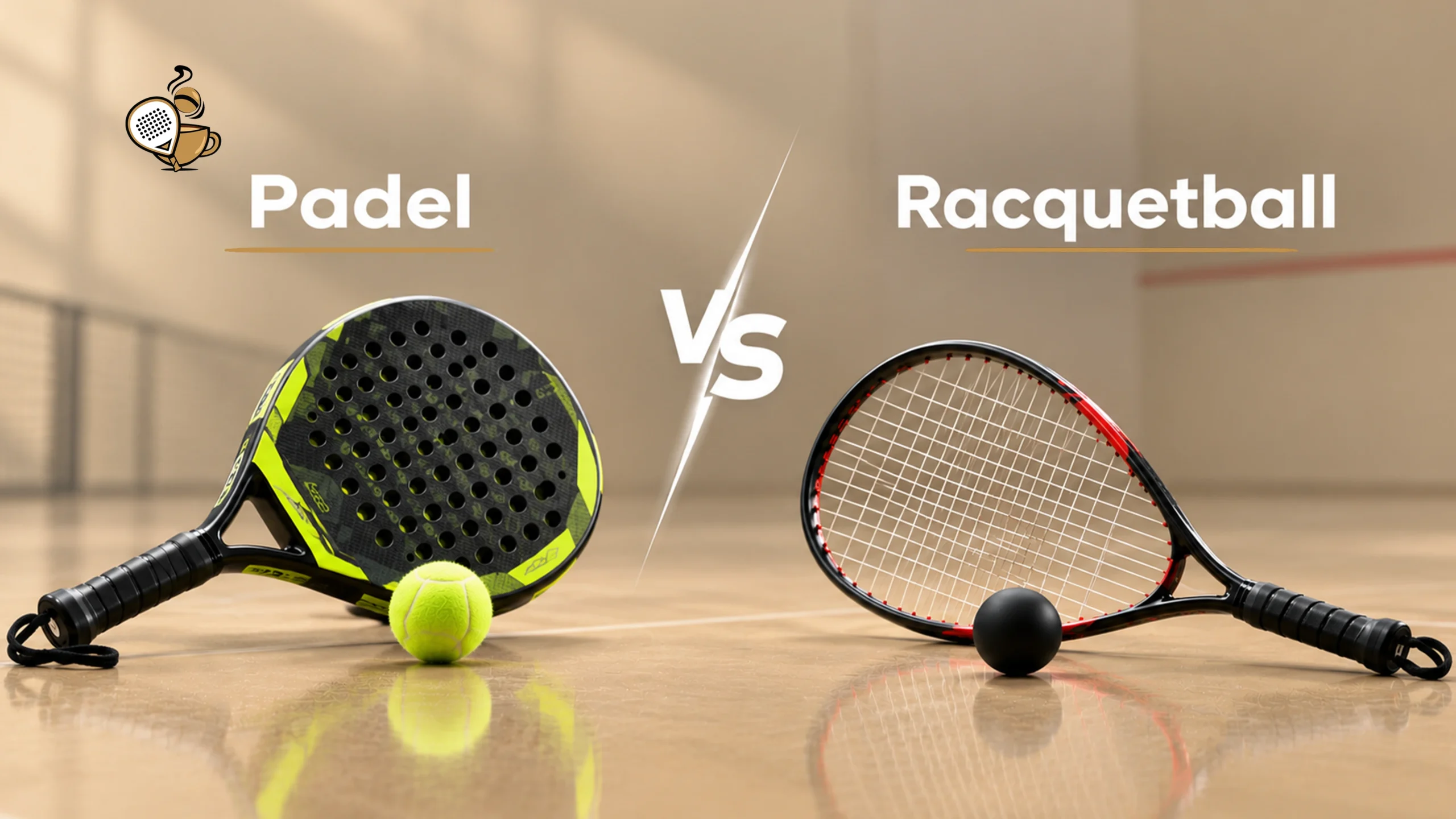
TL;DR
- Padel is played on a 20m x 10m enclosed court with glass and mesh walls, almost always in doubles, while racquetball uses a fully enclosed 40ft x 20ft four-wall court and can be played as singles, doubles, or cutthroat.
- Padel uses a solid, stringless foam-core racket and a depressurised ball similar to a slower tennis ball, while racquetball uses a strung racket and a small, lively rubber ball that moves far faster off the walls.
- Padel scoring follows the familiar 15-30-40-game tennis format with deuce and advantage, plus the new FIP 2026 Star Point at a third deuce, while racquetball uses rally scoring to 15 points per game.
- Padel is a doubles-first sport by design, since the court is built for four players; racquetball is naturally suited to singles but adapts easily to doubles and the three-player cutthroat format.
- Racquetball tends to burn more calories per hour (around 600-800) than padel (around 450-600) because of its faster ball speed and more explosive, singles-driven movement.
- Padel has a gentler learning curve for complete beginners thanks to its underarm serve and forgiving wall rebounds, while racquetball rewards players who already have strong racket-sport reflexes.
- Both sports use the surrounding walls as part of active play, which sets them apart from open-court racquet sports like tennis or pickleball and groups them together as wall-based racquet sports.
- Padel Cafe in DHA Phase 6, Lahore, offers bookable padel courts for players who want to try the sport firsthand, with court dimensions, equipment, and rules that follow the FIP 2026 standard.
Padel and racquetball both put players inside an enclosed court where the walls are part of the game, and that single shared trait is often where the similarities end.
One sport grew out of a private garden in Mexico and now fills booked-out courts across Lahore and the rest of Pakistan; the other was born in a YMCA handball room in Connecticut and became a fixture of North American fitness clubs.
Walk onto either court for the first time and the differences show up fast: the size of the space, the racket in your hand, the way points are scored, and even how many people you need to get a game going.
This guide breaks down padel vs racquetball in 2026 across court dimensions, equipment, rules, scoring, and format, so you can see exactly where the two sports overlap and where they pull apart. Whether you already play one and are curious about the other, or you are picking a wall-based racquet sport for the first time, the comparisons below will help you decide which one is right for you.
Quick Comparison
| Feature | Padel | Racquetball |
|---|---|---|
| Origin | Mexico, 1969 | United States, 1950 |
| Court size | 20m x 10m | 40ft x 20ft (12.2m x 6.1m) |
| Court type | Partially enclosed, glass and mesh walls | Fully enclosed, four solid walls plus ceiling |
| Default format | Doubles (2v2) | Singles, doubles, or cutthroat |
| Serve | Underarm, below waist, diagonal | Overhand or underhand, off the front wall |
| Scoring | 15-30-40-game, deuce/advantage, best of 3 sets | Rally scoring to 15, best of 3 games |
| Main tool | Solid, stringless foam-core racket | Strung, teardrop-shaped racket |
| Ball | Depressurised, slower bounce | Small, lively rubber ball, fast off walls |
| Ceiling | Open or semi-open, not in play | Enclosed, ceiling is in play |
| Eye protection | Optional, less essential | Strongly recommended, often mandatory |
| Best for beginners | Generally easier entry point | Steeper initial learning curve |
The Difference Between Padel And Racquetball: Origins
Padel was invented in 1969 by Enrique Corcuera in Acapulco, Mexico, who enclosed part of his backyard court with walls after running out of space for a full tennis court. The sport spread through Spain and Argentina before becoming one of the fastest-growing racquet sports worldwide, including a rapidly expanding scene in Lahore and across Pakistan.
Racquetball has an older pedigree. It was created in 1950 by Joseph Sobek, a professional tennis and handball player working at a YMCA in Greenwich, Connecticut, who wanted a faster indoor game using a strung racket and a lively rubber ball on a four-wall handball court. It became a staple of American and Canadian fitness clubs through the 1970s and 1980s and remains popular in gyms today.
Racquetball vs Padel Court Dimensions
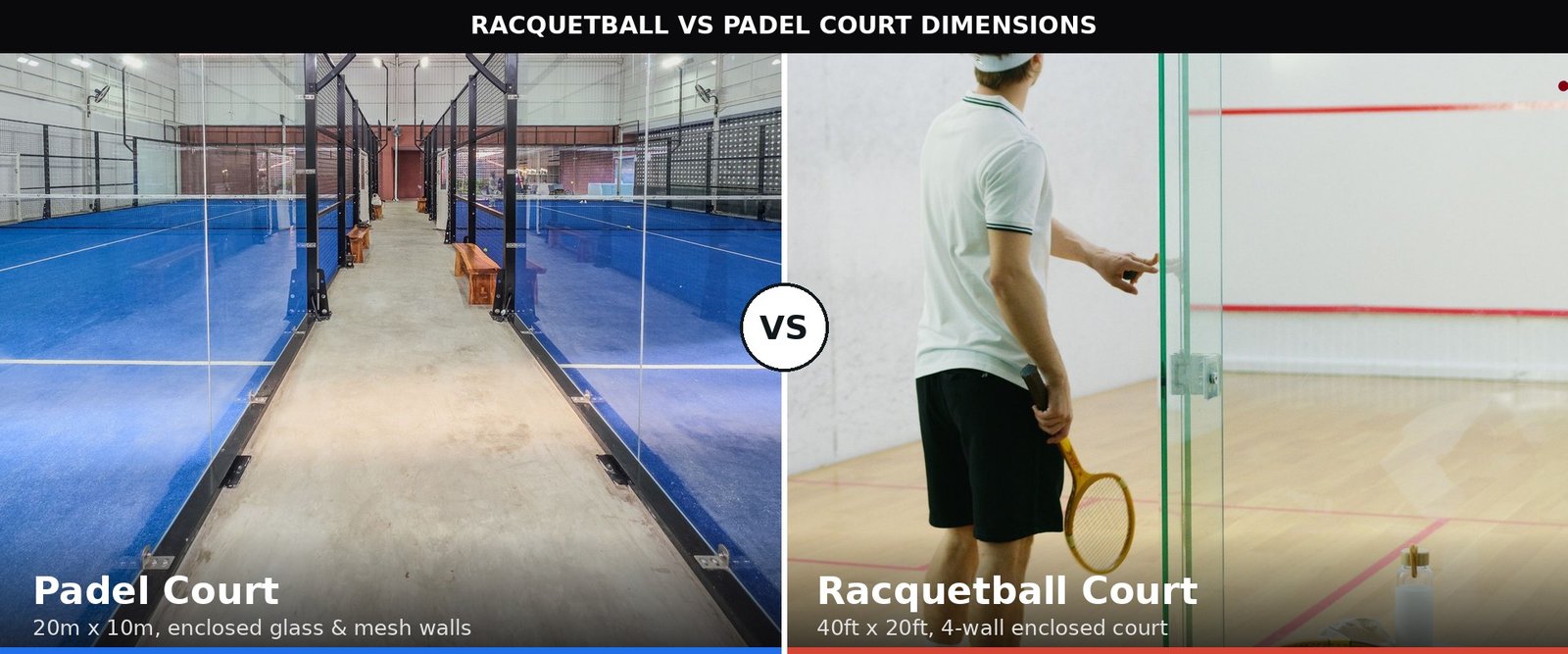
Padel Court
A regulation padel court measures 20 metres long by 10 metres wide, enclosed on the back walls by glass panels roughly 3 to 4 metres high, with metallic mesh fencing along the side sections. A net divides the court at the midpoint, set at 0.88m at the posts and 0.92m at the centre, almost identical to a tennis net. The court is typically open or semi-open above the walls, so the ceiling is not part of active play.
Racquetball Court
A standard racquetball court is a fully enclosed box measuring 40 feet long, 20 feet wide, and 20 feet high (roughly 12.2m x 6.1m x 6.1m). All four walls, plus the ceiling and floor, are legal playing surfaces, and a short red line 5 feet from the front wall marks the service zone. Because the entire court is sealed, the ball can be played off any surface, including a rebound straight down from the ceiling.
Court Comparison Table
| Court Feature | Padel | Racquetball |
|---|---|---|
| Length | 20m (65.6ft) | 40ft (12.2m) |
| Width | 10m (32.8ft) | 20ft (6.1m) |
| Height | 3-4m walls, open above | 20ft (6.1m), fully enclosed |
| Net | 0.88m at posts, 0.92m at centre | No net |
| Walls | Glass and mesh, partial enclosure | Four solid walls, full enclosure |
| Setting | Outdoor or indoor | Always indoor |
For a deeper look at how these dimensions shape gameplay and strategy on court, see our guide to how padel court dimensions affect gameplay and strategy.
Padel vs Racquetball Equipment
Padel Racket and Ball
The padel racket is solid and stringless, built from a fibreglass or carbon face over an EVA foam or polyethylene core, with holes across the face to reduce air resistance and control power. Unlike a tennis or racquetball racket, there are no strings to tension or replace.
- Max length: 45.5cm
- Max width: 26cm
- Max thickness: 38mm
- Weight: 340-380g
- Material: fiberglass or carbon face, EVA or foam core
The padel ball is similar in size to a tennis ball but depressurised, giving it a lower bounce that suits the shorter, enclosed court. For a full breakdown of racket materials, brands, and current pricing in Pakistan, see our guide to padel racket pricing in Pakistan.
Racquetball Racket and Ball
A racquetball racket is strung, similar in construction to a small tennis racket, with a shorter handle and a teardrop-shaped head no longer than 22 inches including the handle.
Frames are typically made from aluminium, graphite, or composite materials, built light enough for the fast wrist action the sport demands. The racquetball itself is small, hollow, and rubber, built to be lively and fast off every wall, which is a major reason rally speeds in racquetball tend to exceed those in padel.
Equipment Comparison Table
| Equipment | Padel | Racquetball |
|---|---|---|
| Racket type | Solid, stringless, perforated face | Strung, teardrop head |
| Racket length | Up to 45.5cm | Up to 22 inches (including handle) |
| Racket weight | 340-380g | 150-260g (typical) |
| Ball | Depressurised, tennis-like, slower bounce | Small, hollow rubber, fast and lively |
| Protective gear | Optional wrist strap | Eye guards strongly recommended |
Padel vs Racquetball Rules
The Serve in Padel
The padel serve must be hit underarm, below waist height, and the ball must bounce once inside the server’s own service box before being struck diagonally into the opponent’s service box, clearing the net in the process. Each server gets two attempts per point, same as tennis, and serves alternate sides after each point.
The Serve in Racquetball
A racquetball serve is struck directly off the front wall from within the service zone, either overhand, sidearm, or underhand, and the ball must then return past the short line before touching the floor.
The server can bounce the ball before serving but cannot step outside the service zone until the ball has crossed the short line. A let serve is replayed, while two consecutive faults result in a side-out.
Rally Rules: What Counts In Each Sport
In padel, the ball may bounce once off the court walls before being returned, but it must always clear the net and cannot touch the ground more than once before a return. Hitting the mesh fencing out of bounds, or the ball bouncing twice, ends the point.
In racquetball, the ball can be played off any combination of walls, the ceiling, and the floor, as long as it strikes the front wall at some point before hitting the floor a second time; there is no net to clear, which is what makes the sport’s pace feel so different from padel.
Padel vs Racquetball Scoring
Padel Scoring
- Points progress 15-30-40-game, identical to tennis
- A tied score at 40-40 is deuce, followed by advantage and game point
- FIP 2026 rules introduce the Star Point at a third deuce in a game, where the receiving pair chooses which side of the court to receive serve, ending extended deuce battles faster
- Games are played to 6, win by 2
- A 6-6 set score goes to a tiebreak
- Matches are best of 3 sets
Racquetball Scoring
- Games are played to 15 points
- Matches are best of 3 games
- A deciding third game, if needed, goes to an 11-point tiebreaker
- Modern IRF competition uses rally scoring, meaning either player or team can score on any rally, not only on their own serve
Padel Doubles Game vs Racquetball Singles and Doubles
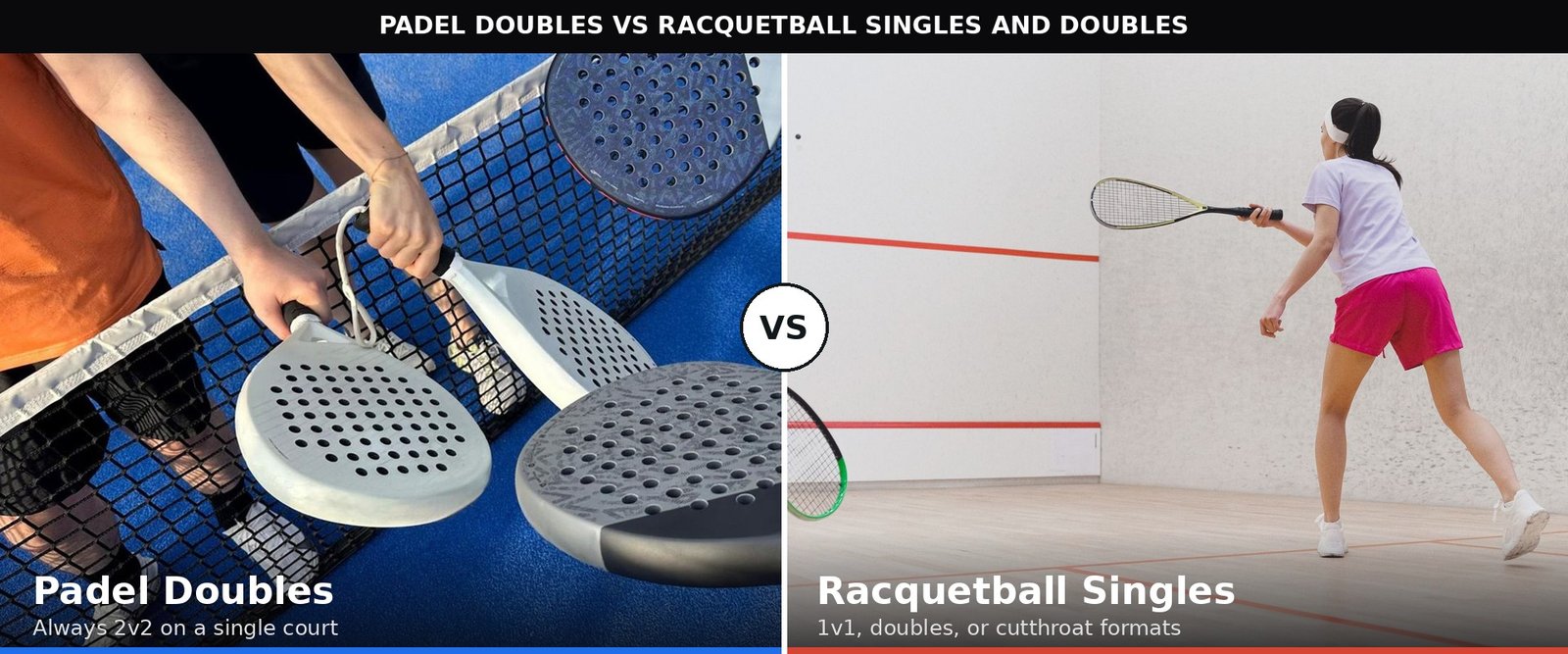
Padel Doubles Game
Padel was designed around doubles from the very start, and the vast majority of padel played worldwide, including at Padel Cafe in Lahore, is 2v2. The court’s compact dimensions and enclosed walls create constant close-quarters play at the net, making communication, positioning, and teamwork just as important as raw shot-making. Singles padel exists and is recognised in competition, but it is far less common socially because the court was never built with a lone player’s coverage in mind.
Racquetball Singles and Doubles
Racquetball is most commonly played as singles, where one player has to cover the entire 20ft by 40ft enclosed box alone, demanding sharp court sense and fast recovery between shots. Doubles racquetball is also popular, played 2v2 with slightly adjusted serve rotation rules, and many clubs also play cutthroat, a three-player format where one player rotates as the server against the other two, giving each player a turn in every role.
Wall-Based Racquet Sports: Context and Comparison
Padel and racquetball both belong to a broader family of wall-based racquet sports, a category that also includes squash, where a single narrow court uses all four walls in a similar way to racquetball, though with a strung racket and a slower, non-bouncy ball. If you are weighing up your options beyond padel and racquetball, our comparison of padel vs squash covers how that sport’s rules and intensity stack up as well.
What sets padel apart from the rest of this group is its net, borrowed directly from tennis, which means walls are used defensively and strategically rather than as the entire basis of every rally. Racquetball and squash, by contrast, have no net at all, and the front wall is where every single point begins and often ends.
Padel Strategy and Positioning
Because padel is almost always played in doubles on a compact, enclosed court, strategy depends heavily on team positioning rather than individual power. The following steps outline how most competitive pairs approach a point from serve to finish.
- Start from the baseline on serve and return, giving yourself time to read the ball off the back wall.
- Move forward together with your partner as a team once the point stabilises, aiming to control the net.
- Use lobs to push opponents back to their own baseline when you are under pressure at the net.
- Close out points at the net with controlled volleys and smashes rather than forcing low-percentage winners from the back.
A few positioning principles separate strong padel pairs from beginners:
- Always move and cover the court as a pair, never as two isolated individuals
- Prioritise court position over outright power, since the walls will often return a hard shot anyway
- Communicate before every point on who is taking the middle ball
- Use the lob early and often to reset a rally rather than forcing a risky passing shot
For a deeper breakdown of positioning drills and shot selection, see our guide on how to improve your padel strategy and game technique.
Benefits of Playing Padel
Accessible for beginners. The underarm serve, forgiving wall rebounds, and doubles format mean new players can get a rally going in their very first session, without the steep learning curve of sports like tennis or squash.
Excellent cardiovascular workout. A typical padel session burns an estimated 450-600 calories per hour, combining short sprints, lateral movement, and constant positional adjustments with your partner.
Built-in social structure. Because padel is a doubles sport by design, it naturally brings four people together for every match, which is part of why it has become such a popular choice for corporate events at Padel Cafe and casual friend groups alike.
Low injury risk. The enclosed court, softer ball, and doubles coverage reduce the extreme lunging and sprinting found in singles sports, making padel a comparatively joint-friendly option.
Accessible across age groups. Because padel rewards positioning and touch over raw power, players of very different ages and fitness levels can comfortably share a court and still have a competitive, enjoyable match.
Growing competitive pathway. With FIP 2026 rule updates, expanding international tournaments, and a rapidly growing base of clubs across Pakistan, padel now offers a genuine competitive pathway for players who want to take the sport further.
Benefits of Playing Racquetball
Exceptional calorie burn. Racquetball’s fast ball speed and constant singles-driven movement push calorie burn higher than most racquet sports, with estimates around 600-800 calories per hour for a competitive singles match.
Full-body workout. Covering an enclosed box alone demands explosive lower-body movement alongside the upper-body rotation needed to generate racket speed, giving racquetball a genuinely full-body training effect.
Fast skill development. Because the ball is always in play off the walls, players get far more reps per minute than in open-court sports, which can accelerate hand-eye coordination and reaction time.
Mental agility. With the ball able to come off any of four walls plus the ceiling, players constantly recalculate angles in real time, sharpening spatial awareness and decision-making under pressure.
Court access at gyms. Racquetball courts are a long-standing fixture of North American and increasingly South Asian fitness clubs, making the sport easy to pick up without needing a dedicated facility.
Excellent for solo training. Because singles is the default format, racquetball is one of the few racquet sports you can play a complete, competitive match in without needing to coordinate a doubles partner or opponent pair.
Which Sport Should You Choose?
| If You… | Choose |
|---|---|
| Want a social sport to play with three friends | Padel |
| Prefer training and competing alone | Racquetball |
| Are completely new to racquet sports | Padel |
| Already play squash or tennis and want a fast transition | Racquetball or Padel |
| Want the highest calorie burn per hour | Racquetball |
| Prefer a lower-impact, joint-friendly game | Padel |
| Want to play outdoors as well as indoors | Padel |
| Have access to a fitness club with an existing court | Racquetball |
| Want a sport with strong corporate and group event appeal | Padel |
| Enjoy fast, high-intensity rallies off every wall | Racquetball |
Play Padel in Lahore: Padel Cafe
If this comparison has you leaning toward padel, Padel Cafe offers regulation FIP-standard courts at Link Bedian Road, near PKLI Hospital, Phase VI, DHA, Lahore. The venue is built for everything from casual doubles with friends to structured coaching sessions, and its courts and facilities are also detailed in our guide to padel courts in DHA Phase 6, Lahore.
Book your padel court at Padel Cafe and experience the sport firsthand on a court built to the same dimensions and standards covered in this guide.
Conclusion
Padel and racquetball share the same basic idea, using enclosed walls to keep the ball alive longer than an open court ever could, but the sports diverge sharply from there. Padel is a social, doubles-first game on a tennis-style court with a net, built around positioning, touch, and teamwork. Racquetball is a faster, more individually demanding sport played inside a fully sealed box, rewarding reflexes, movement, and raw intensity.
Neither sport is objectively better than the other; the right choice depends on whether you want a social, easier-to-learn game or a high-intensity, often solo workout. Many players in Lahore end up trying both, and if padel is the one you want to explore first, Padel Cafe’s courts in DHA Phase 6 are ready whenever you are.
Frequently Asked Questions
What is the main difference between padel and racquetball?
The biggest difference is the court itself: padel is played on a 20m x 10m court with a net and partial glass and mesh walls, while racquetball is played inside a fully enclosed 40ft x 20ft box with no net, where all four walls and the ceiling are in play.
Is padel the same as racquetball?
No. While both are wall-based racquet sports, padel uses a solid stringless racket, a net, and tennis-style scoring, while racquetball uses a strung racket, no net, and rally scoring to 15 points per game.
Which is easier for beginners, padel or racquetball?
Padel is generally considered easier for complete beginners because of its underarm serve, slower depressurised ball, and forgiving wall rebounds, while racquetball’s faster ball and overhand serve take longer to adjust to.
Is padel always played in doubles, while racquetball can be played in singles?
Padel is overwhelmingly played in doubles because the court is designed for four players, though singles padel does exist in competition. Racquetball is most commonly singles but is equally playable as doubles or the three-player cutthroat format.
Which sport provides a better workout, padel or racquetball?
Racquetball typically burns more calories per hour, around 600-800 compared to padel’s 450-600, due to its faster ball speed and more explosive singles-based movement, though padel still delivers a strong cardiovascular workout.
Can someone who plays racquetball easily learn padel?
Yes. Racquetball players already have strong wall-reading instincts and racket-sport reflexes, which transfer well to padel, though they will need to adapt to the underarm serve, the net, and the slower depressurised ball.
Which sport is better for social play and playing with friends?
Padel has a clear edge for social play, since its doubles-first format naturally brings four players together for every match, which is also why it has become a popular choice for corporate events and group outings.
What equipment do you need to start playing padel or racquetball?
For padel, you need a solid stringless racket and depressurised padel balls; beginner rackets start from around PKR 3,500, and padel balls are typically sold in tubes of three. For racquetball, you need a strung racket, a rubber racquetball, and eye protection, which is strongly recommended given the ball’s speed.


0 Comments