SUMMARY
- Padel is the closest alternative to tennis. It uses tennis scoring and is played mostly in doubles.
- Pickleball is the easiest to start. It had 24.3 million US players in 2025, up from 4.2 million in 2020.
- Badminton, squash, and table tennis share tennis footwork and hand-eye skills but use different gear and rules.
- Beach tennis, platform tennis, and paddle tennis keep the tennis feel on smaller or softer surfaces.
- Padel now has about 19.4 million players, 58,300 courts, and nearly 20,000 clubs worldwide, according to the 2026 Playtomic report.
- Most beginners can rally within one session in padel or pickleball. Tennis usually takes longer.
- In Lahore, Padel Cafe (DHA Phase 6) offers padel, badminton, and pickleball courts under one roof.
Tennis is a great sport. It is also a hard one.
The court is big. The serve is tough. Rallies can take weeks to build. Many new players quit before the fun starts.
That does not mean you have to give up the racquet. A whole family of sports like tennis exists. Some are easier. Some are faster. Some are cheaper or kinder to your knees.
This guide covers 10 of the best. For each one, you will see how it compares to tennis, who it suits, and how to start. Use it to find your own tennis alternatives.
Why Look For Alternatives To Tennis?
People switch for good reasons.
- Court access. Tennis courts can be crowded or far away. Smaller courts are easier to book.
- Learning curve. Tennis has a steep start. Other sports let you rally in minutes.
- Social play. Many alternatives are built around doubles. You always have company.
- Joint health. Some sports use lighter balls or softer surfaces. That helps older players and anyone returning from injury.
- Variety. Tennis players often add a second sport. It sharpens footwork and keeps training fresh.
Tennis is not fading. US tennis participation grew about 6 percent in 2025. But the wider racquet world is growing even faster.
What Makes A Sport “Tennis-Like”?
Not every racquet sport feels like tennis. Five traits decide how close a sport comes.
- A racquet or paddle held in one hand
- A ball or shuttle hit back and forth
- A net or wall that shapes the rally
- Singles or doubles play
- Point-by-point scoring with games or sets
The more traits a sport shares, the closer it sits to tennis. Padel shares almost all five. Squash shares only a few. That is not a flaw. It just means a different feel.
Sports Like Tennis
| # | Sport | Court Setting | Racket Type | Usual Format | Closeness To Tennis (1-5) | Beginner Ease (1-5) |
|---|---|---|---|---|---|---|
| 1 | Padel | Enclosed glass court, net | Solid perforated | Doubles | 5 | 5 |
| 2 | Pickleball | Small court, net | Solid paddle | Doubles or singles | 4 | 5 |
| 3 | Badminton | Indoor court, high net | Light strung racquet | Singles or doubles | 3 | 4 |
| 4 | Squash | Four-wall indoor court | Strung racquet | Singles | 3 | 3 |
| 5 | Table Tennis | Table, low net | Rubber-faced bat | Singles or doubles | 3 | 5 |
| 6 | Racquetball | Four-wall indoor court | Strung racquet | Singles | 2 | 3 |
| 7 | Beach Tennis | Sand court, net | Solid racket | Doubles | 5 | 4 |
| 8 | Platform Tennis | Raised platform with screens | Solid paddle | Doubles | 4 | 3 |
| 9 | Paddle Tennis | Small open court, net | Solid paddle | Doubles | 4 | 4 |
| 10 | Crossminton | Outdoor, no net | Short strung racquet | Singles or doubles | 2 | 4 |
Closeness and ease ratings are editorial judgments based on rules, equipment, and learning curve.
The 10 Best Sports Like Tennis
Tennis has a specific feel: the rhythm of baseline rallies, the touch at the net, the mental chess match. If you love that feeling but want something new, here are ten sports that share its DNA.
1. Padel
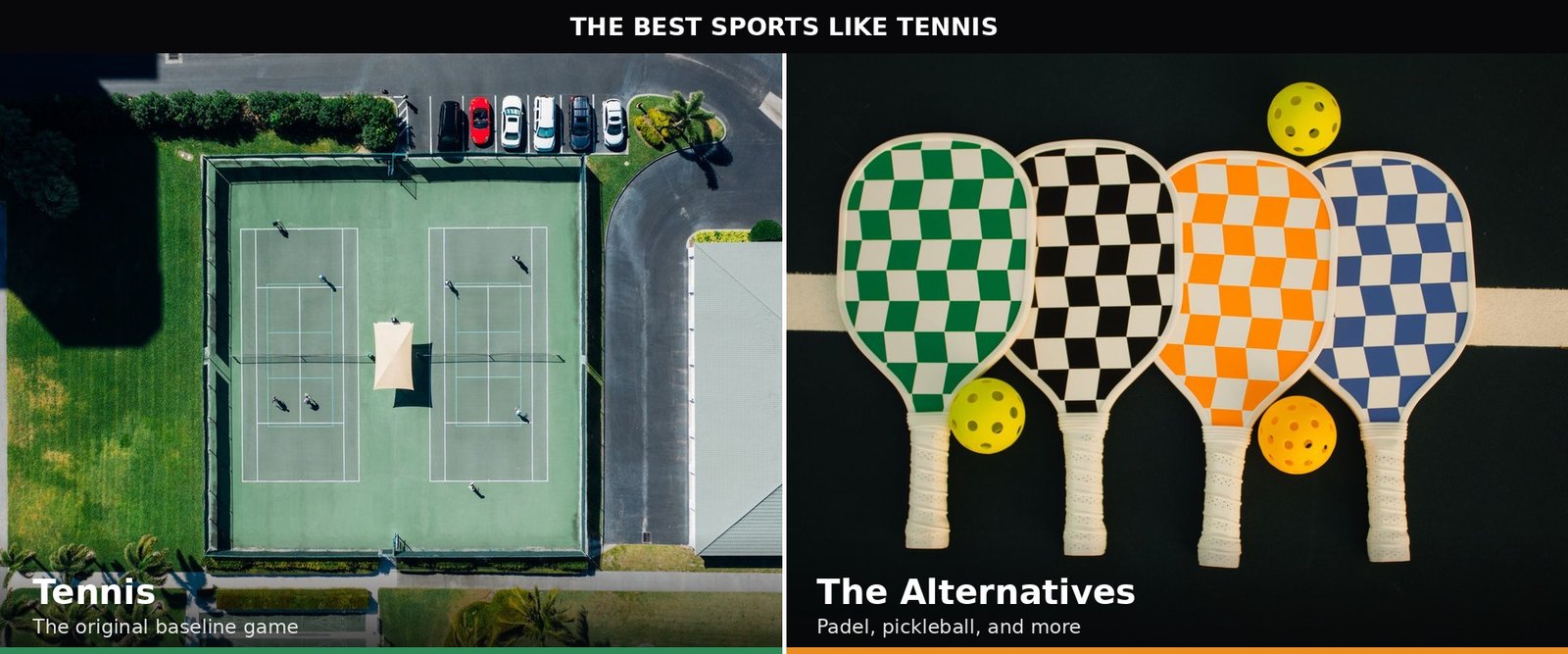
Padel is the closest cousin to tennis. It borrows the net, the scoring, and the doubles feel. Then it adds walls.
The court measures 20 by 10 metres. Glass and mesh walls surround it. After the ball bounces, it can rebound off the walls and stay in play. That turns defence into a skill.
The serve is underhand. The racket is solid, perforated, and shorter than a tennis racquet. The ball looks like a tennis ball but has lower pressure.
Scoring follows tennis: 15, 30, 40, game. The FIP 2026 rulebook added the Star Point, a single deciding point at the third deuce.
Padel’s growth is huge. The 2026 Playtomic report counts 19.4 million players worldwide. The FIP cites even higher figures.
Best for: Tennis players, social groups, true beginners
Why it works: Easy rallies, tennis scoring, strong club culture
2. Pickleball
Pickleball is the easiest of the games like tennis to pick up. You can rally in your first ten minutes.
The court is 44 by 20 feet. A net splits it. A solid paddle hits a perforated plastic ball. The serve is underhand.
One rule defines the game. The 7-foot zone beside the net is called the kitchen. You cannot volley while standing in it. This forces soft, patient play.
Games go to 11 points, win by 2. Only the serving side scores.
US participation hit 24.3 million in 2025. That is up from 4.2 million in 2020. Few sports have grown that fast.
Best for: Beginners, older players, families
Why it works: Small court, slow ball, simple rules
3. Badminton
Badminton looks different from tennis. Yet the motions are close. The overhead serve, the smash, and the quick lateral steps all echo tennis.
A doubles court is 13.4 by 6.1 metres. The net sits high at about 1.55 metres. The projectile is a feathered or synthetic shuttle. It cannot bounce. Every shot must be played in the air, under the same official badminton rules used worldwide.
Scoring is rally-based. Games go to 21. Matches are best of three.
Pro smashes have been clocked above 500 km/h. Recreational play is far gentler and very social.
Badminton had 6.8 million US players in 2025. It is even bigger across South Asia, including Lahore.
Best for: Players who love speed, wrist work, and indoor courts
Why it works: Light racquet, fast reflex training, easy to find courts
4. Squash
Squash trades the net for four walls. Two players share one court and hit a small rubber ball against the front wall.
The court measures 9.75 by 6.4 metres. The ball is hollow and has little bounce. You must hit it before it bounces twice.
Points are rally-scored. Games go to 11. Matches are usually best of five.
Squash is often called one of the toughest workouts in sport. A single player covers the whole court. Quick lunges, sharp turns, and long rallies add up.
Squash is also heading to the Olympics. It joins the programme at Los Angeles 2028. US participation sits near 1.3 million.
Best for: Fitness seekers, competitive singles players
Why it works: Strung racquet, fast reactions, brutal cardio
5. Table Tennis
Table tennis is tennis shrunk to a tabletop. The name is not an accident. It started as an indoor game for tennis players.
The table is 2.74 by 1.525 metres. The net is only 15.25 cm high. The ball is 40 mm across and very light. Games go to 11. Matches are best of five or seven, and the sport often draws the same players as its close cousin, badminton.
Spin matters a lot. Footwork matters too. Top players move like tennis pros in a tiny space.
It is one of the most accessible racquet sports. Kids, adults, and seniors all play. US participation reached 15.9 million in 2025.
Best for: All ages, small spaces, spin lovers
Why it works: Low impact, cheap gear, easy to play at home
6. Racquetball
Racquetball is squash’s louder cousin. The court is bigger. The ball is bouncier. The pace is quicker.
A standard court is 40 by 20 feet, with a 20-foot ceiling. Every wall, the floor, and the ceiling can be in play. The racquet is strung and no longer than 22 inches. The ball is hollow rubber.
Games are commonly played to 15. Singles is the default.
Racquetball had about 3.7 million US players in 2025. Many gyms and universities still keep courts.
Eye protection is standard. The ball moves fast in a tight room.
Best for: Solo competitors, gym members, high-intensity workouts
Why it works: Quick points, strong cardio, easy to practise alone
7. Beach Tennis
Beach tennis takes tennis to the sand. It is played in doubles over a net that is about 1.7 metres high.
The court is roughly 16 by 8 metres. The ball is a low-pressure tennis ball. The racket is solid with no strings. Scoring follows tennis.
Sand slows the movement. That cuts impact on knees and ankles. It also makes every point a workout.
Beach tennis is governed by the ITF. It has a growing international tour, with strong followings in Italy and Brazil.
Best for: Tennis fans near the coast, joint-friendly cardio
Why it works: Tennis scoring, soft surface, relaxed vibe
8. Platform Tennis
Platform tennis is the cold-weather sport on this list. It began in 1928 in Scarsdale, New York.
Courts sit on a raised platform. Heating systems keep snow and ice away. Wire screens surround the court, and the ball can bounce off them. The court is 60 by 30 feet.
Play is doubles. Players use a solid paddle with holes. Each point allows only one serve.
The sport is strongest in the northeastern United States. Most players take it up to stay active through winter.
Best for: Cold-climate players, doubles fans
Why it works: Wall play, social clubs, year-round outdoor sport
9. Paddle Tennis
Paddle tennis is not padel. People mix them up all the time.
Paddle tennis was created in New York in 1915. The court is small, about 50 by 20 feet. A low net splits it. There are no glass walls.
Players use a solid paddle and a depressurised tennis ball. The serve is underhand. Only one serve is allowed.
The game is quick to learn and suits parks and beaches. It also works well for junior players.
Best for: Casual players, kids, park courts
Why it works: Tiny court, soft ball, tennis-style scoring
10. Crossminton
Crossminton is the odd one out. It has no net.
Players hit a weighted shuttle, called a speeder, across two small squares marked on the ground. The speeder resists wind, so the game works outdoors. It was created in Germany in the early 2000s and was first known as Speedminton.
The racquet is short and strung. Rallies are fast. You need quick feet and a sharp eye.
Crossminton is cheap and portable. A park, beach, or backyard is enough.
Best for: Outdoor fans, casual groups, travellers
Why it works: No court needed, light gear, great for play anywhere
Racquet Sports Participation Snapshot
Numbers show where each sport stands. The table below uses 2025 US data from the 2026 SFIA Topline Participation Report.
| Sport | US Players (2025) |
|---|---|
| Pickleball | 24.3 million |
| Table Tennis | 15.9 million |
| Badminton | 6.8 million |
| Racquetball | 3.7 million |
| Squash | 1.3 million |
| Padel | 1.1 million |
Padel looks small in this chart. That is because the US is still an early market. Worldwide, padel counts about 19.4 million players in the Playtomic and PwC estimate. The FIP reports an even higher figure.
Different Types Of Racquet Sports: A Simple Way To Sort Them
There are different types of racquet sports across the world. Three groupings make them easy to understand.
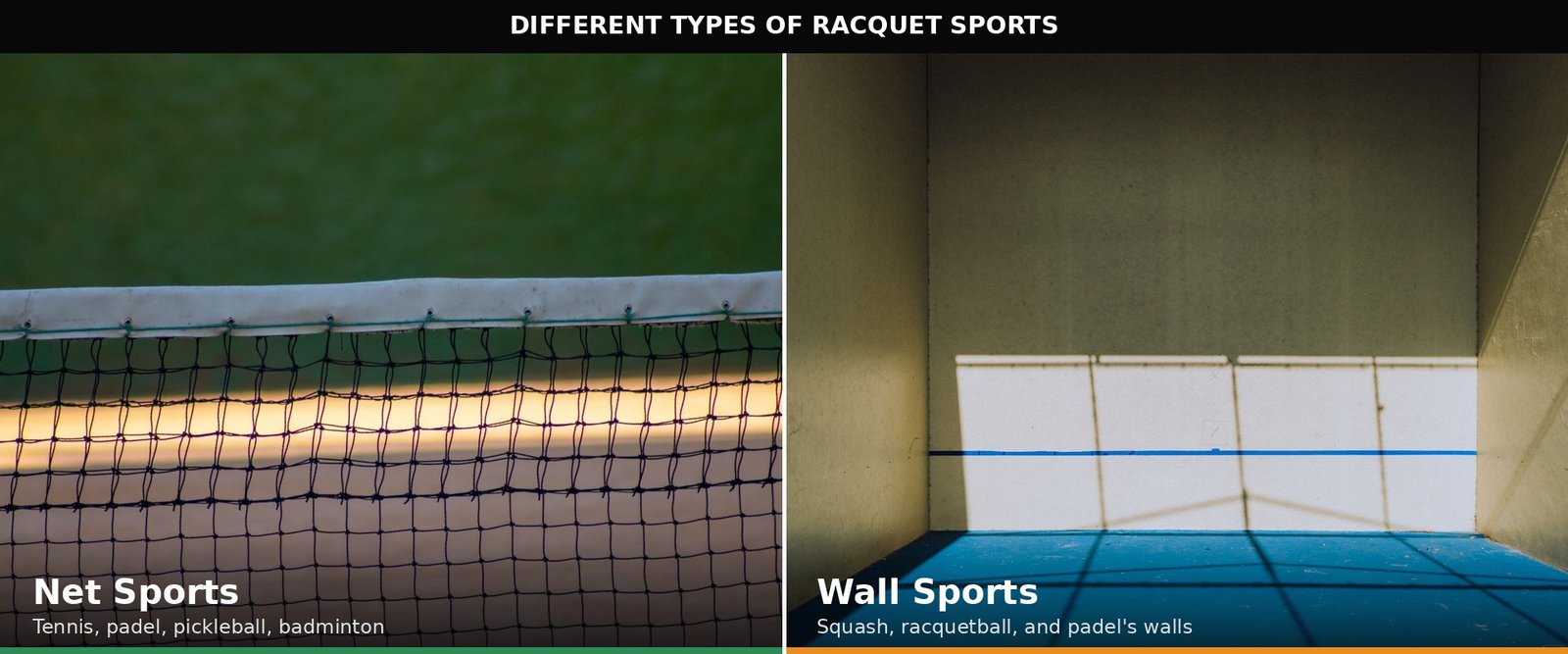
- Net sports. A net splits the court. Tennis, padel, pickleball, badminton, beach tennis, and table tennis belong here.
- Wall sports. Players share a space and use walls. Squash and racquetball are the classic examples. Padel and platform tennis blend nets and walls.
- Open-field sports. There is no court or net. Crossminton fits here.
Knowing the type helps you choose. Net-sport players tend to settle into padel and pickleball. Wall-sport fans lean toward squash and racquetball.
Best Racquet Sports For Beginners
Some sports reward you quickly. These are the best racquet sports for beginners, ranked.
- Pickleball. Smallest court, slowest ball, simplest rules.
- Padel. Underhand serve, wall rebounds that keep rallies alive, doubles format.
- Table Tennis. Cheap, indoors, and fun from the first rally.
- Beach Tennis. Soft surface and slow ball. Great if sand is nearby.
- Badminton. Light racquet and easy rallies. Pro-level technique takes years, but the first game is easy.
Squash and racquetball are harder to start. The ball is fast and the court is tight. Both reward patience, and comparing padel and pickleball head to head is a good way to see just how much gentler a doubles start can feel.
Which Sport Gives The Best Workout?
Every sport on this list raises your heart rate. The difference is how.
Highest intensity: Squash and racquetball. One player covers the whole court. Rallies are fast.
Strong cardio, high agility: Badminton. The shuttle demands constant quick steps and overhead swings.
Balanced and social: Padel and pickleball. Doubles shares the load. You still get steady movement and short sprints.
Lowest impact: Table tennis, beach tennis, and paddle tennis. Soft surfaces or small spaces protect your joints.
The best workout is the one you will repeat weekly. Pick the sport you enjoy most.
How To Choose Your Tennis Alternative
Use this table as a shortcut.
| If You Want… | Try |
|---|---|
| The closest feel to tennis | Padel or beach tennis |
| The easiest start | Pickleball |
| A hard solo workout | Squash or racquetball |
| An indoor sport you can play anywhere | Badminton or table tennis |
| A low-impact option | Table tennis or beach tennis |
| A winter outdoor sport | Platform tennis |
| Something you can play in a park | Paddle tennis or crossminton |
| A social doubles game | Padel or pickleball |
Not sure? Book one session in two different sports. Ten minutes on court tells you more than any article.
Conclusion
Tennis is not the only racquet sport worth your time. There are plenty of other options that suit different bodies, budgets, and personalities.
Padel offers the closest feel with an easier start. Pickleball is the fastest to learn. Badminton and table tennis are cheap and flexible. Squash and racquetball give you a hard workout. Beach tennis, platform tennis, paddle tennis, and crossminton add variety.
Pick one. Book a session. Then play it for a month.
You might find a sport you love more than tennis. You might find one that makes your tennis better. Either way, you win.
Try Padel, Badminton, And Pickleball In Lahore
If you live in Lahore, you do not need to travel far to test these sports.
Padel Cafe sits on Link Bedian Road, near PKLI Hospital, Phase VI, DHA. It offers padel courts, badminton, and a dedicated pickleball court in one venue. Coaching is available for beginners. A full cafe keeps you fed before and after play.
That makes it a strong testing ground for your own tennis alternatives. Play padel in the morning. Try badminton in the evening. See which one sticks.
Frequently Asked Questions
What sports are similar to tennis?
Padel, pickleball, badminton, squash, table tennis, racquetball, and beach tennis are the closest. Padel and beach tennis share tennis scoring and doubles play. Badminton and squash share the swing patterns and footwork. Choose based on court access and how much power you want.
Which sports are easier to learn than tennis?
Pickleball, padel, and table tennis are easier for most beginners. The courts are smaller, the balls move slower, and the serve is underhand in padel and pickleball. Many new players rally in their first session. Tennis often takes several weeks.
What is the difference between padel and tennis?
Padel is played on a 20 by 10 metre enclosed court with a solid perforated racket and an underhand serve. Walls stay in play. Tennis uses a larger open court, a strung racquet, and an overhead serve. Both use the same scoring.
Is pickleball easier than tennis?
Yes, for most beginners. The court is only 44 by 20 feet, the plastic ball is slower, and the serve is underhand. Rallies start within minutes. Tennis takes longer to master because of its larger court and harder serve.
What is the difference between badminton and tennis?
Badminton uses a light strung racquet and a shuttle that cannot bounce. Tennis uses a heavier racquet and a bouncing ball. Badminton scores by rally to 21 points. Tennis uses 15, 30, 40 games and sets. Badminton is faster but gentler on the arm.
Are squash and tennis similar sports?
Partly. Both use strung racquets and reward hand-eye coordination. Squash is played in a four-wall indoor court with a hollow rubber ball and no net. It is faster, tighter, and more intense. Tennis players often adapt quickly but find the pace demanding.
What racquet sports can you play indoors?
Squash, racquetball, badminton, and table tennis are classic indoor sports. Padel and pickleball also have indoor courts, though many padel courts are outdoors. Beach tennis, platform tennis, paddle tennis, and crossminton are usually played outside.
Which tennis-like sports can be played in doubles?
Padel is built for doubles. Pickleball, badminton, beach tennis, platform tennis, paddle tennis, and table tennis all support doubles. Crossminton allows doubles too. Squash and racquetball are mostly singles, though doubles formats exist for both.
What is the best tennis alternative for beginners?
Padel and pickleball are the top choices. Both have underhand serves, smaller courts, and slower rallies. Padel keeps tennis scoring and doubles. Pickleball has the simplest rules. If you can, try one session of each and keep the one you enjoy more.
Which racquet sport provides the best workout?
Squash and racquetball usually deliver the highest intensity because one player covers the full court. Badminton ranks close behind. Padel and pickleball give strong cardio with less joint stress. The best workout is the sport you will play every week.

0 Comments