TL;DR
- Only 20% of employees globally are engaged at work (Gallup State of the Global Workplace 2026) — well-designed corporate events are one of the highest-ROI interventions available
- Team building events lift employee engagement by 30% and cut absenteeism by 41% (Corporate Event Statistics 2026, kandephotobooths.com, June 2026)
- 82% of attendees prefer in-person events over virtual, up from 68% in 2023 (Corporate Event Statistics 2026)
- The best activities share three features: voluntary participation, equal playing field, and a task that requires genuine collaboration — not performed team spirit
Most corporate events fail before they start. Not because of bad catering or a boring venue — but because the activities ask employees to perform enthusiasm they do not feel. Mandatory fun is the fastest way to kill team morale, and most event planners know this. They just do not know what to replace it with.
Here is what the data says: global employee engagement fell to 20% in 2025, the lowest level since 2020, costing the global economy an estimated $10 trillion in lost productivity, according to Gallup’s 2026 State of the Global Workplace report.
But team-building events done right lift engagement by 30% and cut absenteeism by 41% (Kandephotobooths Corporate Event Statistics, June 2026). The gap between an event employees dread and one they remember positively is not budget — it is activity design.
This guide covers 25 corporate event activities that actually work — what each one does for team dynamics, who it suits, and how to run it well. Plus the activities that reliably flop and what to do instead.
Why Most Corporate Activities Don’t Work — and What Does
Before the list: understanding the three features that separate an activity employees enjoy from one they endure.
Voluntary participation (or at least the feeling of it). Activities where employees feel coerced produce the opposite of engagement — they produce resentment. The best corporate activities are ones where the format is inclusive enough that opting in feels natural. Nobody should feel embarrassed to participate or embarrassed not to.
An equal playing field. Activities that reward existing skills (presentation skills, athletic ability, industry knowledge) reinforce existing hierarchies. The CEO wins the trivia round. The former athlete dominates the sports day. Real team connection happens when an activity creates a new context where everyone starts from zero.
A task that requires genuine collaboration. Activities where individuals can succeed alone teach nothing about teams. The activity needs to have a real interdependency — where one person’s strength covers another’s gap, and that exchange is visible to the group.
Keep those three principles in mind. Every activity on this list scores well on all three.
Sport & Physical Activities
Physical activities are often avoided by corporate event planners who assume employees are not athletes. That assumption is wrong — and it misses the point. The best sport-based corporate activities are not about performance. They are about shared experience, friendly competition, and the social dynamic that forms naturally around a game.
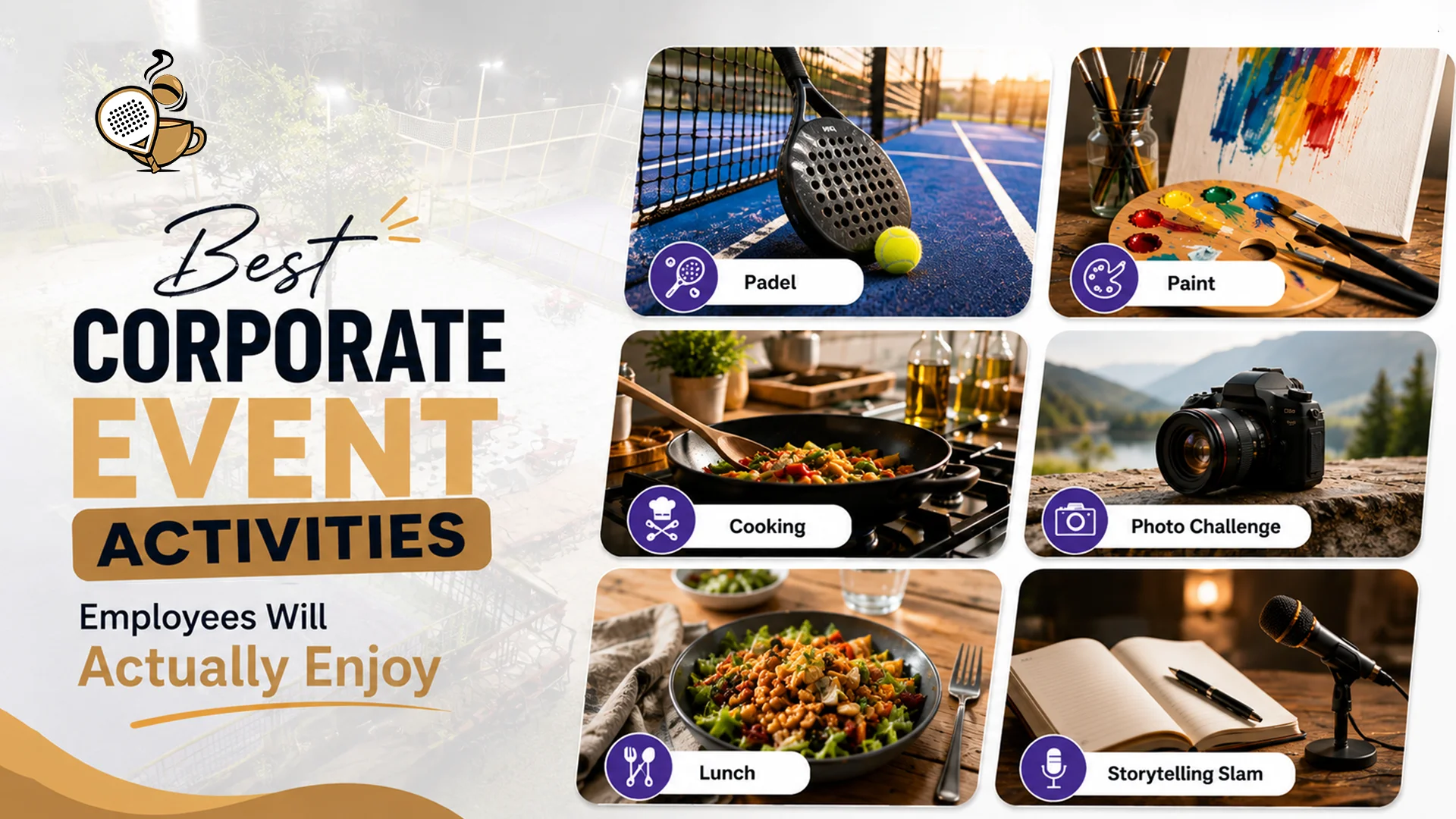
1. Padel
Best for: 8–40 people | Budget: Medium | Setting: Indoor court
Padel is the fastest-growing racket sport in the world for good reason: it is the only court sport where a complete beginner can rally comfortably within 20 minutes. The doubles-only format means teams of four compete together rather than against each other individually — conversation happens naturally, and the glass-wall format means spectators stay engaged even when not on court.
For corporate events, padel works because it removes the physical intimidation of tennis or squash. Nobody is “too unfit” for padel. The format rewards positioning and communication over raw athleticism — which means your quietest team member might turn out to be your best padel player.
At PadelCafe in Lahore, the courts are bookable for group corporate sessions. The on-site café solves the post-game social problem automatically — players move from the court to the table without anyone needing to organise a secondary venue.
Why it works: Shared vulnerability (everyone is new) + genuine interdependency (doubles partner) + spectator energy (glass walls keep non-players engaged)
2. Badminton Tournament
Best for: 12–50 people | Budget: Low–Medium | Setting: Indoor court
Badminton’s fast rallies and instinctive gameplay make it one of the most accessible racket sports for mixed-ability corporate groups. A round-robin tournament format means everyone plays multiple matches, nobody goes home after a single loss, and the energy stays high throughout. Mixing departments in the draw forces cross-team interaction that would not happen in a normal workday.
Why it works: Short matches keep energy high, mixed draws create new connections, round-robin means high participation time per person
3. Pickleball
Best for: 8–30 people | Budget: Low–Medium | Setting: Indoor or outdoor court
Pickleball’s compact court and slower ball make it the most beginner-friendly racket sport available — and one of the most social. Points are short, rallies are frequent, and the game rewards communication over athleticism. Mixed-doubles formats naturally pair different departments or seniority levels, creating organic cross-team interaction.
Why it works: No experience required, doubles format enforces collaboration, short games keep rotation fast and energy high
4. Basketball Shooting Competition
Best for: 10–40 people | Budget: Low | Setting: Indoor court
A structured shooting competition — three-point contest, free throw challenge, knockout — works for corporate groups because it separates skill from participation. Every employee, regardless of fitness level, can attempt a free throw. A bracket format adds stakes without pressure, and the informal atmosphere between attempts is where conversations actually happen.
Why it works: Zero-barrier entry, natural informal conversation during waits, bracket format creates shared investment in the outcome
5. Multi-Sport Olympics
Best for: 20–60 people | Budget: Medium | Setting: Multi-sport facility
Divide teams across four or five short sport challenges — padel, badminton, pickleball, basketball, and a relay — with points accumulating across the day. A multi-sport venue like PadelCafe in Lahore makes this logistically straightforward: all courts in one location, a café for breaks, and an events space for the opening briefing and prize ceremony.
The format ensures that no single employee’s physical skill dominates — the athlete who wins at basketball may lose at pickleball, and the quietest team member may shine at badminton. Different people lead at different stations. That rotation of visible competence is what teams remember.
Why it works: Rotating leadership across activities, prevents single-skill dominance, creates a full-day narrative arc with a clear climax (the prize ceremony)
Creative & Skill-Based Activities
6. Cooking or Baking Challenge
Best for: 8–24 people | Budget: Medium | Setting: Rented kitchen or open space
Divide teams into groups of four and assign each a dish or recipe under a time constraint. The appeal is broad — most people have some comfort in a kitchen, and those who don’t have a role (chopping, timing, presenting) regardless of their cooking skill. The shared meal at the end creates a natural, low-pressure social context.
Why it works: Shared vulnerability (nobody is a professional chef), physical collaboration in a confined space builds trust, the shared meal closes the loop
7. Escape Room
Best for: 6–20 people | Budget: Medium | Setting: Specialist venue or DIY setup*
A time-pressured puzzle environment where teams must decode clues and complete challenges to “escape” before the clock runs out. The format is effective precisely because it has no seniority advantage — the CEO and the graduate trainee have equal standing in front of a locked padlock. Escape rooms consistently surface surprising leadership: the employee who never speaks in meetings becomes the one who solves the room.
Why it works: Removes hierarchy, creates genuine interdependency (multiple puzzle streams), time pressure builds group focus
8. Trivia Night
Best for: 20–80 people | Budget: Low | Setting: Any large space*
Divide into teams of 6–8 with a deliberate mix of departments, seniority levels, and backgrounds. The key is designing the question mix: too much industry knowledge and it rewards senior employees; too much pop culture and it excludes older staff. A well-designed quiz has categories where different people shine — sports, film, history, science, Pakistan geography, company culture rounds.
Why it works: Low barrier, every category gives a different person their moment, team size creates enough internal debate to feel social
9. Paint and Create Session
Best for: 10–30 people | Budget: Low–Medium | Setting: Any large space or rented studio*
A guided painting or craft session where every employee produces something by the end of the session — regardless of artistic ability. The format works because the activity generates conversation naturally (people comment on each other’s work, offer help, laugh at their own results). The collective output — displayed together at the end — gives the group a tangible artifact of the day.
Why it works: Zero prior skill required, the visible imperfection of everyone’s work creates psychological safety, the shared output is a lasting reminder of the event
10. Clay Sculpting or Pottery
Best for: 8–20 people | Budget: Medium | Setting: Pottery studio or rented space*
Tactile, absorbing, and gently humbling — nobody looks dignified at a pottery wheel, which is precisely why pottery works as a team activity. The shared humour of struggling with the same material breaks down professional personas in a way few other activities achieve. Instructors guide the group so nobody is left behind, and the finished pieces become keepsakes from the day.
Why it works: Shared humiliation (benign) equalises the room, sensory engagement reduces status-consciousness, instructors remove the “what am I supposed to do” anxiety
11. Improv Comedy Workshop
Best for: 10–30 people | Budget: Medium | Setting: Any open space*
Facilitated improv games build active listening, rapid thinking, and the willingness to look briefly ridiculous in front of colleagues. The key is using a facilitator who builds from low-stakes warm-up games to slightly more challenging exercises — giving employees time to find their comfort level before the room raises stakes. Teams who do improv together develop a shorthand for collaboration that shows up in meetings afterward.
Why it works: Active listening is a skill that transfers, improv rules (say “yes, and”) are principles teams apply beyond the workshop, shared laughter is the fastest trust-builder
Competitive & Challenge-Based Activities
12. Company-Wide Hackathon
Best for: 20–100+ people | Budget: Low–High (depends on prizes) | Setting: Office or co-working space*
Teams pitch and prototype a solution to a real company challenge in a timed format — typically 4–8 hours. A panel of senior leaders judges and awards prizes, with the option to actually implement the winning idea. The Shark Tank-style format gives junior staff visibility they rarely access through normal channels.
A Gallup study found that only 30% of employees feel someone at work encourages their development (Gallup, 2026). A hackathon is one of the most direct interventions: it signals to employees that their ideas have value and that the company will act on them.
Why it works: Gives junior employees a route to senior visibility, real stakes (winning ideas might be implemented) create genuine investment, cross-departmental teams surface connections that silos hide
13. Scavenger Hunt (City or Venue)
Best for: 15–60 people | Budget: Low–Medium | Setting: City or single venue*
Teams follow a list of challenges, clues, or locations — competing against each other within a time limit. Lahore’s urban texture makes city-wide scavenger hunts genuinely interesting: Liberty Market, Walled City landmarks, and local cultural touchpoints can all become challenge locations. A venue-confined version works equally well if time or logistics are tight.
Why it works: Requires genuine collaboration (tasks need multiple people), urban exploration creates shared discovery, competition between teams without direct conflict
14. Volunteer Day
Best for: 10–50+ people | Budget: Low | Setting: Community location*
A structured day of contribution — cleaning a public space, building something for a community organisation, volunteering at a school — works as a team-building activity because it provides a shared purpose larger than the company. Gallup data consistently shows that employees who feel their work has purpose have higher engagement scores. A volunteer day makes that purpose tangible and physical.
Why it works: Shared purpose larger than work, physical labour creates natural camaraderie, visible community impact is something teams remember and reference later
15. Photo Challenge
Best for: 10–40 people | Budget: Very Low | Setting: Any*
Teams receive a list of photographic prompts — abstract challenges rather than specific subjects — and have a set time to capture them. The judging is done together at the end, which doubles as a social media content session and a window into how different people see the same brief. No photography skills required.
Why it works: Creative brief without a right answer equalises the room, the group viewing session generates genuine conversation, the output is immediately shareable
Wellness & Mindfulness Activities
16. Group Fitness Class
Best for: 10–40 people | Budget: Low | Setting: Open space or studio*
A facilitated class — yoga, HIIT, dance, stretching — works when it is framed as participation rather than performance. The key is choosing a format and instructor who explicitly signals that all levels are welcome. A common error is booking a class where employees feel judged for their fitness level — which produces the opposite of inclusion.
Why it works: Shared physical experience creates bonding, endorphin release improves mood for the rest of the event, non-competitive format keeps it inclusive
17. Mindfulness and Breathwork Session
Best for: 10–50 people | Budget: Low | Setting: Quiet space*
A 30–45 minute facilitated mindfulness or breathwork session is increasingly common in corporate events — and increasingly effective, partly because it is still unusual enough to feel like a genuine gift rather than an obligation. An experienced facilitator guides the group through a practice that employees can take into daily work life.
Why it works: Genuine skill transfer, signals that the company cares about mental health, the shared quiet of a group session creates unexpected intimacy
18. Wellness Pop-Up Station
Best for: 20–100 people | Budget: Medium | Setting: Large event space*
Set up multiple wellness stations — massage chairs, nutrition consultation, guided meditation pods, sleep quality assessment — that employees rotate through at their own pace. The self-directed format respects individual preferences while still creating shared experience. Best used as a component of a larger event rather than a standalone.
Why it works: Autonomy and self-direction increase participation quality, variety means each employee finds something relevant, the relaxed atmosphere encourages cross-department conversation
Learning & Development Activities
19. Lunch-and-Learn Sessions
Best for: 10–40 people | Budget: Very Low | Setting: Any space with A/V*
A 45–60 minute session where an internal expert or external speaker shares genuinely useful knowledge over a meal. The format works when the topic is chosen based on actual employee interest (surveyed in advance) rather than what leadership thinks employees should learn. Employees who feel their development is invested in are significantly more engaged — only 30% of employees globally feel that someone at work encourages their growth (Gallup, 2026).
Why it works: Concrete skill transfer, signals investment in individual development, the meal context reduces the formality that makes people tune out
20. Reverse Mentoring Session
Best for: 8–30 people | Budget: Very Low | Setting: Any space*
Junior employees teach senior staff — typically about technology, social platforms, or emerging trends — in a structured, facilitated format. The format inverts the usual power dynamic in a way that is immediately visible to the whole room. Senior leaders who participate openly signal that learning is a value at every level of the organisation.
Why it works: Validates junior employees’ knowledge, gives senior leaders a visible growth moment, the inverted dynamic creates conversations that would not otherwise happen
21. Innovation Sprint
Best for: 10–30 people | Budget: Low | Setting: Office or open space*
A tightly structured 2–3 hour session where cross-functional teams tackle a real problem — a product gap, a process inefficiency, a customer pain point — using a sprint methodology. Unlike a full hackathon, the innovation sprint is fast enough to fit inside a half-day event. The output is a set of pitched ideas, not a prototype.
Why it works: Real problems create real stakes, cross-functional teams surface perspectives that siloed thinking misses, the time constraint forces prioritisation rather than over-deliberation
Social & Cultural Activities
22. Cultural Food Tour
Best for: 10–30 people | Budget: Medium | Setting: City venues*
A guided exploration of local restaurants or food stalls — tasting 4–6 different cuisines or dishes across a neighbourhood walk. In Lahore, this format plays to the city’s food identity: the Old City, MM Alam Road, and Liberty Market all offer walking-distance variety that no other Pakistani city matches. Food is the most universally shared human experience, and a shared meal — or ten shared bites — generates conversation across every demographic.
Why it works: Universal participation (everyone eats), discovery creates shared reference points, the walking format enables conversations that sitting in a room does not
23. Storytelling Slam
Best for: 10–30 people | Budget: Very Low | Setting: Any space*
Employees share 3–5 minute stories on a shared theme — a mistake they made and what it taught them, a moment they were surprised by a colleague, a time they failed at something important. The vulnerability of the format is its power: when a senior leader goes first and shares a genuine failure story, the psychological safety of the room changes immediately.
Why it works: Shared vulnerability builds trust faster than any structured exercise, authentic stories create genuine connection, the format surfaces dimensions of colleagues that work contexts never reveal
24. Talent Show or Hidden Talents Evening
Best for: 20–80 people | Budget: Low | Setting: Large space with staging*
Not mandatory performance — voluntary showcasing. The format works when participation is genuinely optional and when the tone is celebratory rather than competitive. The revelation of a colleague’s unexpected talent (singing, stand-up, poetry, magic) fundamentally changes how that person is perceived at work. It humanises the professional persona.
Why it works: Humanises colleagues beyond their job roles, voluntary participation ensures authentic performances, collective surprise creates shared emotional memory
25. Corporate Games Day at a Multi-Sport Venue
Best for: 20–80 people | Budget: Medium–High | Setting: Multi-sport venue*
The most complete corporate event format on this list — and the one that requires the least planning from the organiser. Book a multi-sport venue, divide employees into cross-department teams, run a structured games day across multiple courts (padel, badminton, pickleball, basketball), and close with food and a brief prize ceremony.
What makes this format work is the narrative arc: teams form in the morning, compete across different sports through the day (finding out who is surprisingly good at what), and gather at the end with shared experiences to reference. A single-venue setup means no logistics headaches between activities.
At PadelCafe in Lahore, this format is exactly what the corporate events and gatherings programme is designed for: multiple courts across padel, badminton, pickleball, and basketball — alongside an on-site café for breaks — under one booking. For Lahore-based companies, this is the most turnkey corporate games day available.
Why it works: Multiple sports mean multiple people shine at different moments, the shared narrative of the day (who won what, who surprised everyone) becomes team lore, the venue solves logistics so the organiser can focus on people
What Employees Actually Hate — and What to Do Instead
No corporate event guide is complete without the honest flipside.
| What Flops | Why | Replace With |
|---|---|---|
| Mandatory karaoke | Forced performance in front of colleagues = anxiety, not fun | Talent show (voluntary) or trivia night |
| Trust falls | Outdated, awkward, no clear outcome | Escape room or cooking challenge |
| All-day passive presentations | Sitting still for 6 hours is not an event | Lunch-and-learn (45 min) or innovation sprint |
| Forced networking with name tags | Artificial conversation starters feel transactional | Cooking challenge or scavenger hunt (context creates conversation) |
| Team-building exercise with no purpose | If employees can’t see why they’re doing it, they disengage | Any activity with a visible, real-stakes output |
| Sports events that reward only athletes | Creates winners and losers based on pre-existing skill | Padel, pickleball, or multi-sport olympics (beginner-welcome formats) |
How to Choose the Right Activity for Your Team
Use this decision framework before booking:
| Team Profile | Best Activities |
|---|---|
| Large team (50+), mixed departments | Multi-Sport Games Day, Trivia Night, Scavenger Hunt |
| Small team (under 15), tight-knit | Cooking Challenge, Escape Room, Storytelling Slam |
| Remote team coming together in person | Physical sport (padel, badminton), Volunteer Day, Lunch-and-Learn |
| Leadership team only | Innovation Sprint, Reverse Mentoring, Mindfulness Session |
| Mixed seniority levels | Improv Workshop, Photo Challenge, Multi-Sport Olympics |
| Team after a tough quarter | Wellness Pop-Up, Group Fitness Class, Cultural Food Tour |
What Changed About Corporate Events in 2025–2026?
Three shifts define the current moment:
- Micro events replaced mega offsites. According to Samaaro (June 2026), the most effective corporate engagement format in 2026 is small, focused gatherings of 10–20 people — innovation sprints, lunch-and-learns, wellness pop-ups — rather than large annual events. Frequency beats scale.
- In-person preference surged. 82% of attendees prefer in-person events in 2026, up from 68% in 2023. The pandemic-era expectation that virtual could replace physical has been definitively reversed.
- Activities replaced passive programming. The platinumpianist.com analysis of 2026 corporate events found that strategic event investment yields 3–5× higher engagement ROI when built around participation rather than presentation. Employees want to do something, not watch something.
The Right Activity is the One Your Team Actually Shows Up For
Corporate events are not about the activity. They are about what the activity produces: a shared experience, a new connection, a memory that changes how colleagues see each other on Monday morning.
The 25 activities on this list work because they are designed around people, not agendas. Start with your team’s profile — size, energy level, where they are in the year — and match the format to the outcome you need.
For Lahore teams wanting a full-day corporate sports and social experience, PadelCafe’s corporate events offer multi-sport courts, on-site catering, and flexible booking. Book directly or explore individual sports — padel, badminton, pickleball, and basketball — all available for group sessions.
Frequently Asked Questions
What are the best corporate event activities for large groups?
For groups over 40 people, the most effective formats are multi-sport games days (which scale to 80+ participants across multiple courts), trivia nights (scalable to any room size with the right AV setup), and scavenger hunts (which naturally break large groups into competing teams). The key for large groups is ensuring that participation time per person is high — activities where most people watch a few people perform fail at scale.
How do you choose a corporate event activity everyone will enjoy?
Three criteria help: the activity should have a low skill barrier so nobody feels excluded; it should have a format that creates genuine interdependency (collaboration matters to the outcome); and it should generate informal conversation naturally rather than requiring forced interaction. Activities that score well on all three — padel, trivia, cooking challenges, escape rooms — consistently get high post-event ratings regardless of the team’s demographics.
What corporate activities are best for team building?
Activities that create shared vulnerability and equal playing fields build teams fastest. Escape rooms (hierarchy disappears in front of a locked padlock), cooking challenges (nobody is a professional chef), and sport-based activities framed for beginners (padel, pickleball) consistently outperform passive activities in team-building outcome measures. Research by Gallup shows that team-building events lift engagement by 30% when designed around participation rather than observation.
How long should a corporate event activity last?
Most effective corporate activities run 45 minutes to 2 hours per activity. Full-day formats (multi-sport games days, hackathons) work when the activity has natural breaks and multiple phases to sustain energy. The mistake is running a single activity for too long — most group dynamics peak at 60–90 minutes before energy starts to drop. For a half-day event, 2–3 shorter activities outperform one long one.
Are sport-based corporate activities suitable for non-athletic employees?
Yes — when the format is right. Padel, pickleball, and badminton are explicitly beginner-welcome sports where communication and positioning matter more than fitness. The key is framing: position sport-based activities as social experiences with light competition, not performance tests. Multi-sport formats (where employees cycle through several courts) are even more inclusive, as different people shine at different activities.
Where can corporate teams in Lahore book a full-day event venue?
PadelCafe in DHA Lahore offers a complete corporate event setup: padel, badminton, pickleball, and basketball courts alongside a café and events space, all under a single booking. The events and gatherings programme handles group sessions for corporate clients. Contact the PadelCafe events team to book a customised corporate games day.

0 Comments