TL;DR
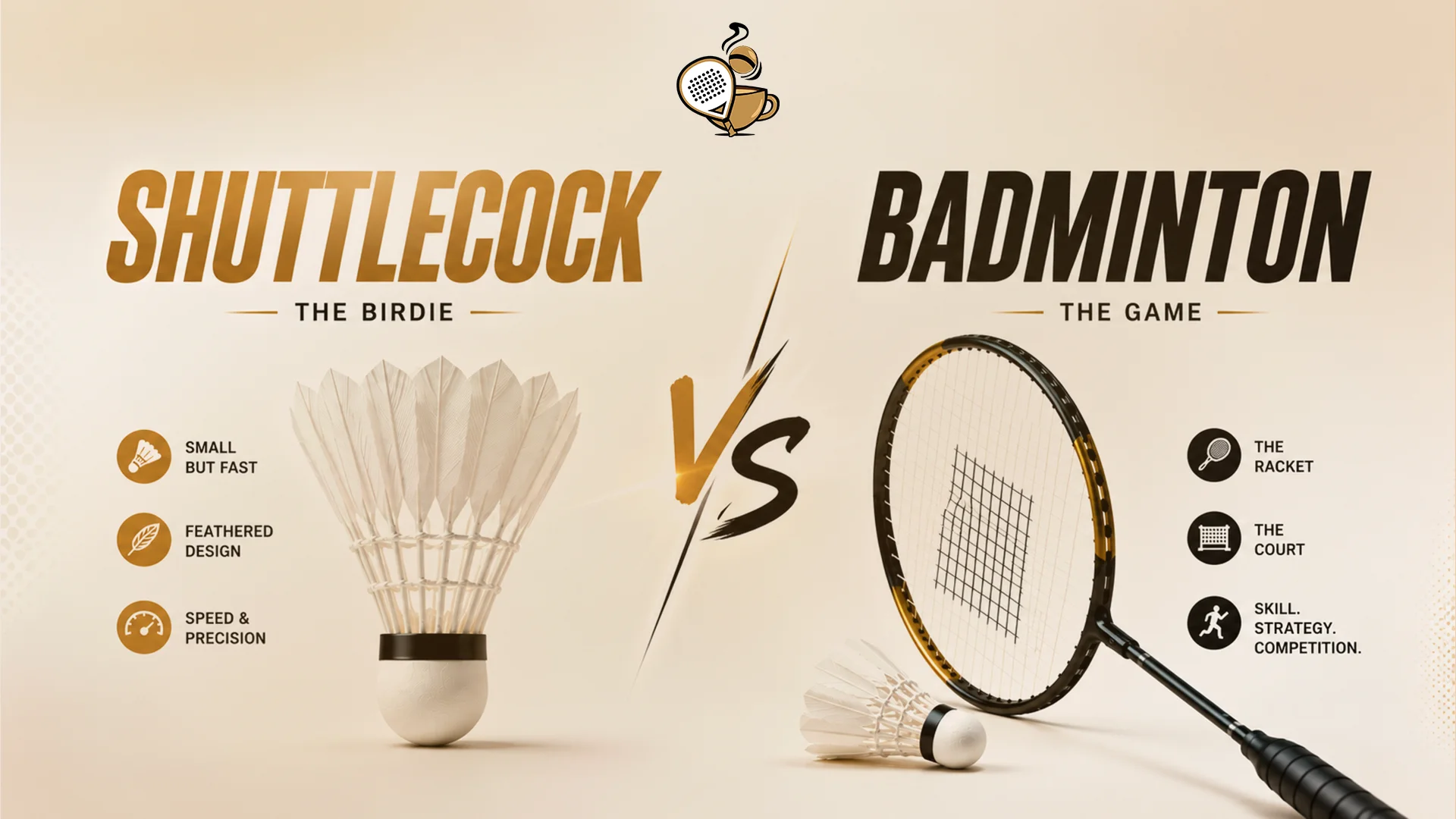
- Badminton and shuttle are not the same thing. Badminton is the formal racket sport; a shuttle (shuttlecock) is the projectile used to play it. The terms are often used interchangeably but refer to different concepts.
- The shuttlecock has a 2,000-year history. Games involving shuttlecocks existed in ancient Greece, China, India, and Japan long before badminton was formalized in 19th-century England.
- Badminton court size varies by format. Singles courts are 44ft long × 17ft wide; doubles courts are 44ft × 20ft wide. The net height is 5 ft at the center and 5 ft 1 in at the posts.
- Feather vs. plastic shuttlecocks differ in flight. Feather shuttles are used in all professional tournaments, fly faster off the racket, and offer better control. Plastics are more durable and preferred for casual/recreational play.
- Badminton is the world’s fastest racket sport. A shuttlecock can travel over 200 mph (320 km/h) off a professional player’s racket, faster than a tennis serve.
You have probably heard people say, “Let’s go play shuttle,” or “I bought a new badminton racket.” But have you ever stopped to wonder: is badminton and shuttle the same thing?
The short answer is no. Yet the confusion is understandable. The words are often used interchangeably in casual conversation, and they are deeply connected. One is a sport. The other is the object you hit. And there is also a traditional game called “shuttle” that predates modern badminton by centuries.
This blog breaks down the difference between shuttle and badminton once and for all. We will cover the origins, equipment, court dimensions, rules, and the ongoing debate over badminton shuttlecock feather vs plastic. By the end, you will know exactly what each term means and why it matters for your game.
What Is Badminton?
Badminton is a formal racket sport played by two opposing players (singles) or two pairs (doubles) who use rackets to hit a shuttlecock over a net. The objective is to land the shuttlecock in the opponent’s half of the court and score points.
The sport originated in British India during the 1860s, where British army officers played a game called “poona.” It was later brought to England and formalized at Badminton House, the estate of the Duke of Beaufort, in 1873, which is where the sport gets its name.
Badminton became an Olympic sport in 1992 and is now governed globally by the Badminton World Federation (BWF). Professional matches are played indoors to eliminate wind interference, and the sport demands exceptional agility, speed, and precision.
What Is a Shuttlecock (Shuttle)?
A shuttlecock, often shortened to shuttle, is the feathered or plastic projectile used in badminton. It has a unique open conical shape: a rounded cork or rubber base covered with leather, with feathers or a plastic skirt forming the cone.
Why Is It Called a Shuttlecock?
The name has two parts:
- “Shuttle” refers to the back-and-forth motion of the object during play, resembling a weaver’s shuttle moving across a loom.
- “Cock” comes from the resemblance of the feathers to those on a cockerel.
Aerodynamics of the Shuttlecock
The shuttlecock’s design makes it aerodynamically stable. No matter how you hit it, it will always turn to fly cork-first. This unique high-drag design means the shuttle slows down rapidly after being hit, unlike a ball, which maintains speed. This drag is what makes badminton so strategic: players must use placement and deception, not just power.
Other Names
In casual conversation, you might hear players call a shuttlecock:
- A “bird” or “birdie” (common in North America)
- A “shuttle” (used globally)
Shuttlecock vs Badminton: Key Differences
Although the terms are often used interchangeably, they represent different things. Understanding the difference between shuttle and badminton is important for correct terminology and appreciating the sport’s history.
Feature | Badminton | Shuttle (Shuttlecock) |
Definition | A formal racket sport with standardized rules and scoring | The feathered or plastic projectile used in badminton; also, a traditional game |
Role | The sport itself | The equipment used to play the sport |
History | Formalized in 19th-century England; Olympic sport since 1992 | Ancient origins dating back 2,000+ years in Asia |
Equipment | Rackets, net, court, and shuttlecock | Primarily the shuttlecock itself |
Scoring | Formal system (21 points, best of 3 games) | No formal scoring (traditional shuttle game) |
Court | Rectangular court with a net (44ft × 17ft/20ft) | No specific court required (traditional form) |
Badminton Shuttlecock: Feather vs Plastic
One of the most common questions players ask is whether to choose feather or plastic shuttlecocks. The choice depends on your level, budget, and playing environment.
Feather Shuttlecocks
Construction: Made from 16 overlapping goose or duck feathers (always from the left wing) embedded into a cork base and covered with leather.
Flight Characteristics: Feather shuttles fly faster off the racket but slow down more quickly towards the end of their flight. They drop nearly straight down on clears, offering predictable trajectory.
Durability: Feathers are brittle and break easily, requiring frequent replacement—often several times per game.
Usage: All professional tournaments and serious leagues use feather shuttlecocks. Experienced players prefer them for better control and feel. In Asia, where feathers are more affordable, plastic is rarely used.
Plastic (Nylon/Synthetic) Shuttlecocks
Construction: Made with a plastic skirt attached to a foam or cork base. They are often called “plastics” or “nylons”.
Flight Characteristics: Plastics fly slower on initial impact but do not slow down as much towards the end. They tend to drop on a diagonal rather than straight down, making them less predictable at the end of a rally.
Durability: Plastics are far more durable—they can last many matches without any impairment to flight.
Usage: Preferred in school gyms, amateur clubs, and recreational play in Europe and North America. They are more cost-effective for beginners and casual players.
Quick Comparison Table: Feather vs. Plastic
Feature | Feather Shuttlecocks | Plastic Shuttlecocks |
Material | 16 goose/duck feathers + cork base | Plastic skirt + foam/cork base |
Flight | Fast off racket, slows down, drops straight | Slower initially, less deceleration, drops diagonally |
Control | Superior, preferred by experienced players | Good, but less precise |
Durability | Low, breaks easily | High, lasts many matches |
Cost | Higher (in Europe/North America) | Lower (more affordable) |
Usage | Professional tournaments, serious play | Recreational, school gyms, beginners |
Badminton Court Size and Dimensions
A regulation badminton court is rectangular. The badminton court size differs slightly between singles and doubles formats.
Singles Court Dimensions
Measurement | Feet | Meters |
Length | 44 ft | 13.41 m |
Width | 17 ft | 5.18 m |
Doubles Court Dimensions
Measurement | Feet | Meters |
Length | 44 ft | 13.41 m |
Width | 20 ft | 6.10 m |
Net Height
- At the posts: 5 ft 1 in (1.55 m)
- At the center: 5 ft (1.524 m)
Other Key Lines
- Short service line: 6.5 ft (1.98 m) from the net
- Doubles service line: 2.5 ft (0.76 m) from the baseline
- Centerline: Divides the left and right service courts
Rules of Badminton
Here are the 6 main rules of badminton that every player should know:
1. Scoring System
- A match is played to the best of 3 games.
- Each game is played to 21 points.
- You must win by a 2-point advantage. If the score reaches 29–29, the player who scores the 30th point wins.
2. The Serve
- The shuttle must be hit below the server’s waist.
- The server and receiver must stand diagonally opposite each other.
- The shuttle must land in the receiver’s service court and cross the short service line.
3. Faults
A fault is called if:
- The shuttle falls outside the court boundaries.
- The shuttle hits the net and does not go over.
- A player touches the net during play.
- The shuttle is hit before it crosses the net.
- The shuttle is hit twice in succession by the same player or their partner.
4. Singles vs. Doubles Rules
- In singles, the court is narrower (17ft wide).
- In doubles, the court is wider (20ft wide), and the service court is shorter and wider.
- In doubles, both partners get a turn to serve, and the serving team continues serving while scoring points.
5. Let Situations
A “let” is a replay. It is called if:
- The shuttle gets caught in or on the net.
- The server serves before the receiver is ready.
- An unforeseen accident interrupts play.
6. Changing Ends
Players change ends of the court:
- After each game.
- In the third game when one player reaches 11 points.
Conclusion
So, is badminton and shuttle the same? No.
Badminton is a formal racket sport with rules, a court, and scoring. The shuttlecock (or shuttle) is the object hit during the game. Also, it refers to a traditional, non-competitive game that has existed for thousands of years.
Understanding these distinctions helps you appreciate the sport’s depth: from the ancient origins of the shuttlecock to the modern athleticism of Olympic badminton. Whether you choose feather shuttlecocks for competitive play or plastic for a casual weekend session, knowing the difference ensures you pick the right gear for your game.
Ready to Play?
Whether you are learning the rules or perfecting your smash, the right environment makes all the difference.
Visit Padel Cafe in DHA Phase 6, Lahore for quality badminton courts, expert coaching, and a welcoming community for players of all levels.
Frequently Asked Questions
Is badminton and shuttle the same thing?
No. Badminton is the formal racket sport. The shuttle (shuttlecock) is the projectile used to play it. In casual conversation, “shuttle” can also refer to a traditional, non-competitive game involving hitting a shuttlecock.
What is the difference between shuttle and badminton?
The difference between shuttle and badminton is that badminton is a sport with standardized rules, courts, and scoring, while a shuttle is equipment used in the sport. Additionally, “shuttle” can refer to a centuries-old traditional game without formal scoring or courts.
What is the difference between feather and plastic shuttlecocks?
The badminton shuttlecock feather vs plastic debate comes down to flight, durability, and usage. Feather shuttles fly faster, slow down more rapidly, and offer better control, used in all professional tournaments. Plastics are more durable and affordable, ideal for recreational players.
What is the official badminton court size?
The badminton court size is 44ft long for both singles and doubles. The width is 17ft for singles and 20ft for doubles. The net is 5ft 1in at the posts and 5ft at the center.
What are the 6 main rules of badminton?
The 6 main rules of badminton include: (1) best of 3 games to 21 points, win by 2; (2) serve below the waist, diagonally; (3) faults include shuttle out, net contact, or hitting twice; (4) singles/doubles have different court widths; (5) “let” situations call for replays; (6) players change ends after each game.
Why is it called a shuttlecock?
The name combines “shuttle” (from the back-and-forth motion, like a weaver’s shuttle) and “cock” (from the feathers’ resemblance to those on a cockerel). It is often shortened to just “shuttle”.
Which shuttlecock should I use as a beginner?
Beginners should start with plastic (nylon) shuttlecocks. They are more durable, cost-effective, and perfectly suited for recreational play and regular practice. As you develop your skills, you can switch to feather shuttlecocks for better control and feel.


0 Comments