
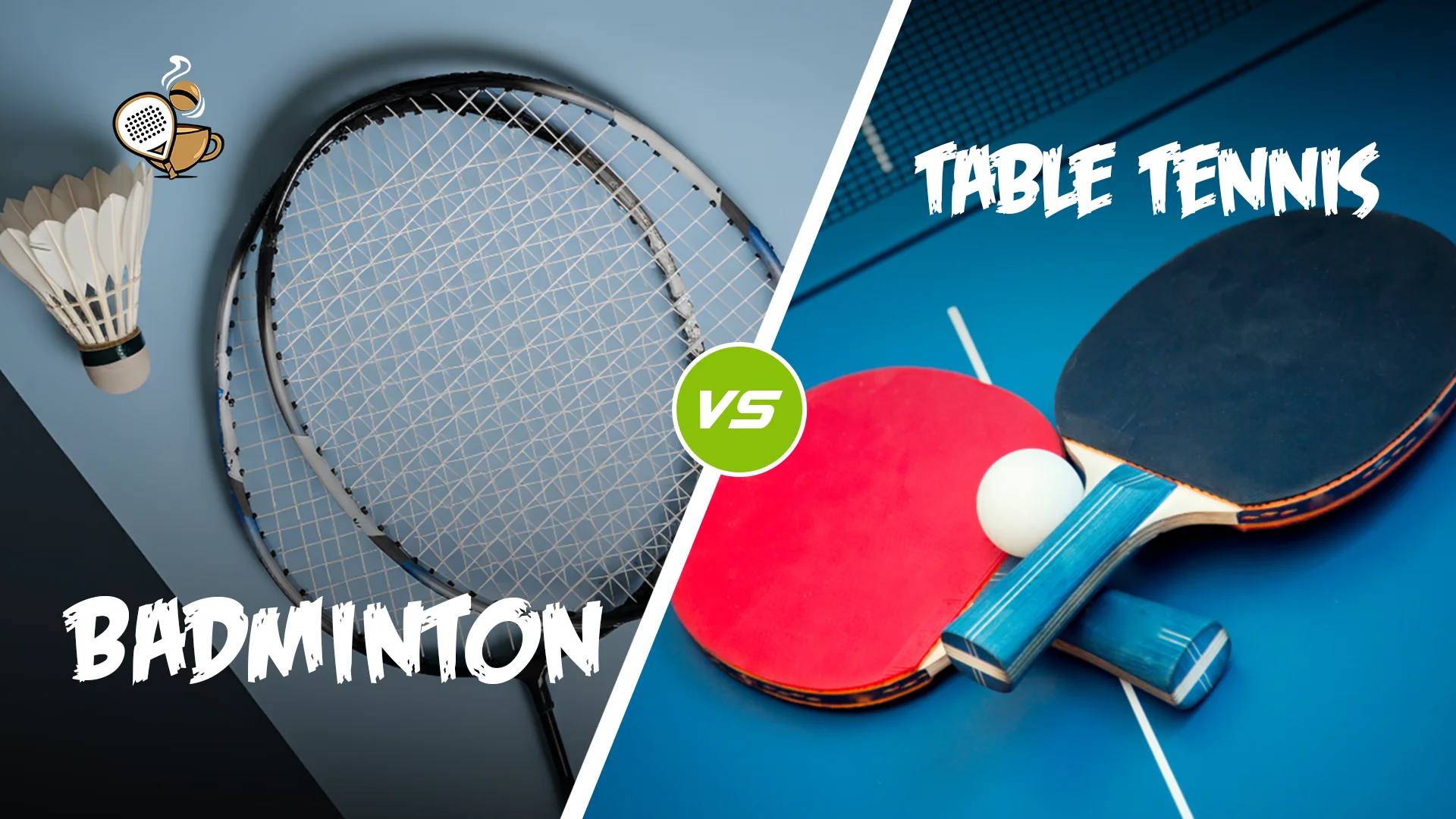
Imagine two friends deciding what to play for fun — one picks up a shuttlecock, the other a ping‑pong ball. Both games get your heart racing, but in very different ways.
Yes, we are talking about two racket sports: badminton and table tennis, respectively. Both are racket-based games but with varying energies and excitement. And choosing between the two is no easy job.
One is fast, powerful, and full court. The other is sharp, strategic, and lightning-quick over a small table. So, which one should you choose to play?
Confused? Well, we’ve got you covered. This writing piece offers a walk-through on the key differences between badminton and table tennis. Dive in to see which game best suits you!
Badminton vs Table Tennis: Detailed Comparison
Here’s a deeper dive into a comparison between badminton and table tennis:
1. Popularity and Accessibility
Undoubtedly, every sport celebrates a certain level of popularity worldwide. The difference comes in the percentage of that popularity.
Badminton: This sport holds the honor of being one of the most popular sports worldwide, thanks to a large base of roughly 220 million players. The game is widely played across Asia and other regions. Badminton courts are often indoors, making them accessible regardless of weather or season.
Below are the main international competitions that reflect badminton’s global reach:
International Badminton Competitions
- BWF World Championships – Premier global event crowning world champions annually.
- Thomas Cup – The Men’s World Team Championship, held every two years.
- Uber Cup – Women’s World Team Championships, biennial.
- Olympic Games (Badminton) – Featured since 1992 with singles and doubles categories.
Table Tennis: On the other hand, table tennis boasts an even broader reach, with 350 million people playing it globally, as per a study by PMC. Its low equipment requirements, small space needs, and adaptability make it ideal for virtually any age, fitness level, or background.
Below are the main international competitions that reflect the global reach of table tennis:
International Table Tennis Competitions
- World Table Tennis Championships – Flagship global event for singles, doubles, and teams.
- Olympic Games (Table Tennis) – Highly competitive event with singles, doubles, and team categories.
- World Cup (Men’s & Women’s) – Major annual event featuring top-ranked players.
- ITTF World Team Championships – Global championship for national teams.
2. Court Size and Layout
Both racket sports feature a sharp contrast in the space required to play.
Badminton Court
The dimensions are as mentioned by the Badminton World Federation.
- A standard badminton court (for doubles) measures 13.4 meters long × 6.1 meters wide.
- For singles play, the width is narrower: 13.4 m × 5.18 m.
- Net height at the center is 1.524 m (≈ 5 ft), and at the posts around 1.55 m.
- For a safe and comfortable setup — especially indoors — a buffer zone (clearance area) around the court is recommended to allow full movement, footing, and reduce collision risk.
Table Tennis Court
In contrast, the table tennis surface is much less as it’s designed for close-range, fast-reaction play rather than large-distance movement. The following dimensions are per ITTF.
- A standard table tennis table (playing surface) measures 2.74 m long × 1.525 m wide, with a height of about 76 cm above the floor.
- The net across the table is about 15.25 cm high.
- For proper play, you need extra clearance around the table so players can move, step back, and swing paddles. For casual recreation, modest space suffices; for competitive or comfortable play, a playing area of roughly 14 m × 7 m is standard.
This difference shapes everything: rallies in badminton rely on footwork, jump smashes, and full-body movement, while table tennis rewards quick reflexes, micro-adjustments, and precise timing at close distance.
3. Equipment
Being different games, the equipment needed for both badminton and table tennis also differs.
Badminton Gear
- A badminton racket is lightweight (typically 70–100 g) and designed for aerodynamic swings.
- The shuttlecock, made of feathers or nylon.
Table Tennis Equipment
- A table tennis racket — often called a paddle or bat — is smaller, solid, and allows players to generate extreme spin.
- The celluloid or plastic ball measures about 40 mm.
4. Physical Demands & Fitness
Every sport is a physical activity that includes several movements and a focus. The difference lies in the percentage of energy burned and the type of movement required.
Energy Burn
- Badminton burns more calories because of constant movement, lunges, and jumps — usually 300–450 per hour, reaching 500–600+ in competitive and intense play. However, the numbers vary based on the game’s intensity.
- Table tennis burns 200–300 calories per hour, with fast but limited movement near the table.
Agility & Coordination
- Badminton strengthens the whole body, improves stamina, flexibility, and overall cardiovascular fitness.
- Table tennis boosts reflexes, hand-eye coordination, balance, and cognitive skills.
Joint Impact
- Badminton’s explosive movements can stress knees and ankles during intense sessions.
- Table tennis is lower-impact and gentler on joints.
5. Mental & Social Benefits
Mental Sharpness
- Badminton sharpens strategy, anticipation, and concentration.
- Table tennis demands quick decisions and spin reading, improving focus and mental agility.
Social & Accessibility
- Badminton is equally social and active, offering a fun group workout and strong fitness benefits.
- Table tennis is highly accessible — low cost, small space, and easy indoor setup.
Final Strike
Choosing between badminton and table tennis is like picking between two totally different kinds of excitement. With millions of players enjoying both sports worldwide, each comes with a different set of excitement, energy, and fun.
The choice you make depends largely on your passion and interest in a particular game. Whether you love explosive movement or fast-thinking rallies, this comparison will help you see which game truly matches your energy, goals, and playing style.
Frequently Asked Questions
Is table tennis good for people of all ages?
Yes. Table tennis has low impact, boosts coordination, balance, and reflexes — making it suitable for children, adults, and seniors alike.
Which sport is better for mental sharpness and reflexes?
Table tennis has an edge. The fast, unpredictable ball requires quick thinking, sharp reflexes, and good hand–eye coordination — excellent for mental agility.
Which sport is faster, table tennis or badminton?
Badminton is the fastest racket sport in the world! Shuttlecocks can travel at speeds of over 400 km/h in professional play—faster than tennis, squash, or table tennis.


0 Comments