
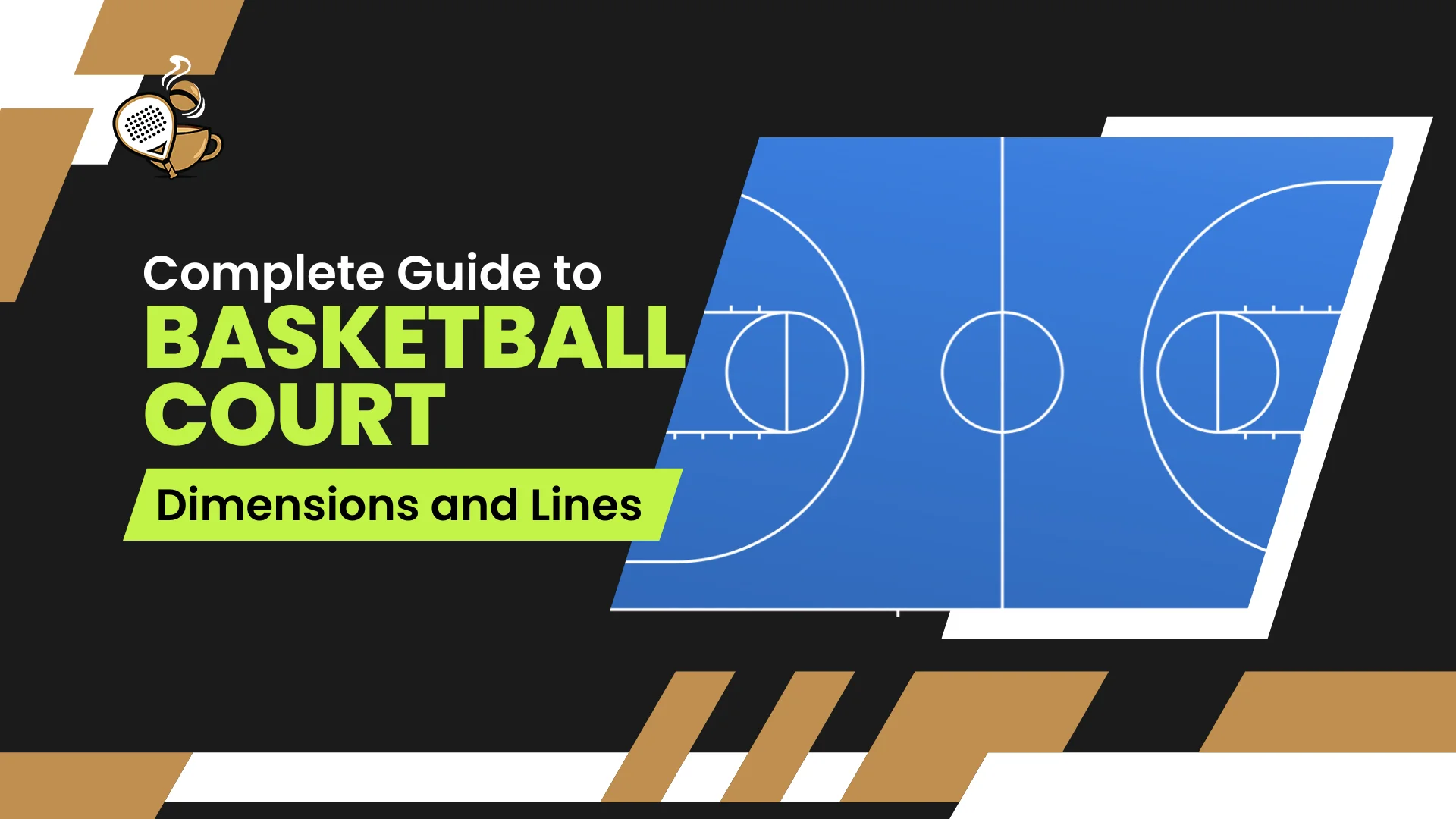
Mastering basketball court dimensions and markings is essential for fair play, strategy, and improving performance in every game.
Basketball is one of the most played sports in the world. According to the latest FIBA stats, more than 610 million people between the ages of six and 54 years play basketball at least twice a month around the globe.
But while most people focus on shooting, passing, and scoring, very few truly understand the court itself. Every line, marking, and measurement on a basketball court exists for a specific reason. These details shape the flow of the game, influence strategies, and ensure fairness for every player.
Curious to learn more about these court dimensions and markings? This complete guide breaks down the details of a basketball court that will help you visualize, understand, and apply your strategies on the court.
Understanding Basketball Court Dimensions
To play any court game strategically, understanding the court is just as necessary as is the learning of the game’s rules. So, before exploring lines and markings, it is important to understand the overall basketball court size.
Basketball court dimensions vary slightly depending on the level of play, but the basic layout stays almost the same worldwide.
Standard Basketball Court Overview
A standard professional basketball court is rectangular, providing equal playing space for both teams. This design ensures balance throughout the game. It also allows for a smooth movement, fast breaks, defensive setups, and optimal shooting opportunities.
Standard Basketball Court Size
- FIBA (International) Courts: 28 meters long and 15 meters wide (approximately 91.9 feet × 49.2 feet).
- NBA Courts: Slightly larger, measuring 94 feet long and 50 feet wide, providing extra space for professional play.
Why the difference?
The difference in court dimensions exists because different organizations have slightly different rules and standards:
- FIBA (International Basketball Federation) sets court sizes for international competitions, focusing on standardization across countries.
- NBA (National Basketball Association) uses slightly larger courts to allow more space for professional-level gameplay, including faster breaks, bigger plays, and more room for taller players.
The extra space in NBA courts enhances player mobility, strategy, and scoring opportunities, making the game more dynamic for professional-level athletes.
Despite these small differences, the purpose remains the same. Even the basic court size allows enough room for player running, ball handling, defensive positioning, and fast-paced gameplay without overcrowding.
1. Main Playing Lines
Every basketball court has several lines drawn across the surface, similar to a basic padel court. Each line defines player moves, scoring rules, and game structure. Understanding these lines makes it easier to follow the game and apply the rules correctly.
Center Line and Center Circle
The center line divides the court into two equal halves. This ensures fairness by giving both teams identical playing spaces.
At the center of this line lies the center circle. It has a radius of 1.8 meters in international games. It is this place where the jump ball at the start of the game takes place, setting the tone for a fair competition.
2. Sidelines and Baselines
Sidelines run along the length of the court, while baselines run along the width. Together, they create court boundaries.
Any ball that touches or crosses these lines is considered out of play. These lines keep the game controlled and organized, ensuring smooth restarts through throw-ins.
They also help referees judge plays accurately, especially during fast-paced movements near the edges of the court.
3. The Key Area: The Paint
The rectangular area near each basket is called the key or the paint. This zone plays a crucial role in scoring, defense, and fouls.
Dimensions of the Key
In international basketball, the key is 4.9 meters wide. It stretches from the baseline toward the center of the court.
This area limits how long offensive players can stay inside, preventing unfair scoring advantages. Defensive individuals also use this space for shot blocking and rebounding.
4. Free-Throw Line and Free-Throw Circle
The free-throw line is located at the top of the key. The best basketball players stand here to attempt the throws after certain fouls.
The free-throw circle has a radius of 1.8 meters and ensures correct player positioning during shots. These markings maintain order and prevent distractions during scoring opportunities.
5. The Three-Point Line Explained
The three-point line is one of the most exciting elements of basketball. Shots made from beyond this arc earn three points instead of two.
Distance of the Three-Point Line
- In FIBA courts, the three-point line is set 6.75 meters from the center of the basket.
- In the NBA, it extends to 7.24 meters.
This distance challenges shooters and adds strategy to the team’s offensive play. However, even then, the players must balance accuracy, positioning, and timing to score from a long range.
6. No-Charge Semi-Circle
This small arc is present directly beneath the basket. The purpose: to protect attacking players who drive toward the hoop.
If a defender stands inside this semi-circle, charging fouls are usually not called. This rule encourages aggressive drives and exciting finishes while maintaining player safety.
7. Backboard and Basket Placement
The basket and backboard sit directly above the baseline and are central to scoring.
Basket Height and Size
The hoop is mounted 3.05 meters above the floor, which equals exactly 10 feet. This height has remained unchanged for decades, preserving the game’s fair play across generations.
The rim diameter is 45 centimeters, allowing the ball to pass smoothly while still demanding precision.
8. Restricted Area and Its Purpose
The restricted area is marked inside the key. This area prevents defenders from camping under the basket (in the paint).
It improves player safety by reducing collisions and encourages more dynamic movement around the hoop. This simple marking plays a huge role in improving game flow.
9. Coaches’ Box and Team Benches
Along the sidelines, there are designated areas marked for team benches and coaching staff. These zones keep teams organized and prevent crowding near the playing area. They also allow effective management of substitutions, timeouts, and team conduct.
High School and College Court Dimensions
Not all basketball courts follow professional standards. The designated game space in schools and colleges uses slightly smaller courts to suit younger players.
High school courts usually measure 84 feet long and 50 feet wide. College courts follow similar dimensions, allowing smooth player development before transitioning to professional-level courts.
Summing Up
Basketball court dimensions may look simple, but they shape every moment of the entire game. Every move throughout the game is dependent on accurate spacing and clear markings – from quick passes to powerful dunks.
Correct court measurements improve fairness, enhance performance, and create better playing experiences for everyone. When players, coaches, and builders understand these dimensions, the game becomes smoother, safer, and more enjoyable.
Frequently Asked Questions
What are the dimensions of a basketball court?
Basketball courts come in many different sizes. In the National Basketball Association (NBA), the court is 94 by 50 feet (28.7 by 15.2 m). Under International Basketball Federation (FIBA) rules, the court is slightly smaller, measuring 28 by 15 meters (91.9 by 49.2 ft). In amateur basketball, court sizes vary widely.
How far is the 3-point line?
- According to the NBA, the 3-point line is about 23’9” at the top, 22′ in the corners.
- NCAA: 22’1.75”
- High School Courts: 19’9”
- FIBA: 6.75 meters (22.15 feet)
Why is it called a 3-point line?
As the name suggests, the 3-point line is used to measure a certain distance. If a player, especially a skilled basketball player, happens to score a three-point shot while outside of the arc, they’re awarded three points in their score instead of the regular two-point shots and one-point free throws during the game.


0 Comments