
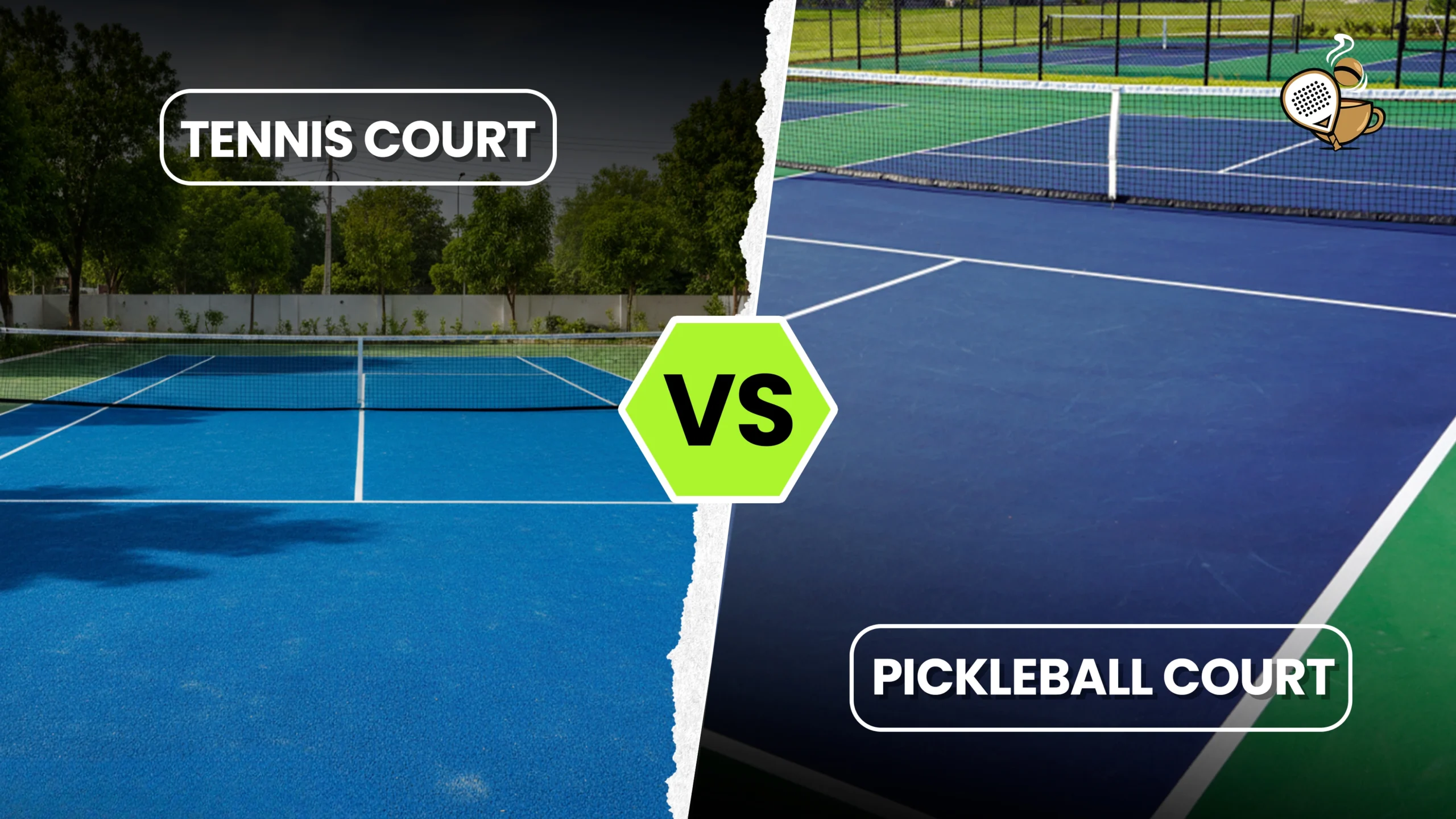
Among all others, racket sports hold a special place in the hearts of sports enthusiasts. So, in the world of such sports in 2026, Pickleball and tennis are two of the fastest-growing racket sports worldwide.
The surging popularity of both games shows that players are aware of the differences in the two court types. However, many others still lack this knowledge. For them, these are simple court games that are played for fun and social engagement.
Speaking of the courts, at first glance, pickleball and tennis courts might look like just rectangles painted on the ground. However, beneath these lines lies a world of functional differences — from court size to game tempo, strategy, accessibility, and even space planning.
This comparison guide breaks down these differences in simple, engaging language to help you understand which court suits your needs best in 2026.
Major Differences Between Tennis Courts and Pickleball Courts
| Feature | Tennis Court | Pickleball Court |
| Length | 78 ft | 44 ft |
| Width | 36 ft (doubles), 27 ft (singles) | 20 ft |
| Total Area | 2,808 sq ft (doubles) | 880 sq ft |
| Net Height (Center) | 34 in | 34 in |
| Net Height (Posts) | 36 in | 36 in |
| Non-Volley Zone (“Kitchen”) | No | Yes (7 ft) |
| Singles vs Doubles | Different court widths | Same court size |
| Typical Surface Options | Hard, clay, grass, synthetic | Mostly hard or multipurpose |
| Play Style Impact | Longer rallies, greater court coverage | Faster reactions, compact play |
1. Court Size
Let’s start with the most visible difference — the size of the playing surface.
- Tennis courts are much larger, measuring 78 feet long and 36 feet wide for doubles play (27 feet for singles).
- In contrast, pickleball courts are 44 feet long and 20 feet wide.
Why does it matter?
This size difference has a big impact on how each game feels. Tennis players must cover more ground, chase deep baseline shots, and transition between defensive and offensive positions across a larger surface. The sport demands endurance, speed, and consistent court movement.
Pickleball courts, being roughly one-third the size of tennis courts, keep players closer together, creating faster reaction points and shorter, tighter rallies.
Because of its smaller footprint and reduced running demands, pickleball is often more accessible to beginners and players seeking lower-impact play, while tennis typically requires greater stamina and mobility.
2. Net and Line Markings
While both sports have nets dividing the court, the net heights differ slightly.
- Tennis nets are usually 36 inches at the center and 34 inches at the posts.
- Pickleball nets also stand at 36 inches in the posts and 34 inches in the center.
Moving on, the court markings differ as well. These markings aren’t just lines — they define how players move, where rallies begin, and what tactics will succeed. The lines on the courts tell different strategic stories:
- Tennis courts include doubles alleys, extending the width for team play.
- Pickleball courts have a 7-foot non-volley zone just behind the net, commonly referred to as the kitchen.*
*Kitchen: Players may not volley (hit the ball out of the air) while standing inside this zone. This rule is unique to pickleball and encourages controlled placement shots, soft dinks, and strategic net positioning.
3. Playstyle and Strategy
The court dimensions influence not just movement but entire play styles.
Playstyle
- On a tennis court, players frequently use deep groundstrokes, powerful serves, and wide angles. In this way, they move their opponents across the full 78-foot length. Baseline rallies and long exchanges are common.
- Pickleball’s smaller court promotes quicker reflexes and controlled placement. Players often transition to the net early and rely on precision rather than raw power.
Strategy
- For tennis players, covering distance and using power are key.
- In pickleball, strategy revolves around kitchen control, soft drinks, quick reactions, and anticipating short exchanges near the net.
4. Accessibility and Space Efficiency
Space requirements happen to be one of the most practical differences between these courts.
- Tennis courts require significantly more land, materials, and maintenance of space. As a result, construction and upkeep costs are generally higher.
- Pickleball courts, being much smaller, can fit into compact areas such as community centers, apartment complexes, school gyms, and even residential backyards.
The dual-use concept: Many facilities convert or overlay tennis courts with pickleball lines and portable nets. Because a standard tennis court can accommodate up to four pickleball courts, this dual-use approach maximizes space efficiency and increases facility capacity.
This adaptability has played a major role in pickleball’s rapid growth since 2020, particularly in urban areas with limited space.
5. Surfaces and Maintenance
Tennis courts are built on a wider variety of surfaces:
- Hard courts
- Clay courts
- Grass courts
- Synthetic surfaces
Each surface affects ball bounce, speed, and maintenance needs.
Pickleball courts are most commonly installed on hard or multipurpose acrylic surfaces designed for durability and consistent bounce.
Important Note: Surface selection influences both playing characteristics and maintenance requirements.
- Clay and grass require regular upkeep and are primarily used for tennis.
- Hard acrylic surfaces are suitable for both sports and are easier to maintain in public or community facilities.
6. Cost and Conversion: Which Is Cheaper?
Let’s not deny the cost of court construction. Budget allocation in this area is critical to ensuring your future plans proceed smoothly. As with padel court costs, there is a price for constructing spaces for these two racket sports as well.
- Building a new tennis court typically requires more land preparation, surfacing material, and fencing, resulting in higher overall costs.
- A dedicated pickleball court generally requires less space and fewer materials, making it more budget-friendly.
For facilities with existing tennis courts, adding pickleball lines or portable nets has become a common, budget-friendly solution to offer both sports within the same footprint. This dual-use concept has helped clubs and parks expand their offerings without significant investment.
7. Player Experience
Both courts offer a great opportunity for physical activity — but the actual experience they offer is different.
- Tennis offers higher cardiovascular demand, longer rallies, and more intense running.
- Pickleball’s smaller space and quick exchanges focus more on hand-eye coordination and fast reflexes.
Neither sport is inherently “better,” but understanding how court size and design shape gameplay helps players choose what fits their fitness goals and social style.
Wrapping Up
In 2026, both pickleball and tennis continue to grow because they serve different needs and different players. The difference between the courts of each sport is not just about painted lines or net height — it is about the kind of experience you want.
Tennis offers tradition, endurance, and powerful rallies across a large playing space. Pickleball delivers quick exchanges, social energy, and smart positioning on a compact court. The right court simply depends on how you want to play.
Frequently Asked Questions
How much bigger is a tennis court compared to a pickleball court?
A regulation tennis court measures 78 feet long and 36 feet wide for doubles play (27 feet for singles). A pickleball court measures 44 feet long and 20 feet wide.
Because of this difference, you can fit up to four pickleball courts within the space of one standard tennis court.
Is pickleball growing faster than tennis?
Pickleball has experienced rapid growth over the past several years, particularly in North America. Its accessibility, smaller court size, and lower entry barrier have contributed to its expanding popularity across multiple age groups.
Can you play pickleball on a tennis court?
Yes. Many facilities paint pickleball lines on existing tennis courts and use portable nets, allowing both sports to be played on the same surface.


0 Comments