
Know the Court, Win the Game
Pickleball is one of the fastest-growing sports globally, but many players still get the basics wrong—especially court dimensions. Whether you’re building a backyard court, marking temporary lines, or just want to understand the rules, getting the measurements right is essential.
This guide covers official pickleball court size, line markings, net height, and layout tips—everything you need to set up or play correctly.
At Padel Cafe Lahore, we know that proper court dimensions make all the difference between a frustrating game and a fantastic one.
Let us break it down for you.
Official Pickleball Court Dimensions
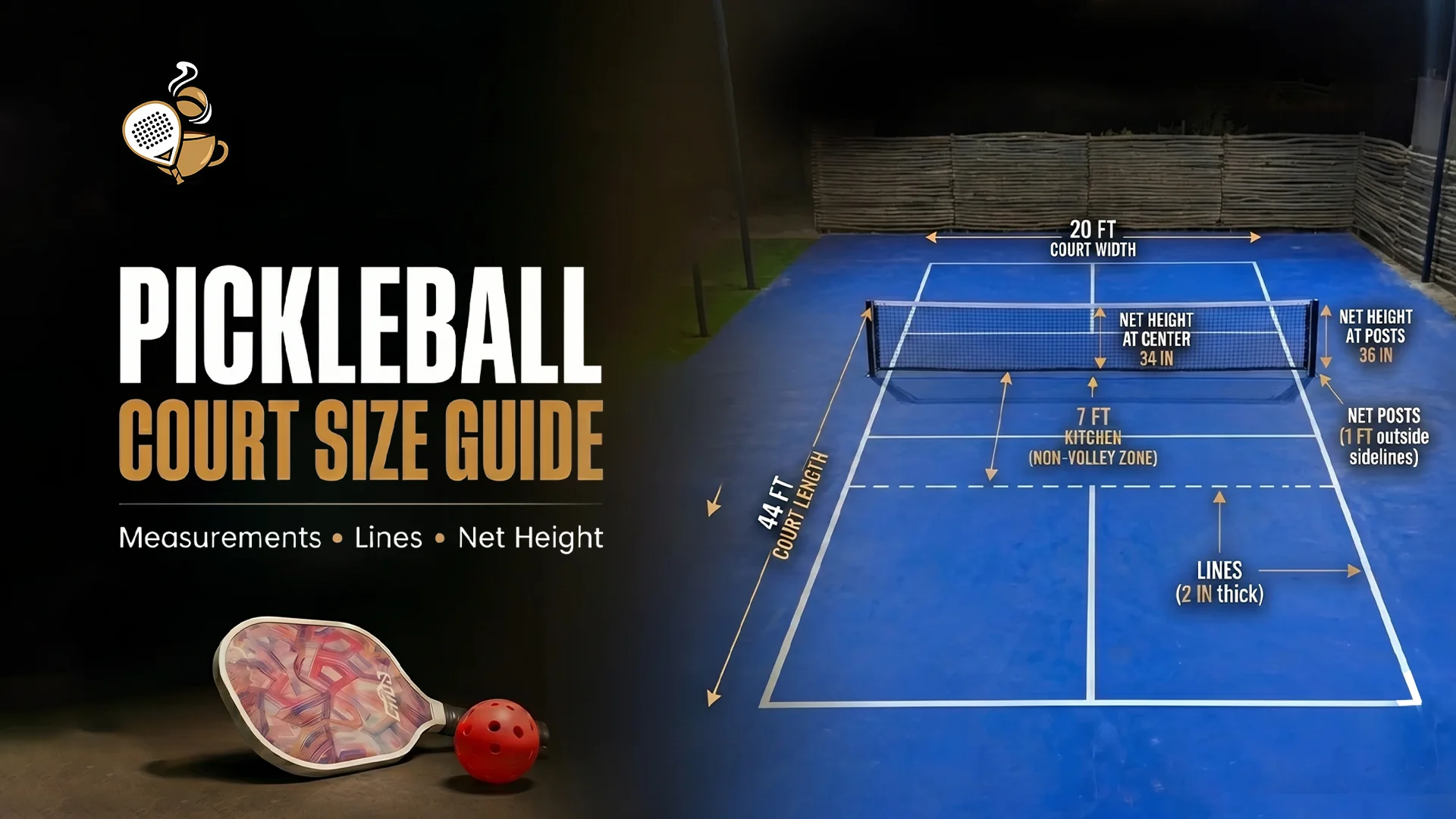
A standard pickleball court is the same size as a doubles badminton court.
Pickleball Court Size
Measurement | Feet | Meters |
Length | 44 feet | 13.41 meters |
Width | 20 feet | 6.10 meters |
This pickleball court size applies to both singles and doubles play, unlike tennis, where singles courts are narrower. So, whether you are playing one-on-one or two-on-two, the dimensions of the pickleball court remain the same.
Total Space Required (Including Run-Off Area)
While the court itself is 20 × 44 feet, you need extra space around it for safe play.
Recommended total playing area:
- Minimum: 30 × 60 feet
- Preferred: 34 × 64 feet
This extra space allows players to move freely behind baselines and beyond sidelines, preventing collisions with walls, fences, or other courts. If you are asking how big a pickleball court is, including run-off, the answer is roughly the size of a single-car garage doubled in length.
Pickleball Court Layout
A pickleball court is divided into specific zones, each with a purpose. Understanding these pickleball court dimensions helps you play strategically.
Key Areas:
- Baseline: The back boundary line where players serve from.
- Sidelines: Side boundaries marking the width of play.
- Centreline: Divides the service area into left and right boxes.
- Non-Volley Zone (Kitchen): 7 feet from the net on both sides.
- Service Courts: Left and right sections behind the kitchen line.
The Kitchen (Non-Volley Zone)
One of the most unique parts of pickleball is the non-volley zone, commonly called the kitchen.
Kitchen Dimensions:
- Depth: 7 feet from the net
- Width: Full court width (20 feet)
Rule:
Players cannot volley (hit the ball in the air) while standing in this zone. You must let the ball bounce first. This rule encourages soft “dinking” shots and prevents aggressive smashing from close range.
If you are learning pickleball court measurements, memorizing the 7-foot kitchen depth is essential—it changes the entire strategy of the game.
Pickleball Line Markings
Clear and accurate line markings are essential for gameplay. When marking a court, precision matters.
Line Width:
- Typically 2 inches (5 cm)
Key Lines Include:
- Baseline
- Sidelines
- Centerline
- Non-volley zone line (kitchen line)
All lines should be high-contrast (usually white or yellow) for visibility against the playing surface. For outdoor courts, weather-resistant paint is recommended.
Pickleball Net Height
The pickleball net height is different at the center and sidelines—a detail many beginners miss.
Official Net Height:
Location | Height |
At the sidelines | 36 inches (91.4 cm) |
At the center | 34 inches (86.4 cm) |
This slight dip in the middle affects gameplay strategy, especially dinks and soft shots. A net set too high or too low completely changes how the ball bounces and travels. Always measure your pickleball net height before a serious match.
Reference Table: Pickleball Court Measurements
Element | Measurement |
Court Length | 44 ft (13.41 m) |
Court Width | 20 ft (6.10 m) |
Kitchen Depth | 7 ft |
Net Height (Center) | 34 in (86.4 cm) |
Net Height (Sidelines) | 36 in (91.4 cm) |
Line Width | 2 in (5 cm) |
Minimum Total Space | 30 × 60 ft |
Preferred Total Space | 34 × 64 ft |
Use this pickleball court measurements table as a quick reference before marking or building a court.
Note: All this data is gathered from authentic sources like the International Pickleball Federation, USA Pickleball Association (USAPA), and the Official USA Pickleball Rulebook.
Why Dimensions Matter
Dimension | Measurement | Why It Matters |
Kitchen depth | 7 ft | Balances offense/defense; encourages dinking |
Net height (center) | 34 in | Allows soft shots and drop volleys |
Net height (sidelines) | 36 in | Prevents extreme cross-court angles |
Court width | 20 ft | Same for singles/doubles; rewards fitness and placement |
Court length | 44 ft | Inherited from badminton; creates natural play phases |
Line width | 2 in | Better visibility; fewer line call disputes |
Run-off space | 3–5 ft minimum | Prevents injuries; allows safe movement |
Indoor vs Outdoor Court Setup
Herea are the main points to be kept in mind while setting up indoor vs outdoor courts.
Outdoor Courts
- Asphalt or concrete surfaces
- Weather-resistant paint
- Wind can affect gameplay
- UV-resistant nets recommended
Indoor Courts
- Wooden or synthetic flooring
- Better control and consistency
- Often marked over basketball or badminton courts
- No wind interference
The size of the pickleball court does not change between indoor and outdoor—only the surface material and line painting method differ.
Pro Tips for Perfect Court Setup
Setting up a pickleball court correctly requires more than just knowing the measurements. These pro tips will save you time, money, and frustration — whether you are marking a temporary court or building a permanent one.
- Use Chalk Before Permanent Paint
- Measure Twice Before Marking Lines
- Ensure Proper Surface Slope for Drainage
- Use a Professional Net Tension Tool
- Mark the Kitchen Line First
- Leave Extra Room for Portable Nets
- Use ContrastingColorsfor Different Sports
- Check Net Height After Every Rain or Move
- Install Padding on Nearby Walls and Fences
- Create a Court Maintenance Checklist
Pro Tips Summary
Tip | Why It Matters |
Use chalk before paint | Avoid costly permanent mistakes |
Measure twice | Ensure square, accurate court dimensions |
Ensure drainage slope | Prevent puddles and surface damage |
Use net tension tool | Maintain consistent 34″/36″ net height |
Mark kitchen line first | Most important strategic line |
Leave room for net legs | Portable nets need extra clearance |
Use contrasting colors | Avoid confusion with other sports |
Check net height after rain | Weather and movement affect tension |
Install wall padding | Prevent player injuries |
Create a maintenance checklist | Extend court life and play quality |
5 Common Pickleball Court Setup Mistakes
Here are the five general mistakes to be avoided while setting up a court:
1. Incorrect Net Height (Most Common)
Many players set the net using tennis or badminton standards, but pickleball requires 34 inches at the center and 36 inches at the sidelines. A net that is too high makes dinking difficult and changes the entire trajectory of the ball. A net that is too low removes the challenge of soft shots. Always measure before playing.
2. Kitchen Line Placed Wrong (Not Exactly 7 Feet)
The kitchen (non-volley zone) must be exactly 7 feet from the net on both sides. Even a 2–3-inch error changes the game significantly, allowing players to volley from closer than allowed or unfairly restricting them. Use a measuring tape, not visual estimation, when marking this critical line.
3. No Run-Off Space → Unsafe Play
Players often mark only the 20×44 ft court and forget the space needed behind baselines and beyond sidelines. Without at least 3–5 feet of run-off on each side, players risk colliding with walls, fences, or other courts. This leads to ankle injuries, racket damage, and unsafe gameplay. Minimum total space should be 30×60 ft.
4. Using a Tennis Net Without Adjustment
A tennis net is 36 inches at the center, two inches too high for pickleball. Simply placing a tennis net on a pickleball court is not enough. You must either use a center strap to lower the net to 34 inches or, preferably, use a dedicated portable pickleball net. Playing with an unadjusted tennis net trains your muscle memory incorrectly.
5. Lines Too Thin or Low Contrast
Official pickleball lines should be 2 inches wide and high-contrast (white or yellow against the court surface). Many DIY setups use thin masking tape or chalk that blends into the court. This causes line-call disputes, slows downplay, and confuses beginners. Invest in durable, visible line markings for a professional playing experience.
Can You Convert a Tennis Court to Pickleball?
Yes. This is very common, especially in Lahore, where tennis courts are more widely available.
On a standard tennis court, you can fit:
- Up to 4 pickleball courts
Temporary nets and taped lines are often used for shared spaces. However, remember that the tennis net height (36 inches at the center) is higher than the required pickleball net height (34 inches at center). You will need portable pickleball nets or adjust the tennis net accordingly.
If you are asking how wide a pickleball court is compared to a tennis court, a pickleball court is 20 feet wide, while a tennis doubles court is 36 feet wide. That is why four pickleball courts fit inside one tennis court.
Backyard Pickleball Court Tips
If you are building a home court, here is what you need to know about pickleball court dimensions for residential spaces:
- Aim for at least 30 × 60 feet of total space
- Use non-slip acrylic surfaces for safety
- Ensure proper drainage for outdoor courts
- Install portable or permanent nets
- Mark lines with durable, high-contrast paint
When planning, remember how big a pickleball court must be, including run-off: approximately 30×60 feet minimum. If your backyard is smaller, you can still practise drills, but official matches will be tight.
Conclusion
Understanding pickleball court dimensions is essential whether you are playing casually, setting up a backyard court, or managing a sports facility. From the 20 × 44 ft layout to the 7 ft kitchen and net height variations, every detail impacts how the game is played.
If you are planning to build or mark a court, stick to official pickleball court size measurements to ensure a proper playing experience. And if you just want to play without the hassle of building a court, we have you covered.
Ready to Play? Visit Padel Cafe
Book your court now
Bring your friends. Bring your family. Just bring yourself. See you on the court at Padel Cafe!
Frequently Asked Questions
What is the size of a pickleball court?
The official size of a pickleball court is 20 feet wide by 44 feet long, the same for both singles and doubles play.
How big is a pickleball court including run-off?
The minimum recommended total area is 30 feet wide by 60 feet long, with 34×64 feet preferred for competitive play.
How wide is a pickleball court?
It is 20 feet wide from sideline to sideline. This is significantly narrower than a tennis court (36 feet wide for doubles).
What are the full pickleball dimensions, including lines?
44 ft long × 20 ft wide. The kitchen extends 7 ft from the net, and the centerline divides each service box into 10 ft × 15 ft sections.
What is the official pickleball net height?
The pickleball net height is 36 inches at the sidelines and 34 inches at the center. This 2-inch dip affects ball trajectory and is unique to pickleball compared to tennis or badminton.


0 Comments