
SUMMARY
- Lahore summers (June–August) regularly exceed 45°C — outdoor courts become unusable for 3–4 months per year
- Indoor courts use hardwood or PU flooring starting from PKR 300/sqft, offering better shock absorption than concrete
- Building an outdoor half-court in Pakistan costs PKR 800,000–2,000,000; a full indoor court starts at PKR 3,000,000+
- PadelCafe’s indoor basketball court in DHA Lahore is bookable online year-round, regardless of weather or season
It is 3 PM on a Saturday in June. Lahore. The thermometer reads 47°C. Somewhere in DHA, an outdoor basketball court sits empty — the concrete surface hot enough to blur the painted three-point line. Nobody is coming until October.
That is the reality of basketball in Pakistan that no global comparison guide ever mentions. The indoor vs outdoor decision is interesting everywhere. In Lahore, Karachi, and Islamabad, it is urgent — because the wrong choice means losing half the year to weather.
This guide breaks down both court types honestly: the real advantages, the surface differences that affect your joints, the PKR costs for players and builders alike, and which type actually makes sense for your situation in Pakistan.
What is the Core Difference Between Indoor and Outdoor Basketball Courts?
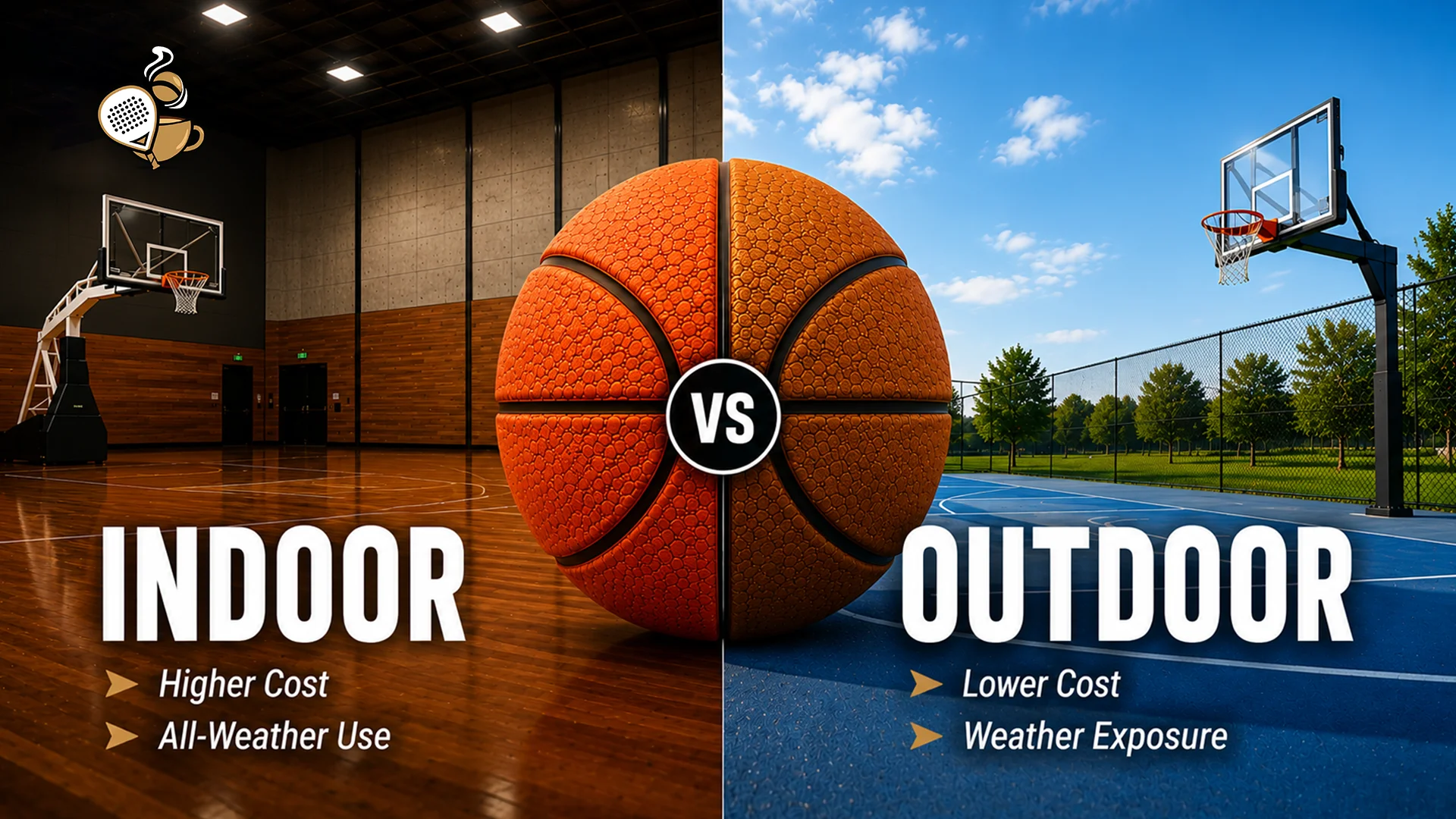
Indoor courts sit inside a climate-controlled building. The surface is typically hardwood, PU (polyurethane), or sprung vinyl — materials engineered for ball response, traction, and joint safety. Outdoor courts are open-air, usually made of concrete or asphalt, designed to survive weather rather than optimise play.
The dimensions are the same: a full NBA-standard court is 28 metres × 15 metres. What differs entirely is the surface underfoot, the conditions overhead, and — in Pakistan especially — how many months of the year you can actually use each type.
| Feature | Indoor Court | Outdoor Court |
|---|---|---|
| Standard size | 28m × 15m (full) | 28m × 15m (full) or half-court |
| Surface material | Hardwood, PU, vinyl | Concrete, asphalt, acrylic coating |
| Shock absorption | High | Low to none |
| Lighting | Controlled | Natural + optional flood lights |
| Weather dependency | None | High |
| Typical Pakistan usability | 12 months/year | 6–8 months/year (Oct–March best) |
What Are the Advantages of Indoor Basketball Courts?
In most countries, the indoor vs outdoor debate is about preference. In Pakistan, it is about practicality.
Year-round usability — Pakistan’s biggest factor. Lahore’s peak summer runs from May through August. Temperatures consistently exceed 45°C, touching 48–50°C during heat spikes. Playing on an exposed outdoor court is not uncomfortable — it is medically risky. Indoor courts with fans or air conditioning sidestep that entirely. A monthly booking at an indoor facility in October costs the same as one in July. An outdoor court in July costs you nothing to use — because no one is using it.
Floor surfaces protect your body. Professional indoor flooring — hardwood, PU, or vinyl — is engineered with shock absorption. When you land from a jump shot on a proper PU court, the floor absorbs a portion of the impact before it reaches your ankles and knees. Concrete absorbs nothing. Every landing transfers the full force up your joints.
Consistent evening play culture. Basketball in Lahore happens after dark — players show up at 8 PM or 9 PM to avoid the heat, even in winter. Indoor courts with proper lighting make night sessions a controlled, comfortable experience. Outdoor flood lighting is inconsistent across Pakistan’s public courts, with many courts relying on uneven street light.
Social infrastructure around the game. The shift in Pakistani sports culture is real. Players want more than a court — they want a venue. Indoor facilities like PadelCafe combine the basketball court with a café, event hosting, and multi-sport options. That combination turns a 90-minute game into an evening social event, not just a workout.
Expert Tip: If you play basketball 3 or more times per week, your cumulative joint load on concrete over one year is significantly higher than on a PU or hardwood floor. The surface difference matters most for regular players — casual players who play once a month are less affected.
What Are the Advantages of Outdoor Basketball Courts?
The case for outdoor is real — and strongest when the weather cooperates.
Lower entry cost. A basic outdoor half-court on a poured concrete base costs a fraction of an indoor build. For housing societies, schools on tight budgets, or neighbourhood parks, outdoor remains the most accessible option.
No booking required. Public outdoor courts and neighbourhood setups are available on a walk-up basis. For spontaneous pickup games — four players who decide to play at 6 PM — outdoor is far more flexible.
Open-air atmosphere. In the right season (October through March in Punjab), outdoor basketball has an energy indoor courts cannot replicate. Cool evening air, open sky, louder atmosphere. Winter basketball in Lahore on a good outdoor court is its own experience.
Easier installation. An outdoor concrete court can be installed by local contractors without specialist flooring knowledge. The barrier to entry for a community, school, or residential building is lower.
Which Court Surface is Better for Your Game and Your Joints?
This is where the decision becomes medical, not just practical.
Pakistan’s outdoor courts are predominantly bare concrete or asphalt — surfaces that were never designed for basketball-specific play. They are durable, weather-resistant, and cheap to lay. But ball bounce is unpredictable (surface irregularities cause erratic bounces), traction is inconsistent (dust accumulates fast on open courts), and shock absorption is zero.
Indoor courts use purpose-built sports flooring. PU (polyurethane) coating over concrete is the most common choice in Pakistan — it provides a sealed, consistent surface with a measurable degree of shock absorption. Hardwood (maple or birch) is the premium standard used in professional arenas. Both outperform outdoor concrete on every performance and safety metric.
| Surface | Material | Shock Absorption | Ball Bounce | Injury Risk | Lifespan | Approx. Cost (PKR/sqft) |
|---|---|---|---|---|---|---|
| Hardwood (indoor) | Maple/birch | High | Consistent | Low | 20–40 years | 1,800–3,000 |
| PU coating (indoor) | Polyurethane | Medium–High | Consistent | Low–Medium | 10–15 years | 600–1,200 |
| Vinyl / interlocking tiles | PVC / PP | Medium | Good | Medium | 10–20 years | 300–700 |
| Acrylic over concrete (outdoor) | Acrylic | Low | Good on flat surface | Medium | 5–10 years | 200–400 |
| Bare concrete/asphalt (outdoor) | Concrete | None | Variable | High | 15–20 years | 100–250 |
Sources: Unicorn Flooring Pakistan (epoxyflooring.pk, 2025); Dominator Hoop cost data (2025)
Expert Tip: The “Oct–March window” rule for Punjab. If you are building or choosing a court in Lahore, Faisalabad, or Multan, assume an outdoor court is genuinely comfortable only from mid-October through late March — roughly 5–6 months. Budget and plan accordingly. An indoor court changes that equation entirely.
How Do Construction and Booking Costs Compare in Pakistan?
Build Costs (for Facility Owners, Schools, Housing Societies)
The cost to build a basketball court in Pakistan varies by court type, size, surface material, and whether the facility is indoor or outdoor.
| Court Type | Size | Surface | Approx. Cost (PKR) |
|---|---|---|---|
| Outdoor half-court | 14m × 15m | Concrete base + acrylic coating | 800,000 – 1,500,000 |
| Outdoor full court | 28m × 15m | Concrete base + acrylic coating | 1,500,000 – 2,500,000 |
| Indoor full court (basic) | 28m × 15m | PU coating over concrete slab | 3,000,000 – 5,000,000 |
| Indoor full court (premium) | 28m × 15m | Hardwood / advanced PU system | 6,000,000 – 12,000,000+ |
Flooring cost range: PKR 300–3,000/sqft depending on material (Unicorn Flooring, 2025). A full basketball court covers approximately 420 sqm (4,520 sqft).
The structural cost for an indoor court — roofing, walls, HVAC, lighting — adds significantly above the flooring alone. For a standalone indoor basketball facility in Lahore, total project cost including structure realistically starts at PKR 8–15 million.
Booking Costs (for Players)
| Venue Type | Session (1–2 hours) | Per Player (4–10 players) |
|---|---|---|
| Outdoor public court | Free – PKR 500 | Free or nominal |
| Private outdoor court | PKR 1,500 – 3,000 | PKR 200–500 |
| Premium indoor court (Lahore) | PKR 3,000 – 5,000 | PKR 400–800 |
For regular players, indoor sessions at PKR 400–800 per person represent strong value when factoring in surface quality, year-round availability, and the absence of weather cancellations.
Which Type of Court is Right for You in Pakistan?
The answer depends on who you are and what you need. Here is a straightforward decision framework for Pakistan’s four main court user types.
| Who You Are | Recommended | Primary Reason |
|---|---|---|
| Competitive player / serious training | Indoor | Surface quality, year-round consistency, injury protection |
| Housing society is building a court | Outdoor (Oct–Mar play) or Indoor with a higher budget | Outdoor lower cost; indoor if the budget allows, and residents play year-round |
| School/academy | Indoor | Year-round academic calendar — outdoor breaks the 9-month programme |
| Casual players (once or twice a month) | Outdoor in season | Cost-efficient; weather window covers casual schedules Oct–March |
| Corporate / group events | Indoor | Controlled environment, café/social infrastructure, reliable booking |
| Parents for children under 15 | Indoor | PU floor dramatically reduces impact injuries during developing years |
Where Can You Play Basketball Indoors in Lahore Right Now?
Options for indoor basketball in Lahore are growing — but still limited compared to cricket or even padel. The courts that exist are worth knowing.
PadelCafe in DHA runs a basketball court designed for premium play. It is bookable online through book.padelcafe.pk, available year-round regardless of season or weather. After a game, the on-site café is open — so the session does not have to end when the final buzzer does. For birthday events or corporate group bookings, the events team handles full-session packages. It is the only basketball venue in Lahore that combines a professional indoor court with full social infrastructure in the same location.
5th Generation Sports Complex was added to the Lahore court directory in 2025 and represents the broader trend of multi-sport facilities entering the city. Lahore Defence Phase 1 Court is among the older outdoor options — a well-known community outdoor court that functions best in the winter months.
What Changed for Basketball Courts in Pakistan in 2025–2026?
Several developments are reshaping where and how basketball is played in Pakistan:
- Multi-sport facility model is replacing single-sport courts. New venues across Lahore combine basketball with padel, badminton, and pickleball under one roof — following the PadelCafe model. Players who once had to travel between venues now play multiple sports in one session.
- Pakistan will host the 2027 South Asian Games in Lahore, Islamabad, and Faisalabad — infrastructure investment in indoor sports facilities has accelerated to meet international hosting standards.
- Housing society sports facilities are getting structured upgrades. DHA Lahore and Bahria Town developments are increasingly incorporating proper sports courts as standard amenities, with indoor options gaining traction.
- School and academy court investment is rising. Basketball academies in Lahore are prioritising indoor courts to maintain year-round training schedules aligned with school terms.
Lahore’s Answer is Clear — and it’s Indoors
For 3–4 months every year, Lahore’s outdoor courts go dark. The heat does not discriminate between serious players and casual ones. The city’s basketball culture is shifting indoors — and with it, the court experience is getting better: better surfaces, better lighting, better social infrastructure around the game.
If you are a player, an investor, or a school administrator choosing between court types, the Pakistan climate gives you the most important variable that no global guide will mention. Plan around it.
Book your next game at PadelCafe’s basketball court in Lahore. It is there when the weather is not.
Frequently Asked Questions
How much does it cost to build a basketball court in Pakistan?
An outdoor half-court on a concrete base costs approximately PKR 800,000–1,500,000 in Pakistan. A full indoor court with professional PU flooring starts at PKR 3,000,000–5,000,000, rising to PKR 12,000,000+ for hardwood systems with full structural build-out.
Can you play basketball outdoors in Lahore during summer?
Not safely. Lahore temperatures regularly exceed 45°C from May through August. An outdoor concrete court during this period poses serious heat-related health risks. Indoor facilities with fan or air-conditioning systems are the only practical option for summer basketball in Punjab.
What is the best floor for an indoor basketball court in Pakistan?
PU (polyurethane) coating over a concrete slab is the most practical choice in Pakistan — offering good shock absorption, consistent ball bounce, and a lifespan of 10–15 years at PKR 600–1,200/sqft. Hardwood maple flooring is the professional standard (PKR 1,800–3,000/sqft) and lasts 20–40 years, but requires climate control to prevent warping.
Is outdoor concrete dangerous for basketball players’ joints?
Over time, yes. Bare concrete provides zero shock absorption. Repeated jumping and landing on concrete transfers full impact force to the ankles, knees, and hips. For players training more than twice per week, the cumulative joint stress on concrete is significantly higher than on PU or hardwood courts.
Where can I book an indoor basketball court in Lahore?
PadelCafe in DHA Lahore offers an indoor basketball court bookable online at book.padelcafe.pk. It is available year-round, including during summer months when outdoor courts are unusable.
What size is a standard basketball court in Pakistan?
A full standard court is 28 metres × 15 metres, following FIBA international standards. This applies to both indoor and outdoor full courts. Half-courts — measuring approximately 14m × 15m — are more common in residential, school, and community settings.

0 Comments