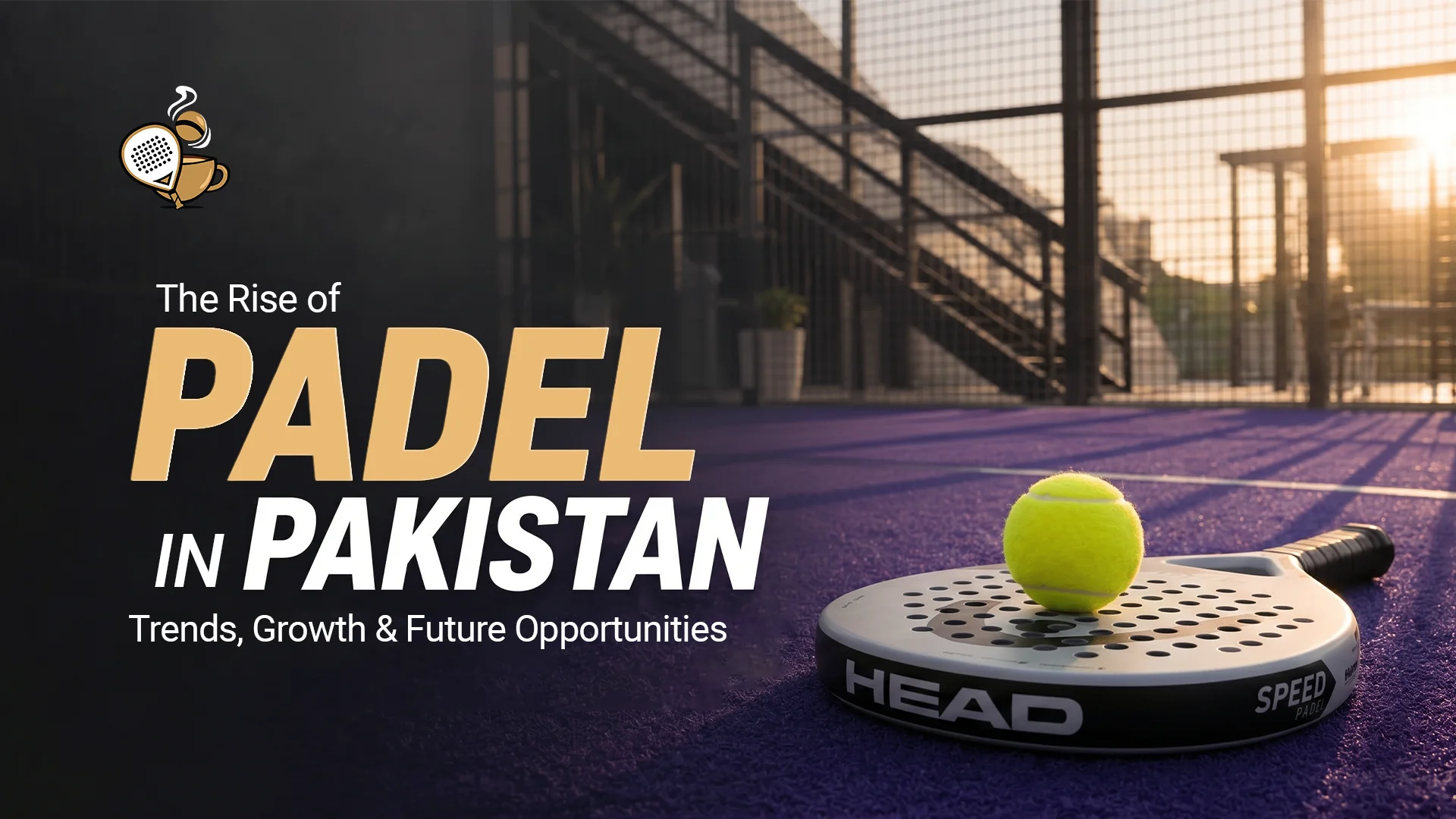
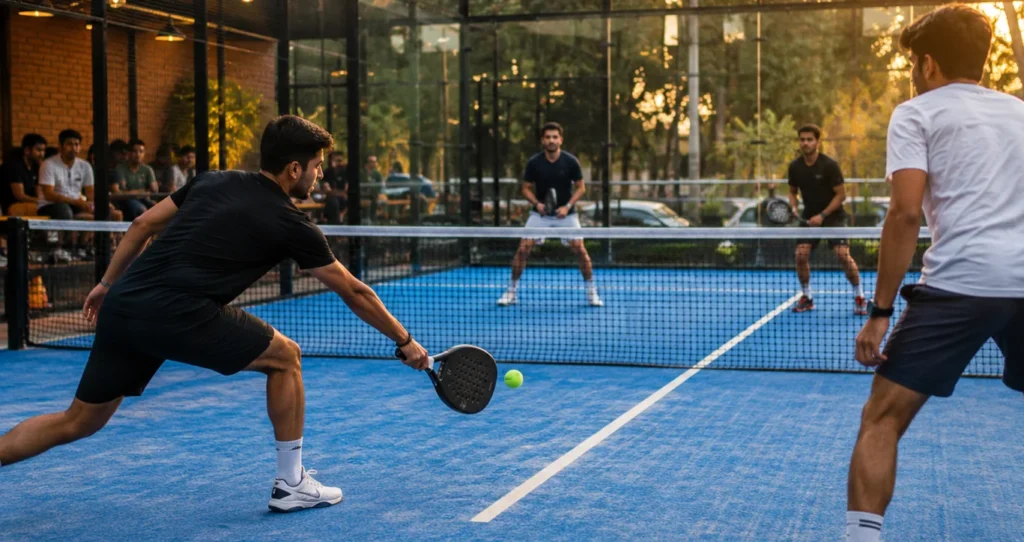
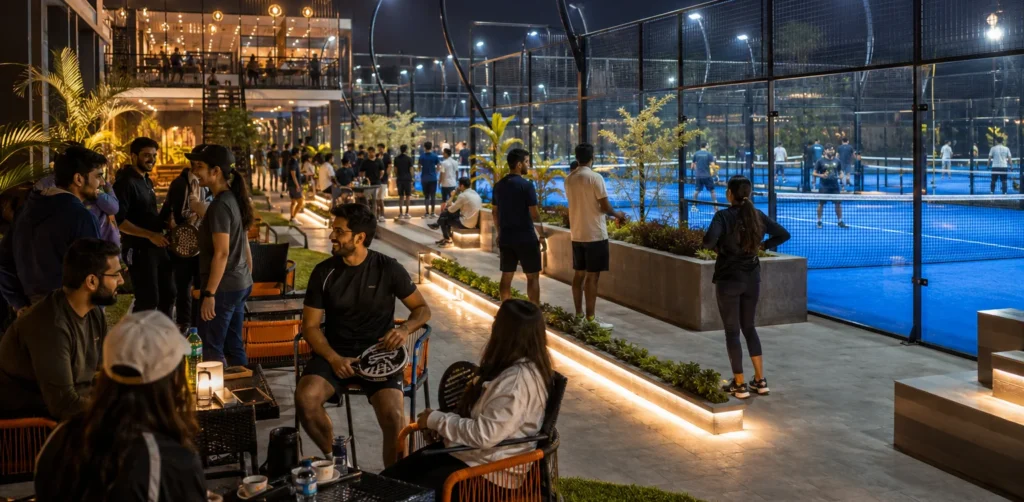
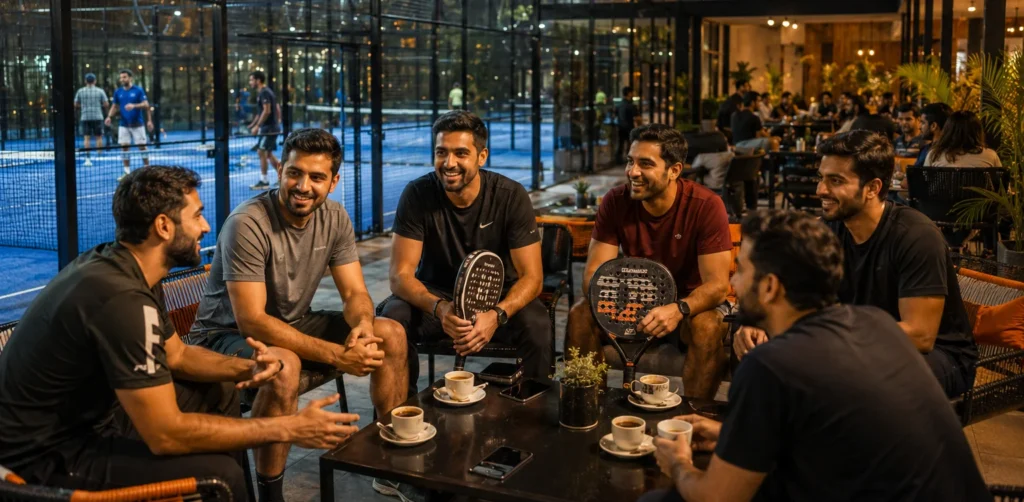
Picture this: a Tuesday night in Lahore. Two glass courts are running at full capacity. Friends are laughing, rallying, and arguing over serves. A group waits on the side, coffees in hand, watching the game like it’s the most natural thing in the world. Nobody is surprised Padel is here. The surprise is how fast it got here.
Pakistan went from zero padel courts to 350+ in under four years. From backyard experiments to a national league with a PKR 30 million prize pool. From borrowed rackets to FIP-affiliated national rankings. The rise of padel in Pakistan is one of the fastest sport adoption stories this country has ever seen — and the momentum shows no sign of slowing in 2026.
Key Takeaways:
- Pakistan has 50,000+ amateur padel players and 350+ courts as of 2026 (PPLP / padelup.pk)
- The Premier Padel League of Pakistan launched in January 2026 with a PKR 30 million prize fund
- Pakistan’s padel search interest peaked at 100/100 on Google Trends during the week of March 8, 2026 (World Padel Network, April 2026)
- Opportunities span court investment (PKR 5M–15M), coaching academies, and equipment retail
What is Padel, and Why is Pakistan Falling in Love with It?
Padel is a racket sport played in doubles on an enclosed glass-and-mesh court roughly a third the size of a tennis court. Walls are part of the game — like squash, you can play the ball off them after it bounces. The result is longer rallies, faster strategy, and a game beginners enjoy from their first session.
Three features make padel almost perfectly suited to Pakistan:
It is built for groups. Doubles-only means you always play with three friends. In a culture where sport is social and evening plans revolve around getting people together, padel fits naturally.
It rewards instinct over athleticism. You don’t need a cricket player’s reflexes or a squash player’s stamina to start enjoying it. According to global data, 92% of players return after their first session — a retention rate no other racket sport comes close to matching.
Pakistani players already have squash in their DNA. Pakistan has produced world-class squash champions for decades. The glass-wall tactics feel intuitive. The transition from squash to padel, or from cricket to padel, is shorter than anyone expects.
| Feature | Padel | Squash | Tennis |
|---|---|---|---|
| Court size | 20×10m (enclosed) | 9.75×6.4m | 23.8×8.2m |
| Walls in play | Yes — glass + mesh | Yes — all walls | No |
| Format | Doubles only | Singles/Doubles | Singles/Doubles |
| Beginner learning curve | Low | Medium | High |
| Social factor | Very high | Low | Medium |
| Return rate after first session | 92% | Not measured | ~60% |
How Fast is Padel Growing in Pakistan Right Now?
Fast. Measurably, verifiably fast.
According to data compiled by padelup.pk (February 2026), Pakistan now has over 50,000 amateur players and 350+ courts nationwide. Three years ago, those numbers were close to zero. The World Padel Network’s Global Search Report (April 2026) confirmed Pakistan’s padel search interest hit 100/100 — an all-time peak — during the week of March 8, 2026.
Here’s the trajectory:
| Year | Est. Courts | Key Milestones |
|---|---|---|
| 2022 | Under 20 | First private courts in Karachi |
| 2023 | ~50 | Karachi Padel Club gains momentum; first club tournaments |
| 2024 | ~150 | Lahore and Islamabad facilities open; Dawn covers the trend (Aug 2024) |
| 2025 | ~250 | CDA Islamabad auctions 5 court sites; Lahore coaching academies launched |
| 2026 | 350+ | PPLP launch, APPT Challenger Circuit, PPF ranking system, national league |
The International Padel Federation (FIP) World Padel Report 2025 (December 2025) records 35 million global players across 150 countries — up from 25 million in 2023. Pakistan is explicitly named by FIP as one of the sport’s high-growth emerging markets in Asia.
Pakistan’s trajectory mirrors what happened in France, which grew court count by 55% in 18 months (TennisCreative, January 2026). The difference is Pakistan’s growth started later — meaning it is still in the acceleration phase, not consolidation.
Why did Padel Take Off in Pakistan — and Why Now?
Pakistan wasn’t an obvious candidate. Cricket dominates everything. Infrastructure takes years to build. Yet padel went mainstream in under three years. Here’s the truth behind the speed.
1. Social media turned glass courts into content. Pakistan had 79.9 million social media user identities as of October 2025, according to DataReportal’s Digital 2026 Pakistan report. Instagram and TikTok made padel visual before it was accessible. Sleek glass walls, late-night doubles sessions, post-game chai — it photographs well and it spread fast.
2. Pakistan’s youth wanted an alternative. Not everyone grows up playing cricket. Padel offered something inclusive, co-ed, and beginner-friendly. Women make up 40% of padel players globally (FIP World Padel Report 2025) — the highest female participation rate of any racket sport. In Pakistan, that mix is increasingly visible on courts.
3. Squash culture made the transition natural. “Pakistan’s squash heritage gave players an instinct for the walls,” says Usama Butt, an LPA representative and former tennis player who now runs one of Lahore’s padel coaching academies. That instinct shortens the learning curve dramatically.
4. The Gulf connection. Millions of Pakistanis work and live across the UAE, Qatar, and Saudi Arabia — all markets where padel is now mainstream. Players brought the sport back with them. The Gulf’s padel culture arrived in Karachi and Lahore through returnees before any formal infrastructure existed.
5. Post-pandemic appetite for social sport. Padel’s doubles format meant social connection was built into every session. After years of restricted gatherings, Lahore and Karachi embraced it fast.
Which Cities are Leading Pakistan’s Padel Revolution?
The growth is national — but each city tells a different story.
| City | Courts (est.) | Scene Character | Key Venue/Development |
|---|---|---|---|
| Karachi | 100+ | Fast, entrepreneurial, informal | Legends Arena, Karachi Padel Club, Padel Up Gulshan-e-Iqbal |
| Lahore | ~80 | Community-led, culture-driven, lifestyle-integrated | PadelCafe, Padel Pro, Padel Zone, Padel Pop |
| Islamabad | ~40 | Institutional, government-backed | CDA auctioned 5 sites (June 2025); Rs7.6M monthly revenue expected |
| Faisalabad | ~15 | Emerging | FDA City Faisalabad Sports Complex |
| Peshawar | ~10 | Emerging | Champions Hub Peshawar |
| Multan | ~8 | Emerging | Local private facilities |
Karachi arrived first — fast, improvisational, and built on private initiative. “We didn’t wait for permission,” says Mamoon Qureshi, an early Karachi enthusiast who set up one of the city’s first private courts. “We built the court in a backyard with imported turf and just started playing.”
Lahore took longer but built deeper. Courts here are tied into coaching ecosystems, wellness communities, and social calendars. At Padel Café in DHA, the integration goes furthest — padel courts, a café menu, birthday events, corporate sessions, and a shop under one roof.
The result is not just a sports facility. It’s a lifestyle destination. Players book a court, stay for coffee, and come back the following weekend with four more people. That community loop is what has driven Lahore’s player retention above the national average.
Islamabad’s story is different again. In June 2025, the Capital Development Authority auctioned five public sites specifically for padel court development, expecting to generate PKR 7.6 million per month in rental income (Dawn, June 2025).
That is, the government recognising padel as infrastructure — a milestone no other city has matched. And in May 2026, Meezan Bank signed an MOU with the Sindh Police Sports Board to construct a padel court at the Police Headquarters in Karachi (The Nation, May 2026). Institutional money is moving in.
What Changed in Pakistani Padel in 2025–2026?
This is the year the sport stopped being a trend and became a structure.
| Date | Milestone |
|---|---|
| Jan 5, 2026 | Premier Padel League of Pakistan (PPLP) launches — PKR 30M prize fund, 6 franchise teams, tournaments across Islamabad/Rawalpindi, Lahore, Karachi |
| Feb 1, 2026 | APPT Challenger Series inaugural event, Karachi — first internationally sanctioned padel in Pakistan (Asia Pacific Padel Tour) |
| Apr 2–5, 2026 | APPT Challenger Lahore debut — Pakistan’s finest talent on internationally ranked courts with APPT Ranking Points |
| May 2026 | Meezan Bank MOU with Sindh Police Sports Board for a padel court at Police HQ Karachi |
| Jul 3–5, 2026 | Pakistan Padel Ranking Cup 2026 — Karachi, under Pakistan Padel Federation (PPF) / FIP auspices |
| Jun–Jul 2026 | FIP Academy Level 1 Referee Course (10th edition) — Pakistan now training internationally certified officials |
Before 2026, padel in Pakistan ran on passion and private initiative. From 2026 onward, it runs on structured leagues, international circuits, national rankings, and certified officiating. That transition — from movement to institution — is what separates a lasting sport from a passing trend.
Expert Tip: The PPF’s national ranking system, aligned directly with FIP international standards, now gives Pakistani players a clear pathway from local tournaments to international competition. Mohammed Aziz Khan (PPF License #174) became the first Pakistani to compete in a FIP International Bronze Tournament in Hong Kong in March 2025. That pathway now exists for hundreds of registered players.
What are the Real Opportunities in Pakistan’s Padel Market?
The sport is growing. But where is the actual opportunity — and what are the real risks?
Opportunity 1: Court investment
A basic two-court padel facility in Pakistan costs between PKR 5 million and PKR 15 million, according to an OLX Pakistan business guide (April 2025). The major cost components are turf, glasswork, and steel structure — typically two-thirds of the total investment. Revenue streams include hourly court bookings, coaching sessions, equipment sales, café or food service, and corporate/event bookings.
Opportunity 2: Coaching and academies
International coaches are already working in Pakistan’s major cities. The PPF offers official coaching certifications aligned with FIP standards. Youth programmes are launching. Anyone entering now — as a certified coach, a coaching academy, or an international coaching partner — is entering a market with almost no qualified competition.
Opportunity 3: Equipment and retail
Courts need rackets, balls, bags, and shoes. Pakistan currently imports most of its padel equipment. Local distribution and retail represent a significant arbitrage opportunity as the player base crosses 50,000 and continues to grow.
| Opportunity | Investment Range | Revenue Streams | Risk Level |
|---|---|---|---|
| 2-court facility (basic) | PKR 5M–7M | Bookings, coaching, F&B | Medium |
| International-standard facility | PKR 12M–15M | All of the above + events, sponsorship | Medium-High |
| Coaching academy | PKR 500K–2M | Session fees, certifications, youth programmes | Low |
| Equipment retail/distribution | PKR 1M–5M | Direct sales, online, club supply | Low-Medium |
How do You Start Playing Padel in Lahore Today?
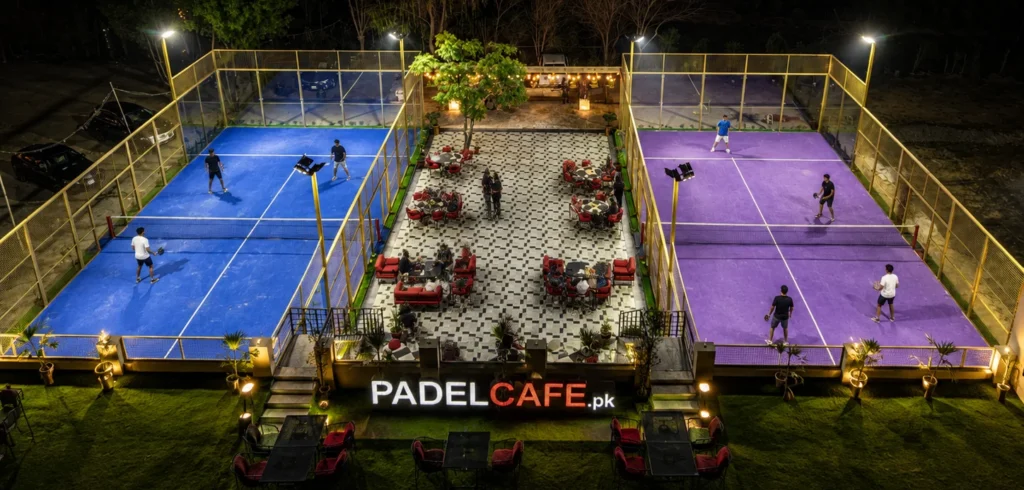
Here’s the thing about padel: the barrier to entry is genuinely low. You need four people, a court booking, and a borrowed racket for your first session.
Step 1: Book a court. PadelCafe Lahore offers online court booking at book.padelcafe.pk. Evening slots fill up — book 24–48 hours ahead. Court pricing in Lahore ranges from PKR 2,000–4,000 per session, depending on time slot and facility.
Step 2: Don’t buy equipment yet. Most courts provide rackets and balls for beginners. Try the sport three or four times before investing. A decent beginner padel racket starts at PKR 3,000–6,000; a quality mid-range option runs PKR 10,000–20,000.
Step 3: Take one coaching session. One hour with a coach at PadelCafe covers court positioning, wall play, and basic serving. Players who take a single coaching session improve faster and enjoy the game more from their first match. Check padelcafe.pk/padel-coaching for session details.
Step 4: Join the community. PadelCafe hosts regular tournaments, morning wellness events, and social sessions. Show up, meet other players, and you will have a game partner within a week. That is how padel works — the community builds itself.
Pakistan’s Padel Story is just Getting Started
Lahore didn’t wait for permission to adopt padel. Neither did Karachi nor Islamabad. The sport arrived through the side door — a backyard court, a borrowed racket, a group chat — and within three years it had a PKR 30 million national league, international tournaments, and government-backed infrastructure.
The next chapter is wider and deeper. Tier-2 cities are building courts. Coaching pathways are formalising. Female participation is rising. And for players in Lahore, the entry point has never been easier.
Book a court at Padel Café, show up with three friends, and find out why 92% of first-timers never go back to just watching.
Frequently Asked Questions
How many padel courts are there in Pakistan?
As of early 2026, Pakistan has over 350 padel courts nationwide, according to data from the Premier Padel League of Pakistan and padelup.pk (February 2026). Karachi leads with over 100 courts, followed by Lahore, Islamabad, and emerging cities like Faisalabad and Peshawar.
Is padel expensive to play in Pakistan?
Court booking fees in Lahore typically range from PKR 2,000 to PKR 4,000 per session for four players — roughly PKR 500–1,000 per person per game. Most courts provide rackets and balls for beginners, so your first few sessions require no equipment investment at all.
Who started padel in Pakistan?
Karachi’s entrepreneurial community pioneered the sport in Pakistan around 2022, with early enthusiasts like Mamoon Qureshi setting up private courts. Legends Arena later formalised it as a commercial offering. Lahore and Islamabad followed within 12–18 months.
Is padel suitable for beginners and non-athletes?
Yes. Padel has one of the lowest learning curves of any racket sport. The enclosed court, shorter distances, and wall-play format means beginners rally successfully within the first session. According to global tracking data, 92% of first-time players return for a second session.
What is the Pakistan Padel Federation?
The Pakistan Padel Federation (PPF) is the national governing body for padel in Pakistan, affiliated with the International Padel Federation (FIP). It oversees national rankings, coaching certifications, referee licensing, and international tournament representation. The PPF announced the Pakistan Padel Ranking Cup 2026 in Karachi (July 3–5, 2026).
Can women play padel in Pakistan?
Absolutely. Padel is co-ed by design — mixed doubles is one of the sport’s most popular formats globally. Women account for 40% of padel players worldwide (FIP World Padel Report 2025), the highest female participation rate of any racket sport. Pakistan’s courts are increasingly seeing mixed groups, and dedicated women’s categories exist in national tournaments, including the PPF Ranking Cup 2026.


0 Comments