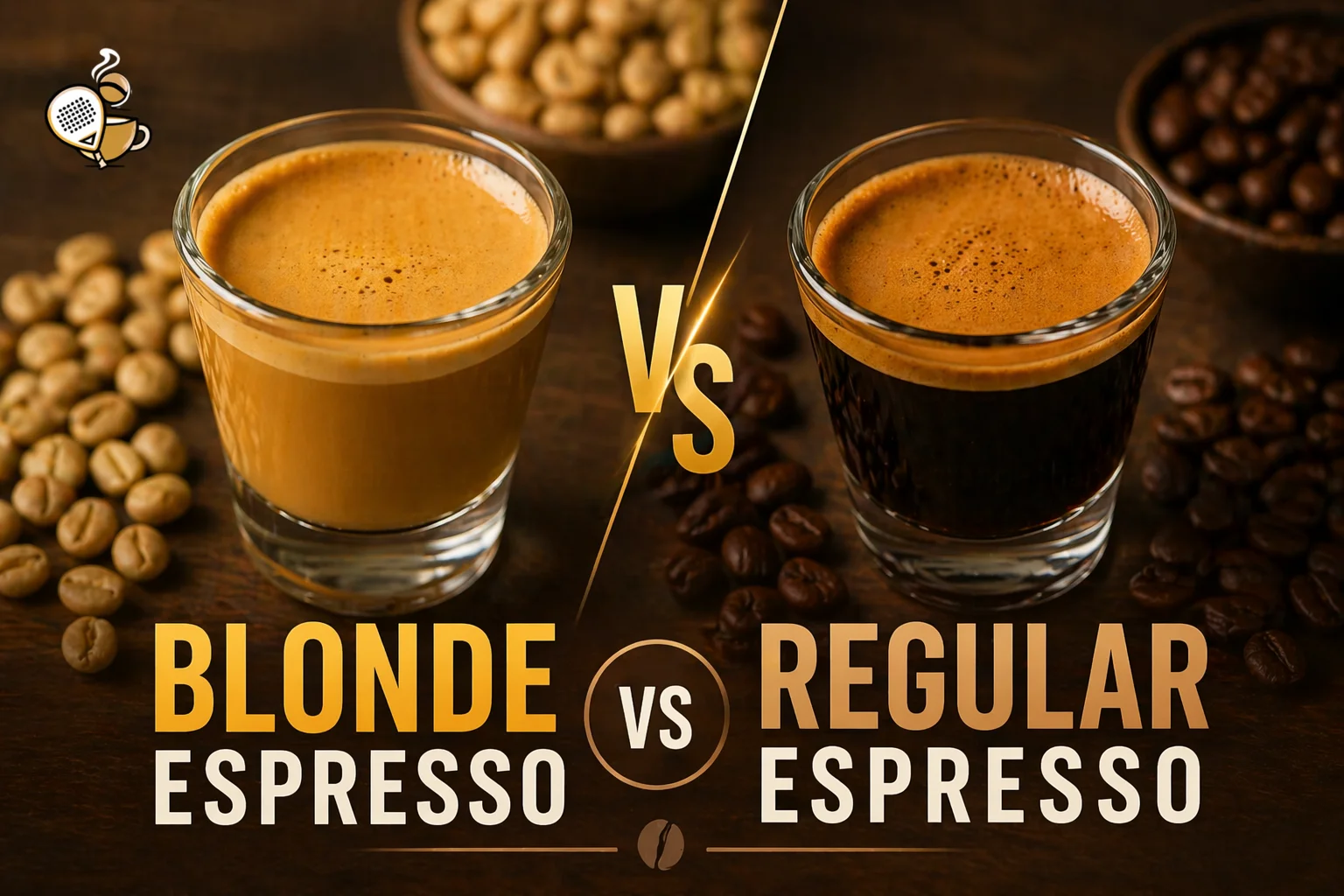
You’re standing at the counter. The barista asks: “Blonde or regular espresso?”
You’ve heard of blonde. You know what regular tastes like. But you’re not quite sure what you’d actually be choosing — or whether it would change your drink in any meaningful way.
Here’s the short version: blonde espresso uses lightly roasted beans pulled before the “first crack” — the point at which beans start expanding from heat. The result is sweeter, more acidic, and slightly higher in caffeine than traditional dark roast espresso. Regular espresso uses dark roasted beans taken well past the second crack: bold, bitter, chocolate-and-caramel. That’s the whole story, really.
Everything below fills in the details — flavor, caffeine, acidity, body, milk pairing, home brewing — so you can make the right call without overthinking it at the counter.
Quick reference:
- Blonde = light roast; regular = dark roast
- Blonde tastes sweeter, citrusy; regular tastes like chocolate and caramel
- Blonde has slightly more caffeine (~85mg per shot vs. ~63–75mg)
- Blonde is more acidic with a lighter body; regular is lower-acid and heavier
- Starbucks coined the “blonde” label in 2013; light roast espresso has existed in specialty coffee for decades
What Is Blonde Espresso?
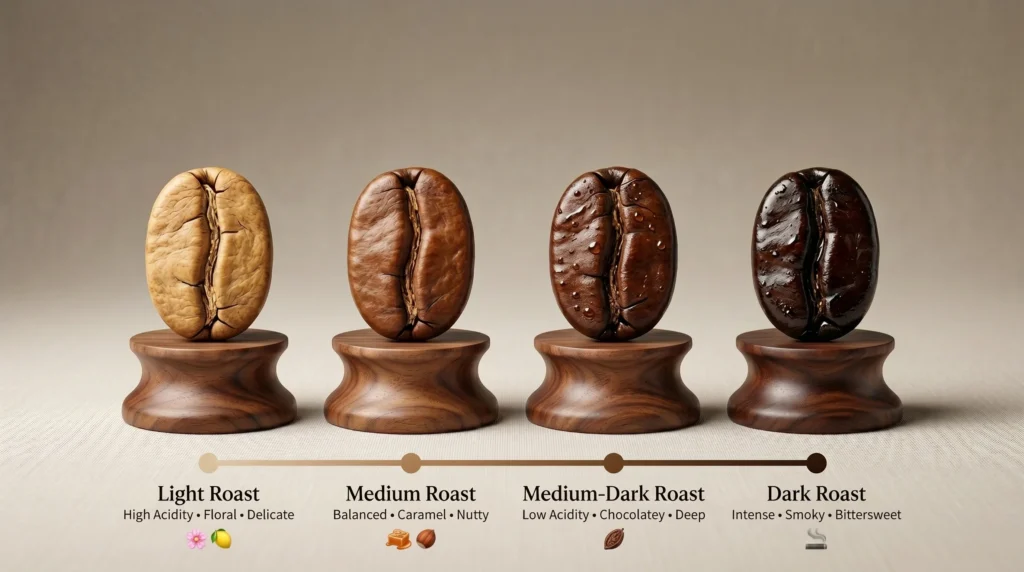
Blonde espresso is brewed from light-roast beans — roasted at 355°F–400°F (180°C–204°C) and pulled before or just at the first crack. That audible pop happens when steam pressure fractures the bean’s cell walls, roughly like popping corn.
Because these beans see less heat, they keep more of the coffee cherry’s original chemistry. The result: a matte, light-brown bean with no surface oil, denser structure than dark roast, and a cup that tastes like where the bean came from — its origin, altitude, processing method — rather than the roasting itself.
Starbucks added blonde espresso to its permanent menu in 2013. Their blend draws from Latin American (Colombia, Costa Rica) and East African (Ethiopia, Kenya) beans — origins known for bright, citrus-forward profiles. The Specialty Coffee Association classifies light roasts as 70–100 on the Agtron scale, a 1–100 reflectance measure of roast color. Starbucks just branded this end of the spectrum “blonde” to make it easier to order.
What Is Regular Espresso?
Regular espresso uses dark-roasted beans, roasted at 425°F–460°F (218°C–238°C) and taken well past the second crack — at which point oils migrate to the surface, producing the dark, oily beans most people picture when they think “espresso.”
Italian espresso tradition specifies hazel-brown to dark-brown crema, pulled through 9 bars of pressure at roughly 88°C–94°C water temperature. The Agtron scale puts these dark roasts in the 25–45 range.
The extended roasting does two things: it caramelizes sugars (producing that caramel-like sweetness) and drives the Maillard reaction between amino acids and reducing sugars (producing chocolate, nuts, toast). It also breaks down acidity and mutes whatever fruit character the raw bean had.
Blonde Espresso vs Regular: Side-by-Side Comparison
| Factor | Blonde Espresso | Regular Espresso |
|---|---|---|
| Roast Level | Light | Medium-dark to dark |
| Roast Temperature | ~385°F (196°C) | Up to 446°F (230°C) |
| Bean Color | Light brown, no surface oils | Dark brown to black, oily |
| Flavor Profile | Citrus, floral, berry, sweet | Chocolate, caramel, nuts, bitter |
| Acidity | Higher | Lower |
| Body/Mouthfeel | Light to medium, smooth | Full, thick, syrupy |
| Bitterness | Low | High |
| Caffeine (per shot) | ~85mg (Starbucks) | ~75mg (Starbucks) |
| Best For | Straight shots, light builds | Milk drinks, traditional espresso |
| Crema | Lighter, thinner | Rich, thick, persistent |
| Brewing Difficulty | Less forgiving, requires precision | More forgiving |
Flavor: What Do They Actually Taste Like?
This is where the choice really lives — not in caffeine numbers or roast temperatures, but in that first sip.
Blonde espresso is bright and sweet. Because the roast doesn’t burn off the bean’s natural compounds, you get distinct notes of citrus, florals, or berries. The body is lighter, the finish almost tea-like. None of that heavy “roasted” quality. If traditional espresso has always struck you as too aggressive, blonde might change how you feel about the whole category.
Regular espresso is comfort food in a cup. Dark chocolate, nuts, caramel, and smoke. The mouthfeel is thicker and more syrupy from the oils released during roasting. Bold. Familiar. For many people, exactly what coffee is supposed to taste like.
Neither is better. Blonde suits people who want complexity and brightness. Regular suits people who want intensity and that roasted punch. It really does come down to what you’re in the mood for.
Caffeine: Which Has More?
Here is where the most common myth lives — and it’s worth setting straight.
Most people assume darker roasts are stronger. More intense flavour, stronger coffee. Logical, but wrong.
Caffeine itself doesn’t change much during roasting. What changes is how much coffee fits into your scoop, your shot, or your dose. Blonde espresso can have slightly more caffeine when measured by volume because the beans are denser. But when measured by weight, caffeine levels are almost the same. The biggest difference isn’t caffeine — it’s flavour.
In practical numbers: a single shot of Starbucks blonde espresso contains roughly 4.7mg of caffeine per milliliter, while a shot of regular espresso contains about 4.2mg per milliliter. At Starbucks specifically, that translates to approximately 85mg per blonde shot versus 75mg for a regular shot — a 10mg difference.
Starbucks Blonde Espresso: ~85mg caffeine per shot vs ~75mg for regular espresso — Starbucks Nutrition Information, 2025
A longer pull or larger dose can easily change caffeine levels more than switching between blonde and dark roast. If you’re choosing between blonde and regular espresso, focus on flavour — not caffeine. The difference is real but small. You will taste the difference far more dramatically than you’ll feel it.
Roast Level and Beans
The roast level is the fundamental fork in the road between these two espressos — everything else (flavour, caffeine, body, acidity) flows from it.
Blonde Espresso Roast
In the broader specialty coffee scene, blonde is generally recognised as “light roast espresso” — a roast level developed just past the first crack, typically finishing at around 385°F (196°C). This lighter profile preserves much of the beans’ original acidity, floral or fruit-forward notes, and terroir-specific flavour complexity.
Starbucks’ version uses Latin American and East African beans — origins known for their bright, citrus-forward profiles. The combination of origin and light roast is what produces that distinctive sweetness.
Regular Espresso Roast
Blonde espresso finishes around 385°F (196°C), just past the first crack. This preserves acidity, floral and fruit notes, and the flavors that reflect where the bean was grown. Starbucks uses Latin American and East African origins for exactly this reason — their natural brightness fits the roast.
Regular espresso goes further. Blonde beans roast for 8–10 minutes. Medium-dark roasts run 12–14 minutes, reaching 410°F–428°F (210°C–220°C). Dark roasts push up to 16 minutes at 446°F (230°C). The extended time converts acids to CO₂, reduces density, and builds the bold, bitter, caramelized character of traditional espresso.
Light roast beans (blonde) are denser and smaller than dark roast beans because they expand less during roasting, which is why they contain slightly more caffeine by volume — National Institutes of Health, PubMed, “Influence of Various Factors on Caffeine Content in Coffee Brews,” 2021
Brewing Differences
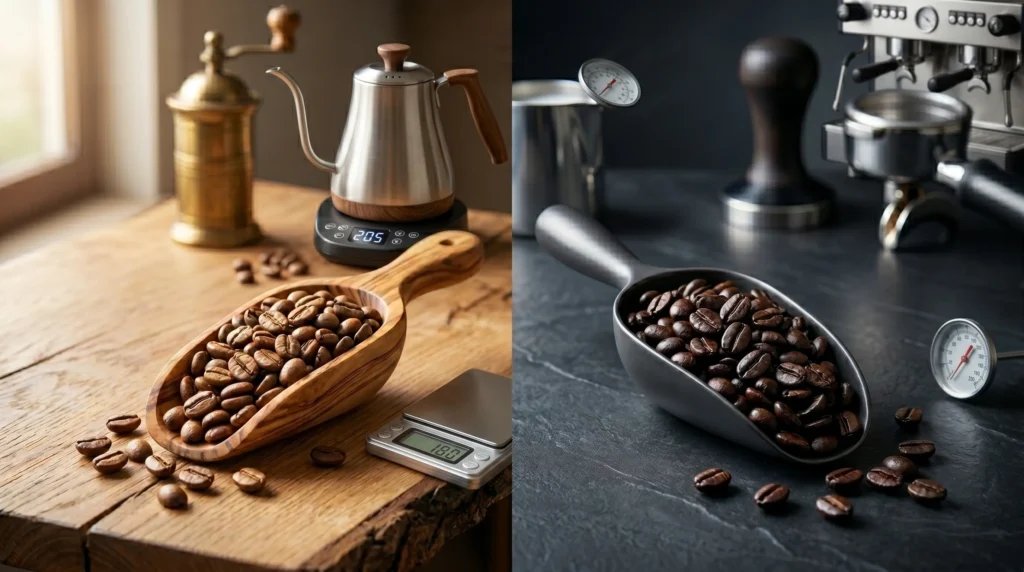
Both shots pull through an espresso machine the same way: pressurized hot water through finely ground coffee. But the details differ, and blonde espresso is genuinely harder to get right.
| Variable | Blonde Espresso | Regular Espresso |
|---|---|---|
| Water Temperature | 203°F–205°F (95°C–96°C) | 195°F–203°F (90°C–95°C) |
| Grind Size | Fine (dial carefully) | Fine |
| Extraction Time | Slightly longer | Standard 25–30 seconds |
| Difficulty | Less forgiving | More forgiving |
| PID Controller | Strongly recommended | Optional |
Blonde espresso needs precise control over temperature, grind, and pressure. Barista Federico Pinna, who placed 6th at the 2024 World Barista Championship, recommends a PID controller — a device that stabilizes extraction temperature — as essentially non-negotiable for light roast.
You’ll likely need to push your water temperature to 203°F–205°F to draw out the sweetness without tipping into sourness. Under-extracted blonde espresso is aggressively sour — the most common failure point for home brewers trying it for the first time.
Regular espresso is much more forgiving. Its bold flavors absorb minor extraction mistakes in a way that light roast simply can’t.
Acidity, Body, and Crema
Acidity: Blonde espresso is noticeably more acidic. Light roasting preserves chlorogenic and malic acids — the same compounds behind the tartness in green apples — which give blonde its citrusy brightness. Dark roasting breaks these acids down, which is why regular espresso tastes rounder. If you have an acid-sensitive stomach, regular espresso is probably more comfortable in volume.
Body: Regular espresso is heavier and more viscous. Blonde is lighter, closer to tea. This comes from how much roasting breaks down cell walls — more roasting means more soluble compounds and a heavier mouthfeel.
Crema: Regular espresso produces thick, golden-brown crema. Blonde produces a thinner, paler layer because less-oily light roast beans release fewer lipids during extraction. Crema thickness isn’t a quality indicator here — it’s just a physical property of the roast.
Which Is Better for Milk Drinks?
Clear answer: regular espresso.
Its bold, bitter profile cuts through steamed milk cleanly, creating the layered flavor that makes a good latte or cappuccino work. Blonde’s lighter body and higher acidity struggle to hold up under milk — and in some combinations, the acidity clashes.
That said, a well-made blonde latte has real fans. Citrus notes paired with whole milk produce something genuinely interesting, especially if you want a lighter, sweeter cup. Starbucks’ Vanilla Blonde Latte shows the combination can work when the flavors are built for each other.
Practical rule: flat white, cappuccino, cortado — go regular. Vanilla or caramel latte, non-dairy milk, something a bit brighter — blonde is worth trying.
Which Should You Choose?
Choose blonde if you:
- Find traditional espresso too bitter
- Like fruity, floral, or citrus-forward flavors
- Want slightly more caffeine
- Drink lattes with vanilla, caramel, or non-dairy milk
- Are new to espresso and want a gentler start
Choose regular if you:
- Like bold, intense, chocolate-and-caramel flavor
- Drink straight shots or with minimal milk
- Prefer a heavier, more satisfying body
- Make milk-heavy drinks — flat whites, cappuccinos, mochas
- Have an acid-sensitive stomach
No wrong answer. Both use the exact same brewing method — hot water through finely ground coffee at 9 bars — and both can be excellent. The only thing that differs is what happened to the bean before it reached the machine.
The global specialty coffee market is projected to reach $83.6 billion by 2025, growing at a CAGR of 10.7% — driven significantly by demand for lighter roast, origin-forward coffees — Grand View Research, 2024
The Verdict
Regular espresso is the classic for a reason: bold, consistent, versatile, and at home in any drink. It’s been the standard for decades.
Blonde is the counter-argument: lighter, brighter, more acidic, and more revealing of where the bean came from. It rewards curiosity and suits palates that want something more delicate.
If you’ve only had one, try the other. Order a straight shot of each. Taste them back to back. The difference is obvious — and one of them will feel immediately like yours.
Frequently Asked Questions
Is blonde espresso stronger than regular?
Depends on what “stronger” means. By caffeine, blonde is slightly ahead: ~85mg per shot vs. 63–75mg for regular. This comes from denser light roast beans packing more caffeine per volume. By flavor intensity, regular wins — it’s bolder, more bitter, more in-your-face.
Does blonde espresso taste different from regular?
Yes, dramatically. Blonde is bright, sweet, and citrusy — lemon zest, orange peel, hints of jasmine. Regular is rich, roasty, chocolatey, with caramel and toasted nuts. Light roasting keeps the bean’s natural fruit acids intact; dark roasting largely destroys them.
Why does blonde have more caffeine than dark roast?
Light roast beans are denser because they retain more moisture during the shorter roast. A standard dose measured by volume contains more blonde beans by mass, delivering slightly more caffeine per shot. A 2021 study found light roast coffee has approximately 5.8mg of caffeine per ounce vs. 5.6mg for dark roast.
Is blonde better for people who hate bitter coffee?
Yes. Light roasting doesn’t trigger the same caramelization and Maillard reactions that produce bitter compounds in dark roasts. The acidity gives blonde a clean, bright taste rather than a harsh one — a good entry point for anyone who’s always found espresso too aggressive.
Can you use blonde beans in any espresso machine?
Any machine will work, but results vary. Machines with precise temperature control (PID-equipped) produce better blonde espresso — light roast beans need higher extraction temperatures (92°C–94°C) than the 88°C–90°C typically used for dark roast. You’ll also need to adjust your grind and dose to avoid sour, under-extracted shots. Super-automatics often lack the precision light roast requires.


0 Comments